

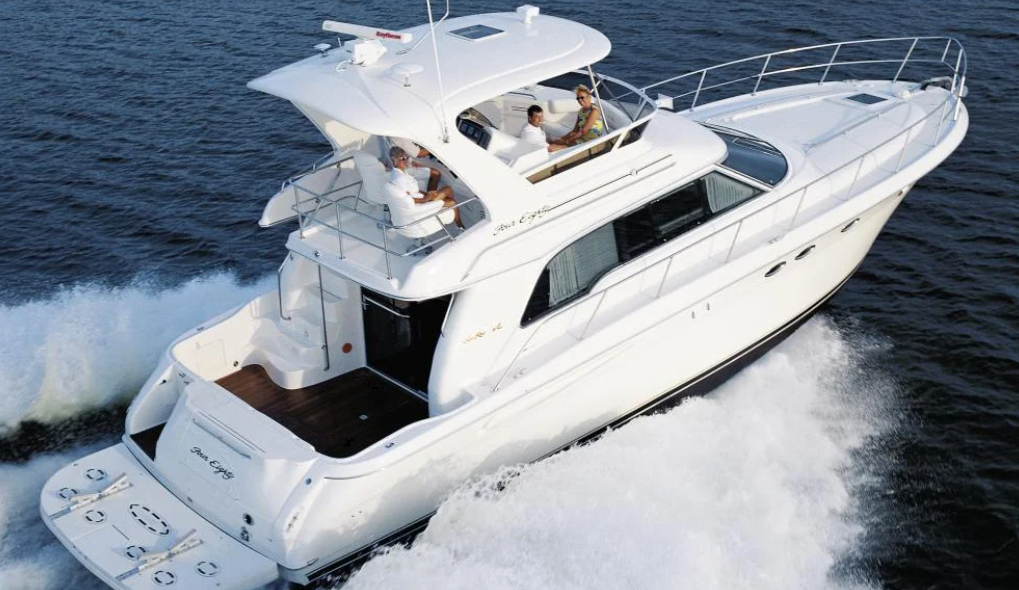
The Sea Ray 48 Sedan Bridge—designated internally by Sea Ray Boats as the 480 Sedan Bridge (480DB) and marketed internationally in specific configurations as the 515 Sedan Bridge (515DB)—represents a pivotal design evolution in mid-sized luxury motor yacht architecture. Manufactured between 1998 and 2004, the vessel was engineered to bridge the operational gap between expressive, low-profile express cruisers and traditional full-body motor yachts. Sea Ray designed this platform to maximize interior living volume and flybridge seating capacity while retaining a sleek exterior profile.
During its six-year production run, the 48 Sedan Bridge established a market benchmark for 45-to-50-foot flybridge yachts. The vessel’s sustained popularity in the pre-owned market is driven by its three-stateroom layout, molded flybridge staircase, deep-Vee hull geometry, and high-output diesel engine options. The platform underwent several incremental revisions to its propulsion and electrical engineering to address evolving diesel engine emissions, power-to-weight demands, and onboard digital integration.
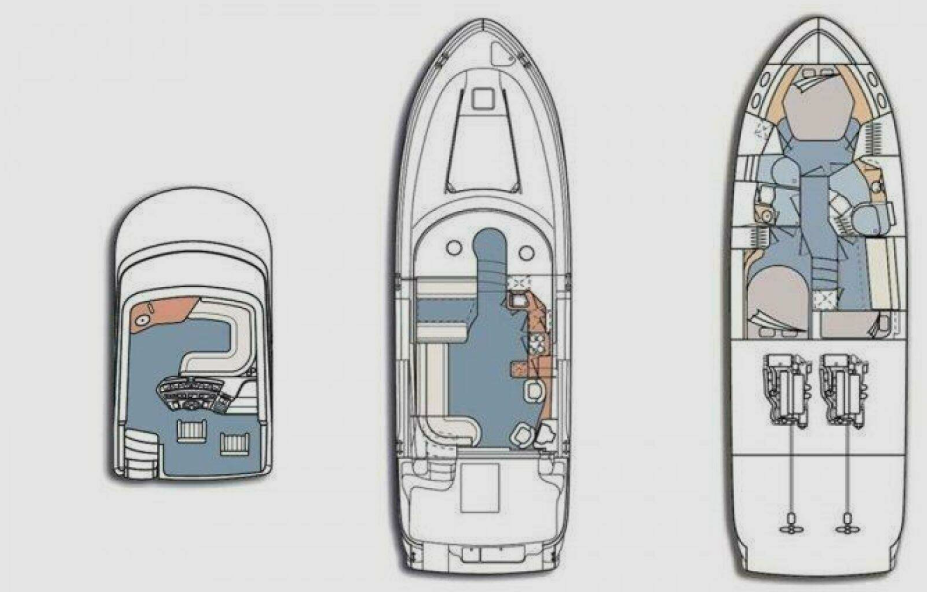
The architectural layout integrates three main engineering disciplines: a structural deep-Vee hull incorporating prop pockets; an accommodation plan featuring three private staterooms, two full heads, and a raised salon dinette; and a mechanically adaptable engine bay capable of housing large-displacement marine diesel engines ranging from 535 to 670 horsepower per shaft.
Hull Architecture, Dimensions, and Naval Engineering
The naval architecture of the 48 Sedan Bridge centers around a hand-laid fiberglass hull incorporating a modified deep-Vee profile with a 15-degree transom deadrise. To mitigate the steep shaft angles typically required for large-displacement diesel engines without encroaching on the lower stateroom floor plan, Sea Ray integrated molded underwater prop pockets into the running surface. These prop pockets lower the engines within the hull grid, reducing the operating shaft angle to optimize horizontal thrust efficiency while keeping total static draft under four feet—a critical metric for shallow-water coastal navigation.
The underwater hull geometry transitions from a fine entry forward to flat running sections aft, balanced by reverse strakes that deflect spray and improve dynamic lift during displacement-to-planing transitions. Topsides, deck structures, and the cabin superstructure utilize fiberglass sandwich construction cored with end-grain balsa wood to preserve structural rigidity while limiting topside weight. The underwater hull bottom uses solid fiberglass laminates reinforced by an engineered composite stringer grid designed to distribute engine torque and wave-impact loads across the entire running surface.
| Dimensional / Capacity Parameter | Imperial Measure | Metric Equivalent |
| Length Overall (LOA) w/ Platform | 51 ft 2 in | 15.60 m |
| Molded Hull Length | 48 ft 0 in | 14.63 m |
| Beam | 15 ft 3 in | 4.65 m |
| Maximum Operating Draft | 3 ft 9 in | 1.14 m |
| Dry Weight / Displacement | 40,400 lbs | 18,325 kg |
| Transom Deadrise | 15 degrees | 15 degrees |
| Fuel Capacity (Twin Tanks) | 500 gal | 1,892.7 L |
| Fresh Water Capacity | 140 gal | 529.9 L |
| Holding Tank Capacity | 68 gal | 257.4 L |
| Water Heater Capacity | 20 gal | 75.7 L |
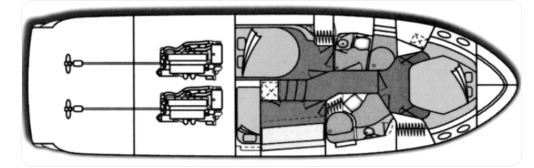
Liquid tankage is situated centrally along the longitudinal center of gravity to minimize running trim variations as fuel and water levels change. Dual 255-gallon aluminum fuel tanks are mounted midships, outboard of the main engine beds, and are connected via a cross-feed valve system that allows fuel management across both engines and the generator.
Propulsion Systems, Mechanical Performance, and Auxiliary Power
Sea Ray offered four main twin-diesel power packages over the vessel’s production run. Initial production models (1998–1999) featured two-stroke Detroit Diesel 6V-92 engines. Subsequent model years transitioned to four-stroke, electronically governed inline-six powerplants from Caterpillar and Cummins, alongside an optional MAN engine package for international and European builds.
| Engine Package | Engine Configuration | Displacement | Total Output | Cruising Speed | Top Speed | Technical Characteristics |
| Detroit Diesel 6V-92 | Twin V-6 Turbo Two-Stroke | 9.0 L | 1,070 hp (535 hp × 2) | 18–20 knots | 22–24 knots | High mechanical torque; mechanical injection; elevated smoke output and fuel burn. |
| Caterpillar 3196TA | Twin Inline-6 Turbo Electronic | 12.0 L | 1,280–1,340 hp (640–670 hp × 2) | 22–25 knots | 28–30 knots | Electronic throttle control; strong mid-range torque; requires routine aftercooler service. |
| Cummins QSM-11 | Twin Inline-6 Turbo Electronic | 10.8 L | 1,232–1,320 hp (616–660 hp × 2) | 24–28 knots | 31–34 knots | Advanced power density; smoke-free operation; smooth fuel mapping across the power curve. |
| MAN D2876LE416 | Twin Inline-6 Turbo Electronic | 12.8 L | 1,340 hp (670 hp × 2) | 26–29 knots | 32–35 knots | European spec option; high cruise efficiency; specialized service requirements. |
Power transfers from the flywheel through direct-drive marine transmissions (such as ZF 325-A gearboxes with 1.73:1 or 1.75:1 reduction ratios) down 2.5-inch Aquamet stainless steel propeller shafts supported by heavy-duty bronze struts. Factory shafting relies on dripless shaft seals and dedicated cooling-water pickups supplied from the raw-water cooling circuit. Standard running gear includes four-bladed Nibral propellers (typically 28″ x 32″ or 28″ x 34″ pitch options) tuned to match specific engine horsepower ratings.
Primary onboard AC electrical power is generated by a sound-shielded Westerbeke diesel generator rated between 10.0 kW and 12.5 kW at 60Hz, or an optional Onan e-QD generator rated at 13.5 kW (120/240V 60Hz) or 11.0 kW (220V 50Hz for international markets). Shore power management relies on 50-amp 240V AC service supplied through a transom-mounted Glendinning Cablemaster with a 75-foot power cord and wireless remote capability. European export models feature dual 220V/50Hz shore inlets with isolation transformers.
The primary DC system operates at 12V DC powered by dedicated 8D engine-starting batteries and deep-cycle house batteries. Engine charging is maintained by high-output alternators, supplemented by 50-amp automated multi-stage converters when operating on shore or generator power. An optional hydraulic swim platform lift system with an 800 lb capacity provides tender launching and functions as a submerged swim step. Docking control can be upgraded with a 24V DC Vetus bow thruster (130 kgf to 160 kgf rating) housed in a 9.84-inch fiberglass tunnel.
Interior Accommodation and Spatial Ergonomics
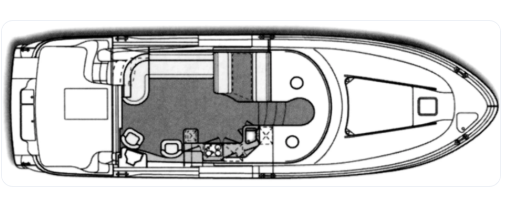
The interior design of the 48 Sedan Bridge uses a three-stateroom, two-head layout anchored by a raised salon dinette. Headroom throughout the main salon and forward companionway reaches 6 ft 4 in.
Moving forward from the sliding glass cockpit door, the main salon sits on a single continuous level. To port, an L-shaped sofa converts electronically into a double berth via a Monoplex switch system. Across to starboard, an entertainment center houses a television, stereo components, and the vessel’s main AC/DC distribution panels.
Forward of the salon, the raised dinette features a high-gloss table seating four adults, positioned to maintain clear sightlines through the main cabin windows. Opposite the dinette, the step-down galley contains:
- Dual under-counter Sub-Zero refrigerator and freezer units equipped with an automatic ice maker.
- A recessed Kenyon three-burner ceramic cooktop.
- A Sharp microwave/convection oven concealed behind high-gloss joinery.
- Molded solid-surface Corian countertops in Aurora or Sandstone finishes featuring a deep sink, pull-out sprayer faucet, and integrated trash chute.
A central companionway leads down to the lower accommodation deck. The forward master stateroom features a pedestal island queen berth with an innerspring mattress, flanked by cedar-lined hanging lockers, gunwale storage cabinets, and under-berth drawers. The private en-suite master head includes a Corian-topped vanity, a VacuFlush toilet, and a circular acrylic shower stall with an acrylic door.
The portside VIP guest stateroom provides a full-size bed, an overhead circular skylight with screen, side portlights, a cedar-lined locker, and direct access to the guest head. The starboard guest stateroom houses upper and lower twin bunks and can serve as a utility space when optioned with the Splendide 2000 HD vented washer/dryer combo unit.
Sea Ray offered three interior wood cabinetry options over the model’s production run:
- Vitricore High-Gloss Cherry: The standard interior finish, characterized by rich reddish tones and high-gloss clear coats.
- Birdseye Maple: A light-toned premium wood option that opens up visual space in the lower cabins.
- Hampton Natural Maple: A modern matte/satin light wood finish introduced late in the model’s production cycle.
Flooring consists of 44 oz. stain-resistant marine carpeting laid over 3/8-inch urethane padding, with optional solid Santos Cabreuva mahogany or natural maple hardwood flooring in the galley and dinette areas.
Flybridge Control Station and Exterior Living Areas
Access to the flybridge is provided by molded fiberglass stairs integrated into the starboard cockpit bulkhead, replacing the vertical aluminum ladders common on earlier sedan bridge designs.
The flybridge was built in two main seating layouts:
- Standard Bridge Layout: Features a centerline helm console flanked by dual custom helm chairs with flip-up thigh bolsters. Forward of the helm, a U-shaped bench seat surrounds a convertible cocktail table that converts into a sunpad with filler cushions. A portside wet bar includes a sink, trash receptacle, and an under-counter ice maker or refrigerator.
- Plan B (European) Layout: Reconfigures the helm station to port with dual companion seats and places a large U-shaped lounge with an aft sunpad along the starboard and transom quarters.
A fiberglass hardtop with an integrated overhead hatch, halogen lighting, and stainless steel support legs came standard on most hulls. The bridge can be fully enclosed with EZ2CY or Strataglass panels and heated or cooled via an optional dedicated 16,000 BTU flybridge air conditioning system.
The cockpit offers a self-bailing fiberglass liner, extended side boarding steps, and engine room access hatches supported by gas struts. Additional exterior details include an acrylic and stainless steel transom door, concealed transom fender storage, and an optional circulating live baitwell system. Side decks with continuous 316 stainless steel handrails lead forward to an optional foredeck sunpad and an anchor locker equipped with a Lofrans Progress II electric windlass.
Maintenance Considerations, Survey Points, and Historical Reliability
Marine surveyors and technicians focus on several critical mechanical, structural, and electrical areas during pre-purchase inspections of the Sea Ray 48 Sedan Bridge.
Because the topsides, decks, and cabin superstructure utilize end-grain balsa coring, moisture intrusion can occur if aftermarket electronics, stanchions, windshield frames, or hatch sealings are improperly bedded. Moisture meter checks are essential around flybridge support stanchions, bow rails, and underwater skin fittings. Additionally, due to high engine torque loads, engine beds, shaft struts, and prop pocket laminates should be inspected for signs of stress fracturing or flex degradation.
Operational service schedules require specific maintenance steps across three primary operating intervals:
- 100-Hour Interval: Complete engine and generator oil and filter changes, along with comprehensive sacrificial zinc anode replacements.
- 250-Hour Interval: Inspection of raw-water pump impellers, fuel/water separator filter cartridge replacement, and belt tension adjustments.
- 1,000-Hour Interval: Major cooling system overhaul, including the removal, disassembly, cleaning, and pressure testing of heat exchangers, aftercoolers, transmission coolers, and fuel coolers, alongside turbocharger inspections.
When evaluating specific propulsion options, early-production Caterpillar 3196 engines require confirmation that factory updates have been performed. Early CAT 3196 aftercoolers were susceptible to internal seawater corrosion that could allow raw water into the intake manifold. Surveyors should verify that updated marine aftercoolers (typically with bronze or improved-alloy housings) and replacement turbos were installed.
The Cummins QSM-11 engine package is widely praised for long-term mechanical reliability, but its dry exhaust elbows and raw-water heat exchangers require thorough flushing and inspection every 1,000 operating hours to prevent localized thermal breakdown or cooling leaks. Dripless shaft seals also require verified water-injection flow to prevent thermal scorch on the rubber bellows and cutlass bearings.
On auxiliary systems, the Sealand VacuFlush sanitation system requires periodic replacement of its duckbill valves, vacuum pump diaphragms, and bowl seals to maintain proper vacuum pressure across both heads. Because the vessel uses multiple split-system marine air conditioners (Salon, Master, Guest, and Flybridge), condensate drain pans and sump pump discharge lines must remain clear to prevent water from accumulating in the subfloor storage bays.
Synthesis and Market Overview
The Sea Ray 48 Sedan Bridge remains a benchmark model in the pre-owned luxury motor yacht market. Its combination of a three-stateroom interior, raised salon dinette, molded flybridge staircase, and 30-plus-knot top-end performance (when powered by electronic Caterpillar or Cummins engines) continues to meet contemporary coastal cruising demands. Provided that routine maintenance on cored sandwich structures and high-output diesel cooling systems is kept up to date, the platform’s hull dynamics, structural build quality, and interior layout ensure its ongoing appeal among mid-sized flybridge yachts..