

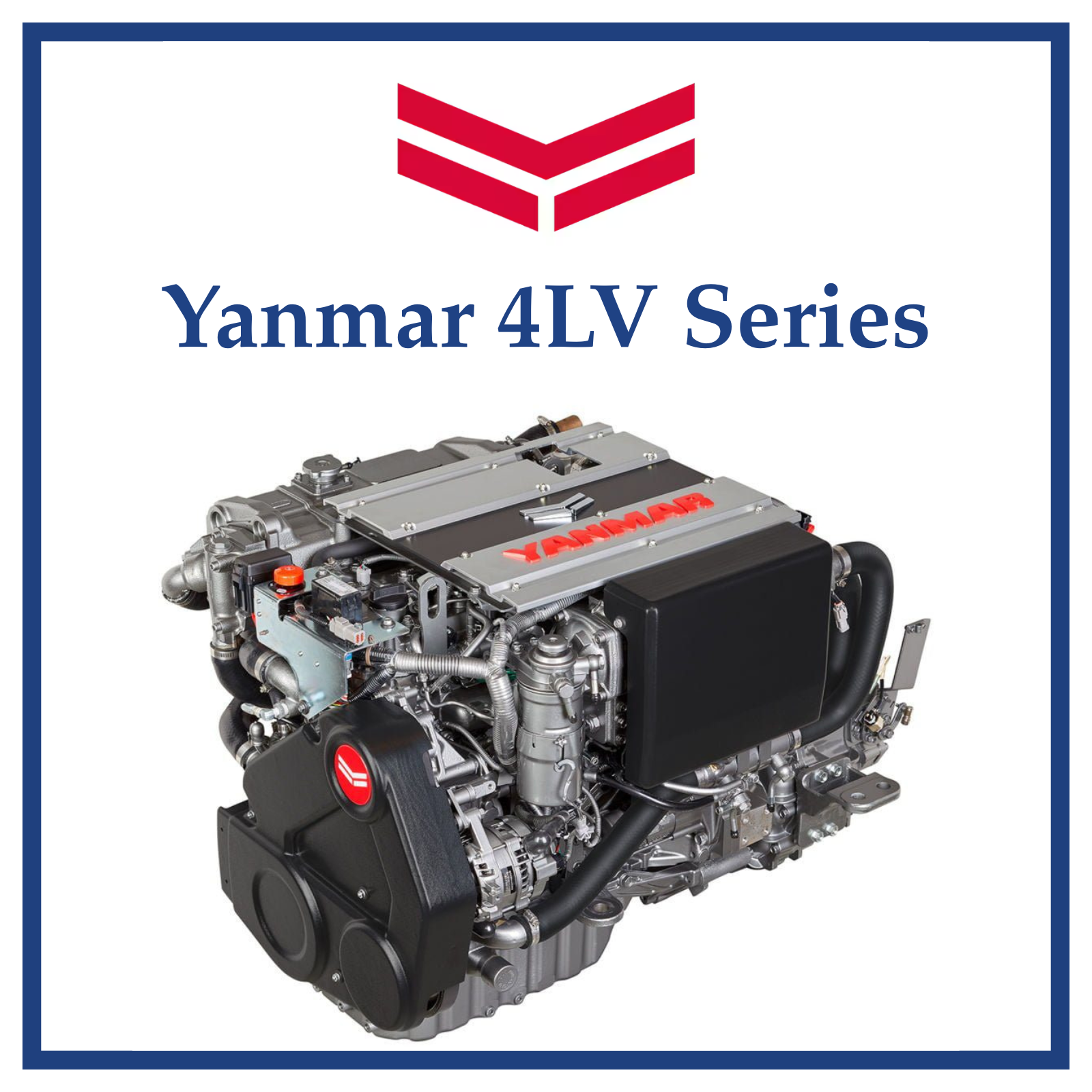
The Yanmar 4LV series launched in 2017 and quickly became one of the most dominant engine platforms our industry has seen. At 2.755 liters of displacement from four cylinders, it delivers output from 150 to 250 metric horsepower, variable-timing common rail injection, and connectivity to NMEA and J1939 CAN-bus networks as standard. Yanmar positions it specifically for sailing yachts over 50 feet, superyacht tenders, and light commercial vessels, and a growing list of builders from Amel to Oyster to Bali Catamarans has chosen it accordingly.
This guide covers all five output variants, how to read the model designation, the drive options available for each, and what makes this engine so well-suited to the demands of blue water sailing.
How To Decypher The 4LV Model Code
The Yanmar naming convention is consistent across all engine families once you understand the logic. Starting from left to right in a name like 4LV195:
The first character is a number (4) and it tells you the cylinder count. Four cylinders, inline.
L is a series designator within Yanmar’s marine lineup, indicating this engine belongs to the LV family of higher-output marine diesels, as distinct from the JH series (smaller sailboat auxiliaries) or the 6LY series (larger inboards).
V indicates this is a V-type generation designation within the LV family. In Yanmar’s internal nomenclature, V distinguishes this generation from earlier L-series engines.
The number at the end — 150, 170, 195, 230, or 250 — is the output rating in metric horsepower (mhp). This is the primary differentiator between variants. The block, bore, stroke, and displacement are shared across all five models. Output is determined by ECU mapping and turbocharger calibration, not by different hardware.
The Z suffix, when present, designates the sterndrive (Z-drive) configuration using Yanmar’s ZT370 sterndrive unit. An engine listed as 4LV250Z is the 250 mhp variant in sterndrive configuration. The ‘No Z’ suffix indicates the inboard shaft configuration.
So 4LV195 reads: four-cylinder, LV marine series, V generation, 195 metric horsepower, inboard shaft configuration.
Engine Background
The 4LV series is based on the Toyota 1GD-FTV, a 2.8-liter turbocharged intercooled diesel used in Land Cruiser Prado and HiLux applications across global markets. Yanmar’s relationship with Toyota — a parent company shareholder — made this a natural starting point, and the marine adaptation is comprehensive: full freshwater cooling with heat exchanger, a marine-specific ECU with NMEA 2000 and J1939 CAN-bus outputs, marine-rated alternators, and Yanmar’s proprietary combustion matching optimized for the varying load profiles of a sailboat auxiliary.
The platform was released in 2017 and was designed to consolidate two older Yanmar engine lines — the 4LH series for light commercial duty and the 4BY and 6BY series for pleasure boats — into a single modern platform capable of serving both markets and large sailboat applications. The result is an engine with a genuinely broad application range and a parts and service network that reflects that scale.
A secondary balancer shaft reduces four-cylinder vibration to levels that surprised reviewers when the engine was first tested — quieter at idle and cruise than many competing six-cylinder engines. The chain-driven camshaft and fuel pump also contribute to lower noise versus belt-driven equivalents. On a sailing yacht where the engine runs infrequently but the saloon is expected to be quiet when it does, these are meaningful engineering choices.
The 5 Output Models (& What Separates Them)
This is an important section for someone comparing boats with different engine options or choosing a new build specification.
All five 4LV engines share the same 2.755-liter, four-cylinder, turbocharged and intercooled architecture. The bore and stroke across the 230 and 250 models is confirmed at 92mm x 103.6mm. The 150, 170, and 195 models share the same block — Yanmar’s official spec sheets confirm the same 2.755-liter displacement across all five. Output differences are achieved through ECU calibration and turbocharger tuning, not through different internal hardware.
The five models also divide into two RPM groups, which matters more than the HP number for understanding the engine’s character:
The 4LV150, 4LV170, and 4LV195 develop maximum power at 3,500 RPM. These are the models most commonly specified in single-engine sailboat applications and in catamaran installations where economy and low-speed maneuverability take priority over peak output.
The 4LV230 and 4LV250 develop maximum power at 3,800 RPM. They carry a higher turbocharger output and are more frequently specified in twin-engine express cruiser and performance-oriented catamaran applications, or where a single large sailboat needs more reserve power for heavy weather motoring.
| Model | Output (mhp) | Output (kW / bhp) | Rated RPM | Peak Torque | Sterndrive (Z) Option |
|---|---|---|---|---|---|
| 4LV150 | 150 mhp | 110 kW / 148 bhp | 3,500 RPM | Approx. 380 Nm @ 2,000 RPM | Yes (4LV150Z) |
| 4LV170 | 170 mhp | 125 kW / 168 bhp | 3,500 RPM | Approx. 430 Nm @ 2,000 RPM | Yes (4LV170Z) |
| 4LV195 | 195 mhp | 143 kW / 192 bhp | 3,500 RPM | 495 Nm @ 2,000 to 2,600 RPM | No |
| 4LV230 | 230 mhp | 169 kW / 227 bhp | 3,800 RPM | Approx. 540 Nm @ 2,000 to 2,500 RPM | No |
| 4LV250 | 250 mhp | 184 kW / 247 bhp | 3,800 RPM | Approx. 590 Nm @ 2,000 to 2,500 RPM | Yes (4LV250Z) |
The 4LV195 is the sweet spot variant for most large sailing yacht applications — peak of the lower-RPM group, meaningful torque from 2,000 RPM, and not running at the top of its stress envelope the way the 230 and 250 models are at rated output. For bluewater cruising sailors who run the engine at moderate load for extended periods, the 195 is consistently the preferred specification.
Drive Configurations
The 4LV series is available in three drive configurations, and this choice is as important as output rating when evaluating a boat.
Inboard Shaft with KMH-Series Gearbox
The primary configuration for sailing yachts. The engine pairs with either the KMH50A (8-degree down-angle output flange, three reduction ratios: 1.71:1, 2.19:1, or 2.62:1) or the KMH50V (12-degree V-drive, four reduction ratios). The V-drive is particularly useful in sailing yachts with center cockpit layouts where the engine must be positioned well aft — the V-drive allows the output shaft to angle forward before reversing direction to drive the propeller shaft aft. Both gearboxes use hydraulic multi-disc clutches, which allow smooth, deliberate shifting without the dog-clutch sensitivity of older saildrive units.
ZT370 Sterndrive (Z suffix models)
Available on the 150, 170, and 250 mhp variants. Yanmar’s ZT370 sterndrive is a purpose-designed unit for the LV and LP series engines, using a counter-rotating Duoprop-style propeller arrangement. The sterndrive configuration is primarily found in express cruiser and tender applications rather than sailing yachts — the underwater appendage it requires is not compatible with the hull forms of most bluewater monohulls or catamarans.
Bonus: Jet Drive
All five 4LV models are available in jet drive configuration for applications using waterjet propulsion. This is a niche configuration in the recreational market but well-established in Williams Jet Tenders’ top-of-range DieselJet models, which use re-engineered 4LV engines as the power source for their high-performance RIB tenders.
What Makes the 4LV The Right Engine For 50’+ Sailing Yachts?
Yanmar explicitly positions the 4LV for sailing yachts over 50 feet, and the engineering rationale behind that statement is worth unpacking rather than just repeating.
A sailing yacht’s auxiliary engine lives a particular kind of life. It runs infrequently, sometimes 10 to 15 percent of total passage hours, at highly variable loads. It idles in marinas, pushes hard through windless passages, and charges house batteries at light load for hours at anchor. Traditional mechanically injected engines struggle with this duty cycle. Fixed injection timing, calibrated around peak torque RPM, runs too advanced at low RPM. An oversupply of fuel washes lubricating oil from cylinder walls, promotes bore glazing, and dilutes the sump oil. At high hours on a sailing yacht, these effects compound.
The 4LV’s Denso high-pressure common rail injection system with variable timing eliminates this problem. The ECU continuously adjusts injection timing and duration to match actual load and RPM, so the engine combusts cleanly across the full operating range — including extended low-load running. This is not a marketing claim. It is a well-documented characteristic of common-rail injection that experienced marine diesel mechanics across multiple review sources confirm as a genuine advantage for sailboat auxiliary use.
The 2.755-liter displacement also matters here. More displacement at lower RPM means the engine produces usable torque without being worked hard. On a 55-foot yacht displacing 40,000 pounds, the difference between 150 and 250 mhp is largely academic at cruising RPM. What matters is that the 150 or 195 mhp engine can push that hull at 6 to 7 knots while turning at a moderate, low-stress RPM — and it can do so cleanly, quietly, and without glazing cylinders.
The NMEA 2000 and J1939 CAN-bus integration is the final piece. On a modern sailing yacht with a Raymarine, Garmin, or B&G multifunction display, the 4LV feeds real-time engine data, like RPM, coolant temperature, fuel consumption, fault codes, and hours directly to the chart plotter. For offshore passage-makers, that transparency is a safety asset.
What Boats Use The Yanmar 4LV Series?
The 4LV has been adopted by a wide range of builders since its 2017 introduction. The list below covers confirmed installations across sailing yachts and catamarans. The 4LV150 and 4LV195 dominate sailboat applications; the 4LV230 and 4LV250 appear more frequently in twin-engine catamaran and performance applications.
| Boat Make and Model | Years | Model / Config |
|---|---|---|
| Amel 50 | 2018 to present | 4LV150, single, shaft |
| Amel 60 | 2022 to present | 4LV195 or 4LV230, single, shaft |
| Beneteau Oceanis Yacht 60 | 2025 to present | 4LV150 |
| Oyster 565 | 2019 to present | 4LV150, SD15 saildrive |
| Hallberg-Rassy 57 | 2018 to present | 4LV195, single, shaft |
The 4LV also appears in various Dufour, Grand Soleil, and Moody models from 2017 onward in the 50-foot-plus range. As Yanmar’s primary large sailboat auxiliary platform, it is increasingly common in new builds from any builder specifying Yanmar engines above the JH-CR range.
Recalls, Common Problems, & What To Watch For
The 4LV is a recent engine with a relatively short service history, especially compared to the mechanical engines we often discuss here at Murray Yacht Sales. The track record so far is positive, but a few patterns are worth knowing…
Common Rail Fuel System Sensitivity
Like the Cummins QSB 6.7 and Volvo Penta D6 series covered in this series, the 4LV’s Denso high-pressure common rail injection operates at very high pressures and is sensitive to fuel contamination. Water in the fuel — a particular concern on sailing yachts that take on fuel in remote locations — accelerates injector and pump wear. A quality Racor dual-filter pre-filtration system with a water separator is not optional on a bluewater cruising yacht with this engine. Inspect the filtration setup on any used boat you are evaluating, and ask whether the system has been serviced on schedule.
Low-Load Operation and the Common Rail Advantage
This is worth addressing directly because it is one of the most frequently asked questions from sailors considering the 4LV: does the common rail system protect against cylinder glazing at the low loads typical of marina running or battery charging? The answer is yes, and this is where the 4LV meaningfully improves on older mechanical engines. Variable injection timing means the ECU always delivers the correct quantity of fuel for the actual load — avoiding the excess-fuel condition that glazes cylinder walls in mechanically injected engines running light. This is confirmed by the Yanmar technical review and the TradeABoat long-term assessment.
Heat Exchanger and Impeller Maintenance
Standard for any freshwater-cooled marine diesel: annual raw water impeller replacement, periodic heat exchanger inspection and flushing, thermostat replacement at higher hours. The 4LV is designed for ease of access at key service points. Follow the Yanmar service schedule — not the hours alone, but the calendar interval as well. Sailing yachts often accumulate low hours over many years, and calendar-based maintenance matters as much as hour-based on these platforms.
ECU Connectivity and Dealer Diagnostics
Fault code reading and ECU-level diagnostics on the 4LV require Yanmar’s dealer diagnostic tools. Independent mechanics can handle routine maintenance but ECU faults require a Yanmar dealer. The NMEA 2000 integration means fault codes often display at the helm display in plain language, which helps owners understand what is happening before calling a dealer. The global Yanmar network means that for most bluewater destinations, a qualified dealer is accessible within a reasonable distance.
Parts Availability and Serviceability
The 4LV is current production and fully supported. Yanmar operates marine dealer networks in over 130 countries, and the 4LV’s shared architecture with Toyota means that certain internal components benefit from automotive-scale parts availability. Consumables — filters, impellers, belts, zincs, thermostats, and coolant — are widely stocked.
The KMH50A and KMH50V gearboxes are purpose-built marine units with their own service requirements: gearbox oil changes at 500-hour intervals and hydraulic clutch inspection as needed. V-drive versions carry more oil (5.4 liters versus 2.0 liters for the standard down-angle box) and require attention to the V-drive seals and oil level as part of routine service.
The ZT370 sterndrive (on Z-suffix models) requires annual service, including drive oil sampling, bellows inspection, and zinc replacement. As with any sterndrive, haul-out is required for seal and bellows work.
Murray Yacht Sales Team Recommendation page with parts and service items
Buyer’s Perspective
A 4LV-equipped sailing yacht from 2017 onward is already off to a strong start. The platform is well-matched to the duty cycle, electronically transparent, HVO-compatible, and backed by one of the industry’s strongest global dealer networks. For buyers coming from older mechanical-injection sailboats, the step up in quietness, cleanliness, and diagnostic visibility is immediately apparent.
Questions worth asking before purchase:
- Which output variant is installed — 150, 170, 195, 230, or 250? Confirm from the engine serial number, not just the brochure.
- What drive configuration — standard down-angle shaft, V-drive, sterndrive, or jet? Each has different service implications.
- Is a pre-filtration Racor system installed and serviced?
- Are service records complete, including oil changes and heat exchanger maintenance?
- Has the engine ever displayed ECU fault codes? If so, have they been diagnosed and resolved by a Yanmar dealer?
- On V-drive installations: when was gearbox oil last changed, and has it been tested for contamination?
On value: the 4LV is a premium specification that adds genuine resale value to sailing yachts in the 50-foot-plus segment. Buyers who find this engine in an Amel, Oyster, Hallberg-Rassy, or comparable quality bluewater yacht with complete service records are looking at one of the better engine stories in the current brokerage market.
The Yanmar 4LV series represents the current benchmark for large sailing yacht auxiliary engines. Five output models on a shared platform, multiple drive configurations, variable-timing common rail injection, and a global service network make it a practical choice across a wide range of sailing applications — from the Amel 50’s efficient single-engine cruising to twin-engine catamaran maneuvering in a crowded marina. The engineering case for this engine on a blue water sailing yacht over 50 feet is clear, and the growing list of quality builders who agree makes it easier than ever to find in brokerage.