

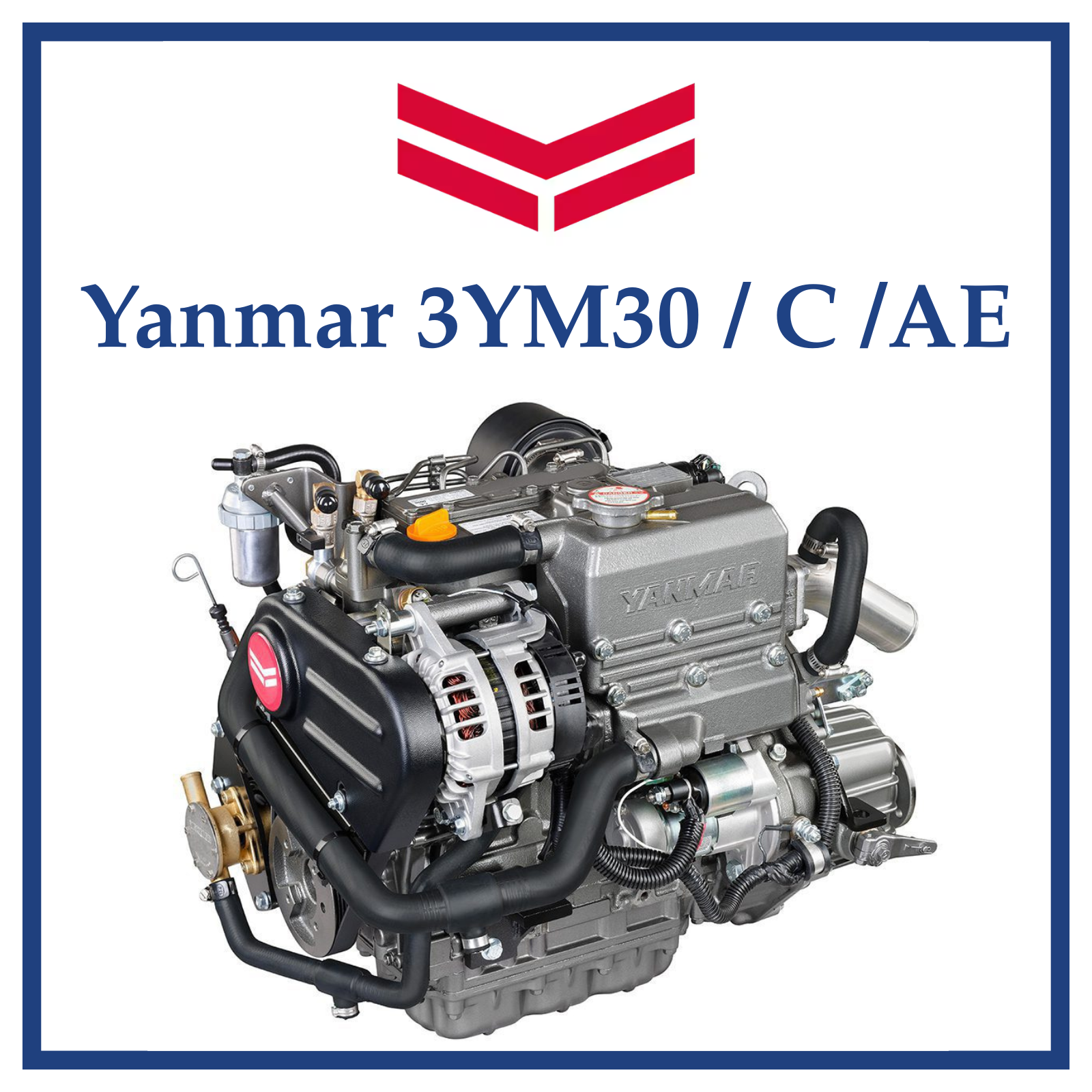
The Yanmar 3YM30 has powered more production sailboats than almost any other engine in its class. It shows up under the companionway steps of Beneteau Oceanis cruisers, Jeanneau Sun Odysseys, Hunter 33s, Bavaria yachts, and a long list of others built from the mid-2000s onward. The engine itself is compact, freshwater-cooled, and mechanically direct.
What makes this engine family worth understanding in more detail is that the 3YM30 name actually covers three distinct variants — the original 3YM30, the saildrive-specific 3YM30C, and the updated 3YM30AE — and they are not the same engine. The differences in displacement, rated RPM, alternator output, and paired drive unit are meaningful for anyone buying a used boat, troubleshooting a cooling problem, or sourcing parts.
Let’s break it down.
How To Read The Yanmar Model Code
Before comparing the variants, it helps to know what the letters and numbers in the model name actually mean. Yanmar’s naming convention is logical once you see it laid out.
Starting from left to right in a name like 3YM30C:
- Cylinder count (3 Cylinders)
- Generation designation (Y as in YM series, Yanmar’s current line of purpose-built marine auxillaries)
- Marine (Confirms this is a purpose-built marine engine)
- Horsepower output (Approximate crankshaft output of roughly 29 to 30 horsepower)
- BONUS! A suffix like C here indicates the drive configuration or variant.
- No suffix = standard shaft-drive gearbox unit.
- C=saildrive configuration
- AE=updated generation
So when you see 3YM30C, you are reading: three-cylinder, YM series, marine, 30 HP class, saildrive. And 3YM30AE reads: three-cylinder, YM series, marine, 30 HP class, updated generation.
Engine Background
Yanmar introduced the 3YM30 in the early 2000s as a direct replacement for the 3GM30, which had been a workhorse auxiliary across the sailing world for years. The 3GM prefix gave way to 3YM to mark the generational shift. The new engine brought fresh water cooling via heat exchanger, front-mounted service points for easier maintenance access, and compliance with the Tier II emissions standards that took effect in the US and EU in 2006.
The 3YM30C arrived alongside the shaft-drive version as the saildrive-paired configuration, bundled with Yanmar’s SD20 saildrive unit. It is mechanically the same engine as the 3YM30 but configured and flywheel-matched for saildrive connection rather than a conventional reverse gearbox.
The 3YM30AE came later as a true mechanical update — a new block, larger displacement, and a lower rated RPM — rather than a simple rebadge. It pairs with the updated SD25 saildrive when ordered in saildrive configuration.
Specs Comparison
This is where the variants diverge in ways that matter. The three engines share the same general architecture and installation footprint, but they are not identical under the skin.
| Specification | 3YM30 | 3YM30C (Saildrive) | 3YM30AE |
|---|---|---|---|
| Cylinders | 3, inline | 3, inline | 3, inline |
| Displacement | 1.115 L (68.1 cu in) | 1.115 L (68.1 cu in) | 1.266 L (77.2 cu in) |
| Bore x Stroke | 75 mm x 84 mm | 75 mm x 84 mm | 80 mm x 84 mm |
| Rated Output | 21.3 kW / 29.0 mhp | 21.3 kW / 29.0 mhp | 21.3 kW / 29.1 mhp |
| Rated RPM | 3,600 RPM | 3,600 RPM | 3,200 RPM |
| Fuel System | Indirect injection, mechanical in-line pump | Indirect injection, mechanical in-line pump | Indirect injection, mechanical in-line pump |
| Aspiration | Naturally aspirated | Naturally aspirated | Naturally aspirated |
| Alternator | 12V / 60A (80A optional) | 12V / 60A (80A optional) | 12V / 125A standard |
| Drive Configuration | Shaft; KM2P-1 gearbox | Saildrive; SD20 | Shaft (KM2P-1) or saildrive (SD25) |
| Dry Weight without gear | 123 kg / 271 lbs | 157 kg / 346 lbs (with SD20) | 127 kg / 280 lbs (without gear) |
| Emissions | EPA Tier 2, EU RCD | EPA Tier 2, EU RCD | EPA Tier 3, RCD 2, BSO II |
The headline difference is worth pausing on. The 3YM30AE achieves virtually the same rated output — 29.1 mhp — from a larger 1.266-liter block turning at a lower 3,200 RPM, compared to the original 3YM30’s 1.115-liter block spinning at 3,600 RPM. More displacement, less stress, lower operating speed. The result is more torque delivered at lower revs, reduced combustion noise, and a meaningfully quieter engine at equivalent speeds. Yanmar also fitted the 3YM30AE with a 125-amp alternator as standard — more than double the 60-amp unit on the earlier versions — which matters considerably on a modern cruising boat with a loaded house bank.
Variants, & What Each One Is Best Suited For
3YM30 — The Original, Shaft Drive
The base 3YM30 is the shaft-drive version, paired with the KM2P-1 gearbox. This is the version you will find in the majority of production sailboats from roughly 2004 through the mid-2010s. The cone-clutch gearbox allows reasonably quick shifts between ahead and astern, and the engine’s service points at the forward end make access manageable in most engine compartments.
3YM30C — The Saildrive Version
The C suffix designates saildrive configuration, mated to the Yanmar SD20 saildrive unit. The engine itself is mechanically identical to the 3YM30 — same 1.115-liter displacement, same 3,600 RPM rating. What changes are the flywheel housing and mounting arrangement for the SD20. The SD20 uses a dog clutch rather than the cone clutch of the KM2P-1, which has a practical implication: avoid quick shifts from ahead to astern without first letting the engine settle at idle. Force a fast reversal, and you risk clutch damage.
The SD20 was the standard Yanmar saildrive unit through this generation and is paired with the 3YM30C as well as the smaller 3YM20C and 2YM15C in the family. Many European production builders — Jeanneau, Bavaria, and others — specified the saildrive version as standard for center-cockpit and fin-keel designs, where the saildrive’s elimination of a shaft, stern gland, and cutless bearing simplified both build and ownership.
3YM30AE — The Updated Generation
The AE suffix signals the most significant update in the 3YM30 lineage. The block is new: the bore has grown from 75mm to 80mm (stroke remains 84mm), taking displacement from 1.115 liters to 1.266 liters. Rated speed has dropped from 3,600 to 3,200 RPM. Output stays at roughly 29 mhp, but the character of how it gets there changes – more torque, earlier, at lower revs.
The 3YM30AE’s installation footprint is identical to that of the original 3YM30, as Yanmar confirmed in its announcement of the updated engine. This makes the AE a clean repower option for older boats with original 3YM30 installations. The paired saildrive is the SD25, which replaced the SD20. The SD25 carries the same outer dimensions as the SD20 and is visually identified by a light grey, non-metallic paint on the leg and an improved hard-anodized aluminum finish for better corrosion resistance.
What Boats Use These Engines
The 3YM30 family is one of the most widely fitted auxiliary diesel series in production sailboats since the mid-2000s. The chart below covers confirmed installations. Drive configuration — shaft or saildrive — varied by builder and sometimes by model year within the same hull.
| Boat Make and Model | Years | Variant | Notes |
|---|---|---|---|
| Beneteau Oceanis 34 / 34.1 | 2008 to present | 3YM30 or 3YM30AE | Shaft drive; earlier hulls have original 3YM30 |
| Beneteau Oceanis 343 / Clipper 343 | 2004 to 2010 | 3YM30 | Shaft drive |
| Jeanneau Sun Odyssey 35 / 35DS | 2004 to 2012 | 3YM30 or 3YM30C | Both shaft and saildrive configurations exist |
| Jeanneau Sun Odyssey 379 | 2012 to 2016 | 3YM30 or 3YM30AE | Shaft drive standard; confirm engine generation by year |
| Hunter 33 / 33.5 | 2004 to 2013 | 3YM30 | Shaft drive; subject to early heat exchanger advisory |
| Bavaria 32 / 33 Cruiser | 2005 to 2014 | 3YM30C (saildrive) | SD20 standard fit; Hanse and Bavaria both used Yanmar saildrive |
| J/109 | 2002 to 2010 | 3YM30C (saildrive) | SD20 saildrive; dedicated owner forum has strong engine documentation |
| Vindö 40 (Swedish) | Various | 3YM30 | |
| X-Yachts Xp38 | 2011-2021 | 3YM30 or 3YM30AE | Sail drive; earlier hulls have original 3YM30 |
The 3YM30AE, being the current production version, appears in newer builds across Jeanneau, Beneteau, and Bavaria models from approximately 2015 onward, as well as in repower installations on older hulls originally fitted with the 3YM30 or even the earlier 3GM30.
Common Problems and What To Watch For
Early Heat Exchanger Undersizing (Pre-E05566 Serial Numbers)
The most significant documented issue with the original 3YM30 is a heat exchanger that was undersized for the engine’s full operating range on early production units. Yanmar issued Marine Service Advisories MSA E05-023 and E05-025 to address this. Engines with serial numbers below E05566 have the original 38-tube exchanger core, which cannot cool the engine effectively above approximately 2,800 to 3,000 RPM during extended running. The symptom is consistent: the coolant temperature alarm triggers after several minutes at higher revs, but the engine runs fine at cruising speeds.
In many cases, Yanmar performed the fix — replacement of the original core with the updated 63-tube unit — under warranty. If you have a 3YM30 with a serial number below E05566 and no record of exchanger replacement, check it. Yanmar-authorized dealers can confirm whether your engine has received the updated core.
The 3YM30AE is not affected by this issue. The redesigned block and revised cooling system addressed it from the ground up.
Exhaust Elbow Carbon Blockage
The cast iron exhaust elbow is a well-documented service item across the 3YM family. Carbon and soot accumulation inside the elbow restricts exhaust flow and creates backpressure. In severe cases, this has pushed carbon into the oil, causing accelerated wear. The fix is elbow removal and cleaning, or replacement with an aftermarket stainless unit, which is a meaningful upgrade in longevity. Inspect the elbow at every major service. If it has not been replaced on a high-hours engine, budget for it.
Raw Water Impeller
Annual replacement is needed. The 3YM30 family uses a Jabsco-compatible raw-water pump impeller, and failure can cause rapid overheating and potential heat exchanger damage. This is routine sailboat auxiliary maintenance, but impeller condition is the first question to ask on any used boat and the first thing to confirm on a newly purchased one.
SD20:
- Dog Clutch Sensitivity For 3YM30C saildrive installations, the SD20’s dog clutch requires smooth, deliberate shift inputs. Aggressive from-ahead-to-astern shifts without pausing at idle will damage the clutch over time. It is a known limitation of the design. Boats that have spent years in charter or marina environments with less attentive crew are more likely to show clutch wear. Check for smooth, positive engagement in both directions at survey.
- Diaphragm Seal The rubber diaphragm seal on the SD20, where it passes through the hull, should be inspected every five years and replaced as needed. A failed diaphragm introduces water into the bilge. It is not a catastrophic failure — water entry is gradual — but it needs to be caught. Ask for saildrive service history on any boat with an SD20.
Parts Availability and Serviceability
Yanmar maintains the largest marine engine dealer network in the world, and all three 3YM30 variants are well-supported. The 3YM30 and 3YM30C are legacy but not orphaned — filters, impellers, exchanger cores, belts, thermostats, injectors, and SD20 components are all available from Yanmar dealers and reputable aftermarket suppliers. The 3YM30AE is current production and fully stocked.
All three engines use mechanical indirect injection, which is genuinely good news for long-term ownership. There is no ECU, no common-rail pressure system, and no electronic fuel management to worry about. An experienced marine diesel mechanic can service these engines without proprietary diagnostic tools. The injection pump and injectors are rebuildable, and Yanmar’s global parts network means components are readily available in most cruising destinations worldwide.
The front-mounted service points on the 3YM30 family — raw water pump, raw water filter, fuel filter, and oil filter all accessible from the front of the engine — are a real practical advantage in the tight engine compartments typical of 30 to 40 foot sailboats.
Air Filter – Air Filter Element / Cleaner – Compatible with Yanmar 2GM 2GMF 3GM 3GMF 2GM20 3GM30 2YM15 3YM20 3YM30
Fuel Filter – Diesel – Yanmar (secondary) FUEL FILTER 104500-55710 // O-RING 24341-000440 – OEM Parts – 3YM20 3YM30 3YM30AE
Impeller – Yanmar 128990-42200 (Johnson Pumps 09-810B-1 Impeller Kit)
Oil Filter – Yanmar 119305-35170 – Oil Filter Assy, D68XL65 (Pack of 2); Yanmar OEM Part, Compatible with Yanmar YM series, Replaces 119305-35151
Buyer’s Perspective
A 3YM30 or 3YM30C in a well-maintained boat with documented service history is one of the more straightforward used-engine stories in sailboat brokerage. The platform is proven, parts are available, the mechanical injection system keeps service simple, and the global Yanmar network means you are never far from support.
- What is the engine serial number? If below E05566 on a 3YM30 or 3YM30C, confirm the heat exchanger has been updated.
- Has the exhaust elbow been inspected or replaced? Ask specifically.
- Are impeller replacements on the service record, and when was the last one done?
- For saildrive boats: when was the SD20 diaphragm seal last inspected?
- Is this a 3YM30, 3YM30C, or 3YM30AE? The model code matters for parts sourcing and understanding what generation of hardware you have.
On the 3YM30AE specifically: buyers who find this engine on a boat from the mid-2010s onward are getting a genuine improvement in block design, lower operating stress, and a significantly more capable alternator as standard. The 125-amp alternator on the AE is increasingly important as house battery banks and onboard electrical demands have grown.
Next Steps
The 3YM30 family is one of the most durable and widely supported auxiliary engine lineages in sailing. Each variant has a clear identity: the original 3YM30 for shaft-drive boats, the 3YM30C for saildrive applications with the SD20, and the 3YM30AE as the updated platform with more displacement, lower RPM, and a much better alternator. Know which one you have, check the serial number on older examples, keep the elbow clean and the impeller fresh, and these engines tend to run well for a very long time.
Questions about a sailboat with a 3YM30 or any variant? Our team at Murray Yacht Sales is glad to help you think through what you are looking at. Reach out anytime.