
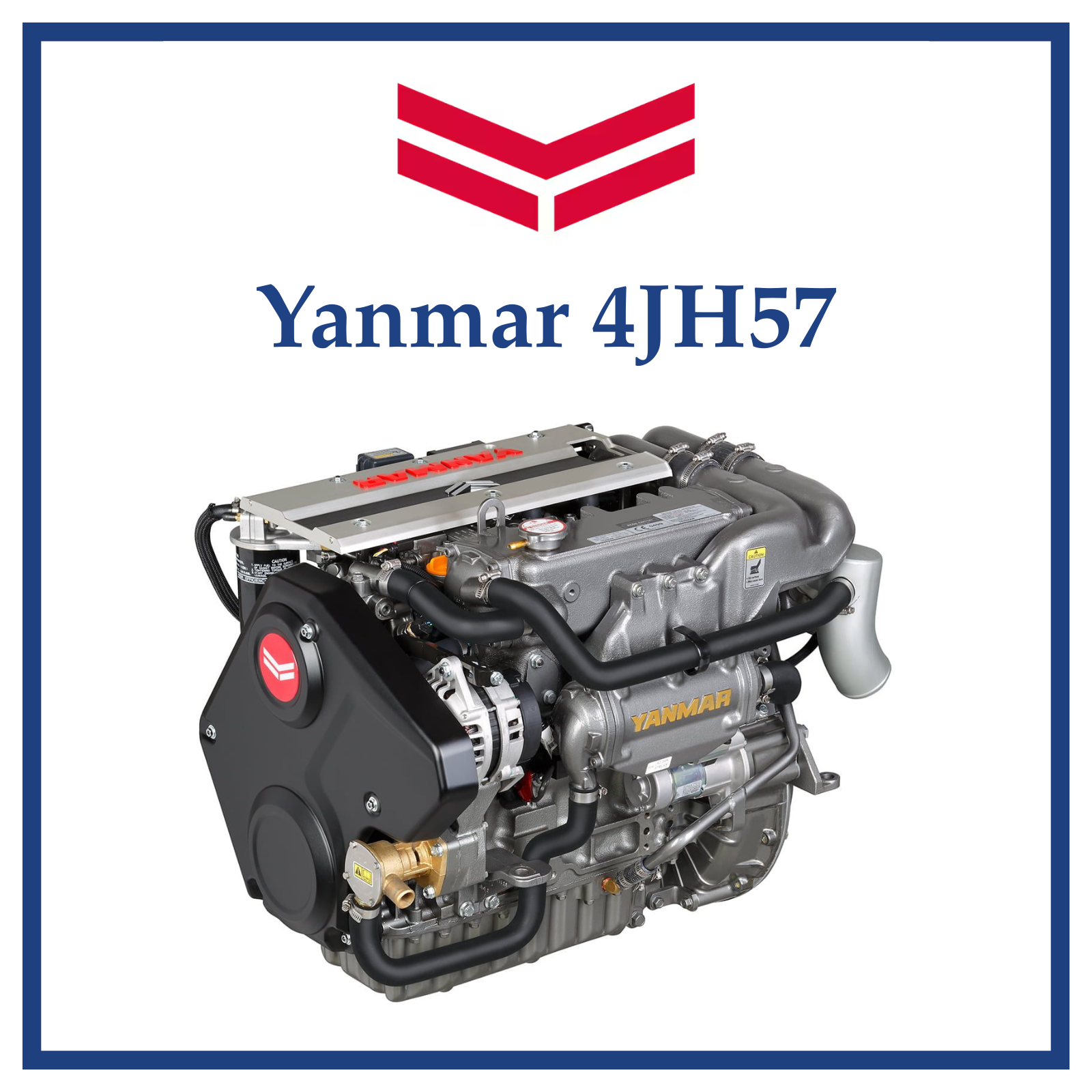
The Yanmar 4JH57 is a compact, naturally aspirated, common-rail diesel that does its job with minimal drama. On a catamaran, that is exactly what you want from an auxiliary engine. Sailors aboard Lagoon 42s, Lagoon 46s, and Excess 14s are the most likely to find a pair of these under the aft cabin steps — quiet at cruise, light enough to preserve performance under sail, and paired with the Yanmar SD-60 saildrive on most modern installations.
This guide covers the engine, the saildrive it is typically paired with, the boats it powers, and what owners and buyers should know about both.
Engine Background
Yanmar introduced the 4JH-CR common rail series in 2014, developed from the platform’s industrial TNV series and purpose-built for marine auxiliary duty. The series replaced the older 4JH4 line, which had been a standard fitment in production catamarans and monohulls for years. The jump to common rail brought quieter combustion at idle, better fuel efficiency, and compliance with EPA Tier 3 and EU RCD Stage II emissions standards without adding significant weight or size.
The 4JH57 is the higher-output variant in the two-engine JH-CR family — rated at 57 metric horsepower (mhp) versus the 4JH45 at 45 mhp. Both share the same 2.19-liter, four-cylinder block and Bosch common-rail injection system. Output is differentiated through fueling and calibration rather than mechanical changes, which means the two engines share the same service procedures, parts, and maintenance intervals.
The engine is also certified for HVO (Hydrotreated Vegetable Oil), Yanmar’s nod to the bluewater cruiser community’s growing interest in cleaner fuel alternatives — a detail that matters more each year as marinas in Europe and Oceania expand HVO availability.
Specs at a Glance
| Configuration | Inline 4-cylinder, 4-stroke diesel |
| Displacement | 2.19 liters (134 cu in) |
| Bore x Stroke | 88 mm x 90 mm |
| Rated Output | 41.9 kW / 57 mhp @ 3,000 RPM |
| Aspiration | Naturally aspirated |
| Fuel System | Bosch Common Rail direct injection |
| Compression Ratio | 18.9:1 |
| Cooling | Freshwater-cooled with heat exchanger |
| Alternator | 12V / 125A |
| Dry Weight (without drive) | 220 kg / 485 lbs |
| Typical Saildrive | Yanmar SD-60 |
| Shaft Drive Gearbox Options | KM35P, KM35A2, KM4A1, ZF25, ZF30M |
| Emissions | EPA Tier 3, EU RCD Stage II, HVO-approved |
| Introduced | 2014 |
Variants and Model Designations
The 4JH57 and 4JH45 are the two engines in Yanmar’s current JH-CR family. They share the same block, the same Bosch common-rail injection hardware, and the same service intervals. The difference is output — 57 mhp versus 45 mhp — achieved through calibration rather than different components. For practical purposes, everything in this gude applies equally to both variants.
Earlier Lagoon 42 models (pre-2016 or so, depending on the build) may carry the older 4JH4E at 54 HP, a mechanically injected engine from the previous generation. That is a different engine with a different service profile. If you are evaluating brokerage Lagoon 42 listings, confirm which engine is installed. The 4JH57 and 4JH45 are common rail; the 4JH4E is not. The maintenance and troubleshooting picture differs meaningfully between them.
On the Lagoon 42 specifically: the 4JH45 is the standard factory fitment. The 4JH57 is a popular factory upgrade, and many Lagoon 42s on the market carry it. On a 26,000-pound catamaran, the extra 12 horsepower per engine adds up in close-quarters maneuvering and against current.
What boats use the Yanmar 4JH57
The 4JH57 is the standard or optional-upgrade engine across Lagoon and Excess Catamarans’ current mid-range lineup, and it appears in several monohull applications as well.
| Boat Make and Model | Years | Notes |
|---|---|---|
| Lagoon 42 | 2016 to present | 4JH57 is an upgrade over standard 4JH45; confirm which is installed |
| Lagoon 46 | 2020 to present | Twin 4JH57 standard fitment; SD-60 saildrive |
| Excess 14 | 2021 to present | Twin 4JH57 standard or upgrade; performance-oriented catamaran from CNB/Lagoon group |
| Delphia 10 (sailboat) | 2017 to present | Single 4JH57, shaft drive; Polish-built monohull cruiser |
As the Gulf Coast Excess dealer, we have to give a special mention to the internationally-popular 14. A sister brand to Lagoon within the Beneteau Group, Excess is built for a different sailor, one who values the sailing experience and a connectivity with the crew on a single level. The 14 is faster, lighter, and offers more sail area and more sensations at the helm. This means the Excess 14 is less dependent on its engines in most conditions, but differential thrust maneuvering in a marina remains exactly the same.
What To Watch Out For
The 4JH57 engine itself has a strong reliability record. Most issues reported by owners of these catamarans relate to the SD-60 saildrive rather than the engine. That distinction matters — it tells you where to focus your attention on survey and during ownership.
SD-60 Clutch History (Pre-2017 Drives)
The SD-60 went through a documented clutch design issue that Yanmar corrected in 2017. Earlier SD-60 drives used a ram-angle clutch plate that was prone to erratic engagement — owners reported hesitation when shifting from reverse to neutral, soft clutch engagement, and in some cases, clutch failure. Yanmar updated the design in 2017, and drives produced after that point have not shown the same pattern.
The practical implication for buyers: if you are looking at a Lagoon 42 built before 2018 or so, ask about the saildrive service history and whether any clutch work has been performed. Post-2017 drives are considered reliable. Pre-2017 drives that have not been serviced or updated deserve a closer look.
Saildrive Seal and Anode Maintenance
This is the most consistent maintenance issue across all saildrive installations, regardless of brand. The rubber diaphragm seal where the saildrive passes through the hull is a wear item that requires inspection and eventual replacement. Yanmar recommends replacement every five years or per condition — on a boat used for bluewater passages, this interval should be taken seriously. A failed hull seal puts water in the engine compartment. It does not sink the boat quickly, but it is not a problem you want to discover offshore.
Anode selection is equally important. The aluminum saildrive leg is vulnerable to galvanic corrosion, and the anode on the drive protects only the drive itself — not the rest of the underwater hardware. Any boat with a mix of bronze, stainless, and aluminum underwater fittings needs a properly coordinated anode plan. Do not use copper-based antifouling on the saildrive leg.
PARTS, AVAILABILITY, AND SERVICEABILITY
Yanmar has the largest marine engine dealer network in the world, and the 4JH-CR series is current production. Parts availability is excellent — impellers, filters, belts, zincs, thermostats, injectors, and SD-60 saildrive components are all stocked by dealers and widely available from third-party suppliers.
The common-rail system requires dealer-level diagnostic tools for ECU fault code reading, but day-to-day maintenance on the 4JH57 is accessible. Oil changes, impeller replacement, heat exchanger service, and anode replacement are all manageable for an owner with basic mechanical confidence. The SD-60 oil change can be performed with the boat in the water using a hand pump, though incomplete extraction is a known quirk — warm the engine first and accept that you may not recover the full three-quart capacity.
For bluewater cruisers, the global Yanmar network is a genuine asset. Parts are available in the Caribbean, Mediterranean, Pacific, and most cruising destinations with a marine industry. This matters more than most spec comparisons when you are 500 miles from the nearest city.
Oil Filter Yanmar 129150-35170, Pack of 2 Filters, FILTER ASSY, D80X80L Supersedes 129150-35153 and 129150-35153-12 Compatible with: 3TNV88 4JH110 4JH2-DTE, 4JH2-E, 4JH2-HTE, 4JH2-TE, 4JH2-UTE 4JH3-DTE, 4JH3-E, 4JH3-HTE, 4JH3-TE 4JH45, 4JH4AE, 4JH4-E, 4JH4-E, 4JH4-HTE1, 4JH4-TE 4JH57, 4JH5E 4JH80 4JH-DTE, 4JH-E, 4JH-HTE, 4JH-TE 4TNV84T 4TNV94L 4TNV98 4TNV88: 4TNV88-BDHQ 4TNV88-BDHQ(T) 4TNV88-BDSA 4TNV88-BDSA(T) 4TNV88-BDSAC 4TNV88-BDSA2 4TNV88-BDSA2T 4TNV88-BDWI 4TNV88-BDYE 4TNV88-BNYE883 4TNV88-BNYE883T 4TNV88-GNP 4TNV88-XMS
Buyer’s Perspective
Twin 4JH57s on a well-maintained Lagoon 42, 46, or Excess 14 represent a straightforward engine story. The platform is modern, well-supported, and suited to the boats it powers. On a catamaran, the engines are auxiliaries — they get you in and out of anchorages, push you through calms, and charge the house bank. The 4JH57 does all of that quietly and efficiently.
Questions worth asking before purchase:
- What year are the saildrives? Pre-2017 drives warrant a closer look at clutch condition and service history.
- When was the hull seal last inspected or replaced? Five years is the standard interval.
- Are service records on file, including SD-60 oil changes and impeller replacements?
- On the Lagoon 42: is this a 4JH57 or the standard 4JH45? Confirm the model, not just the horsepower listed in the brochure.
On value: both the Lagoon 42 and Lagoon 46 are among the most popular catamarans in the brokerage market. The 4JH57 upgrade over the standard 45 HP engine is a big positive for resale, particularly on boats destined for bluewater passage-making, where extra power per engine in confined anchorages is appreciated.
Closing
The Yanmar 4JH57 is a capable, well-matched engine for the catamarans it powers. It is quiet, fuel-efficient, HVO-compatible, and backed by the deepest service network in the marine diesel world. Pay attention to the saildrive — that is where the maintenance story on these boats really lives — and the engine itself will give you very little to worry about.
Looking at a Lagoon 42, Lagoon 46, or Excess 14? Our team at Murray Yacht Sales knows these boats well. Reach out anytime.