

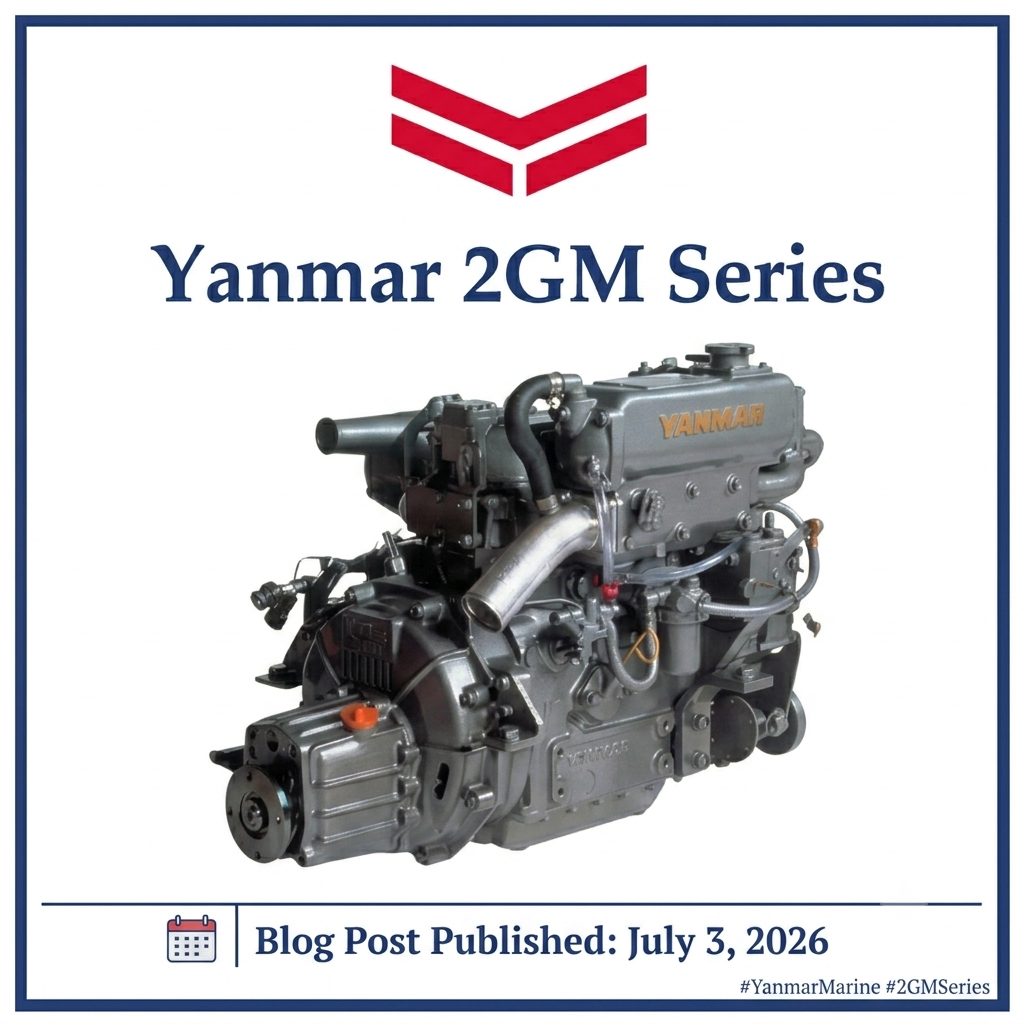
Auxiliary Marine Propulsion and the GM Family Legacy
The development of the Yanmar GM engine series in 1980 and 1981 marked a technological milestone in the design of auxiliary powerplants for the recreational yachting industry. Prior to this era, sailboat owners typically relied on heavy, single-cylinder, low-RPM engines or marinized industrial gasoline powerplants. The GM series represented a completely new generation of engines designed from the ground up specifically for marine environments, delivering a lighter, smaller, smoother, and quieter propulsion option.
The twin-cylinder 2GM block became the standard choice for small to mid-sized cruising sailboats ranging from 25 to 32 feet in length. Over its production run, which lasted until December 2005, the series earned a reputation for mechanical simplicity, fuel economy, and extreme durability. Many of these engines exceed 10,000 hours of service when properly maintained. Dozens of classic production sailboats—such as the Catalina 27, Westerly Corsair, Albin Vega, Morgan 24, Hunter 30, Hunter 31, Hunter 33, J/30, and Pearson 31—relied on this series for auxiliary power.
                 YANMAR MODEL IDENTIFICATION SYSTEM

     -------------> Vertical Cylinder Configuration
     |
     +--> [ "2" ] -------------------> Two Cylinders [1, 6]
          |
          +--> [ "GM" ] -------------> GM Engine Block Family
               |
               +--> [ "20" ] --------> Bored-Up Evolution (636 cc)
                    |
                    +--> [ "F" ] ----> Factory Freshwater Cooled
                    +--> [ "C" ] ----> Saildrive Configuration [1, 6]
                    +--> [ "V" ] ----> KM3V Compact V-Drive Gear
Yanmar employs a highly structured nomenclature system to identify its engine configurations :
- Vertical Cylinder Configuration: The absence of a leading “Y” indicates that the engine features a vertical cylinder alignment, in contrast to horizontal models like the early YSE, YSB, and YSM series.
- Cylinder Count: The leading digit (“1”, “2”, “3”, “4”, or “6”) designates the exact number of cylinders.
- Block Type: The letters “GM” or “HM” identify the specific engine block family.
- Bored-Up Series: The “10”, “20”, or “30” suffix (e.g., 2GM20) designates the “bored-up” evolutions introduced in 1983 to provide upgraded horsepower and larger electrical charging systems.
- Cooling Suffix: The presence of an “F” designates factory freshwater cooling utilizing a closed-loop circuit and an external heat exchanger. The absence of an “F” designates direct raw-water (seawater) cooling.
- Saildrive Suffix: The letter “C” indicates that the engine was shipped from the factory with an integrated saildrive unit (such as the Kanzaki SD20).
- Transmission Angles: A “BE” designation indicates a down-angle gearbox , while “V” denotes a compact V-drive arrangement utilizing the KM3V marine gear. An “M” suffix indicates that the engine shipped from the factory without any gearbox.
- Export Suffix: An “E” indicates a normally aspirated export engine.
- European Assembly (YEU): Engines carrying an “E” prefix at the start of their serial numbers (e.g., E00123) indicate assembly at Yanmar’s European facility in the Netherlands. These are designated as “YEU” models.
Technical Specifications and Model Comparison
The transition from the original 2GM series to the bored-up 2GM20 series involved changes in displacement, cylinder bore, continuous output, and dry weight. The following table compares the physical and mechanical specifications of these models.
| Specification | Yanmar 2GM (Original) | Yanmar 2GMFY (Commercial) | Yanmar 2GMY (Later Commercial) | Yanmar 2GM20 (Base Raw Water) | Yanmar 2GM20F (Freshwater Cooled) |
|---|---|---|---|---|---|
| Production Period | ~1979 – 1983 | 1980s – 2005 | 2005 – 2006 | 1983 – 2005 | 1983 – 2005 |
| Cylinders | 2 inline | 2 inline | 2 inline | 2 inline | 2 inline |
| Bore × Stroke | 72 mm×72 mm | 72 mm×72 mm | 72 mm×72 mm | 75 mm×72 mm | 75 mm×72 mm |
| Displacement | 586 cc (0.586 L) | 586 cc (0.586 L) | 586 cc (0.586 L) | 636 cc (0.636 L) | 636 cc (0.636 L) |
| Crankshaft Max Output | 13.0 HP @ 3300 RPM | 13.0 HP @ 3300 RPM | 14.8 HP @ 3600 RPM | 18.0 HP @ 3600 RPM | 18.0 HP @ 3600 RPM |
| Continuous Rating | 11.8 HP @ 3200 RPM | 11.8 HP @ 3200 RPM | 13.0 HP @ 3300 RPM | 16.0 HP @ 3400 RPM | 16.0 HP @ 3400 RPM |
| Max Torque | — | — | — | 3.75 kg⋅m @ 2800 RPM | 3.75 kg⋅m @ 2800 RPM |
| Compression Ratio | 23:1 | 23:1 | 23:1 | 23:1 (approx.) | 23:1 (approx.) |
| Cooling System | Direct raw water | Heat exchanger | Direct raw water | Direct raw water | Heat exchanger closed-loop |
| Alternator Output | 35 A | 35 A | 35 A | 55 A (LR155-20) | 55 A (LR155-20) |
| Fuel Injection Type | Indirect swirl chamber | Indirect swirl chamber | Indirect swirl chamber | Indirect swirl chamber | Indirect swirl chamber |
| Starter Motor | 12 V,1.0 kW | 12 V,1.0 kW | 12 V,1.0 kW | 12 V,1.0 kW | 12 V,1.0 kW |
| Dry Weight | 100 kg (220 lbs) | 155 kg (341 lbs) | 140 kg (308 lbs) | 106 kg (233 lbs) | 114 kg (251 lbs) |
Model-by-Model Evolution
The Original Yanmar 2GM Series (1979–1983)
Released in the late 1970s, the original 2GM featured a square cylinder architecture with a 72 mm bore and a 72 mm stroke, yielding a total displacement of 586 cc. Developing 13 HP at 3300 RPM, the engine utilized a pushrod overhead valve (OHV) configuration, a high 23:1 compression ratio, and indirect fuel injection. This early model was designed with direct, thermostat-controlled raw (salt) water cooling.
A unique feature of the original 2GM was its standard dual starting capability. Alongside a conventional electric starting motor, a raised manual hand-start handle could be slotted onto the forward end of the camshaft. To make hand-starting possible, an individual decompression lever was fitted atop each cylinder head. However, spinning the heavy flywheel fast enough to generate compression heat required significant physical strength.
As emission regulations tightened, Yanmar modified the original 2GM block for specialized commercial markets, giving rise to the 2GMFY and the 2GMY :
- The 2GMFY: Built as a heavy-duty commercial auxiliary engine, it was fitted with freshwater heat exchanger cooling and a heavy-duty mechanical gearbox. This gearbox added approximately 40 kg to the engine’s dry weight, bringing the total configuration to 155 kg with a height of 606 mm.
- The 2GMY: Introduced as a commercial launch engine, it was raw-water-cooled, lacked emission certification, and delivered 14.8 HP at 3600 RPM. It was designed with a raised hand-starting setup that could be fitted fore or aft. It weighed 140 kg and measured 713 mm in length, 454 mm in width, and 580 mm in height.
The Yanmar 2GM20 and 2GM20F Series (1983–2005)
To meet the demand for more horsepower within the same physical footprint, Yanmar introduced the 2GM20 in 1983. The primary upgrade involved widening the cylinder bore from 72 mm to 75 mm while keeping the stroke at 72 mm. This increased the displacement to 636 cc, with each cylinder having a volume roughly equivalent to a 300 ml soda can.
The larger displacement boosted maximum output to 18 HP at 3600 RPM and continuous output to 16 HP at 3400 RPM. The engine was equipped with a lighter flywheel to allow for higher revs, and the charging system was upgraded from a 35 A alternator to a 55 A model.
The 2GM20 series utilized Yanmar’s proprietary swirl-type pre-combustion chamber. This design mixed fuel and air in a small pre-chamber before entering the main cylinder, which improved combustion efficiency, reduced exhaust smoke, and lowered noise levels. This technology allowed the engine to meet early US EPA and EU low-emission limits for marine engines under 19 kW.
The series was sold in both direct seawater-cooled (2GM20) and indirect freshwater-cooled (2GM20F) versions. Saildrive options (2GM20C and 2GM20FC) coupled the engine to a Kanzaki SD20 saildrive leg using a dog-type clutch.
European Assembly (YEU) Variations
In the mid-1980s, Yanmar began shifting partial assembly of the GM series to the Netherlands. In 1997, this resulted in the release of the “YEU” (European Union) sub-variants, which carry an “E” prefix before the engine serial number.
While keeping the core engine block specifications, the YEU models featured several value-engineered modifications. The most critical change was the raw water pump. The Japanese-assembled models used a proprietary Yanmar pump, whereas the YEU models used a Swedish-built Johnson pump with a different impeller drive mechanism, a non-serviceable internal cam, and a 6-bolt cover plate. The YEU variants also used different pistons, modified manifold gaskets, and distinct alternator belt routings, which require careful parts verification during servicing.
Modern Successors: The YM Series
In 2004 and 2005, Yanmar phased out the 2GM20 series, replacing it with the modernized 2YM15 and 3YM20 series. These newer powerplants feature a redesigned cylinder block, an indirect injection combustion system, and standard freshwater heat exchanger cooling.
The YM series meets modern US EPA Tier II and BSO Tier II exhaust emission standards, which the older GM blocks could not achieve. Maintenance was also simplified on the YM engines by moving the raw water pump and other routine service points directly to the front of the block.
Physical Dimensions and Mounting Footprint
Installing or repowering an auxiliary engine requires precise physical alignment within the vessel’s engine bed. The compact dimensions of the 2GM and 2GM20 blocks make them highly adaptable for tight engine compartments.
                     ENGINE FOOTPRINT DIMENSIONS

               |<------------- Length (A) ------------->|
               +----------------------------------------+
               |                                        |  ^
               |               Engine Block             |  | Height (C)
               |                                        |  v
               +----------------------------------------+
                   |                                |
                 ======================================
                 | <------- Foundation (E) -------> | (Width between stringers)
The physical dimensions for the standard engine configurations are detailed in the table below.
| Dimension / Parameter | Standard Japanese 2GM20 | Standard Japanese 2GM20F | YEU 2GM20F (with KM2P Gear) | Commercial 2GMY |
|---|---|---|---|---|
| Overall Length (A) | 638 mm (25.1 in) | 638 mm (25.1 in) | 655 mm (25.8 in) | 713 mm (28.1 in) |
| Overall Width (B) | 455 mm (17.9 in) | 455 mm (17.9 in) | 490 mm (19.3 in) | 454 mm (17.9 in) |
| Overall Height (C) | 495 mm (19.5 in) | 495 mm (19.5 in) | 545 mm (21.5 in) | 580 mm (22.8 in) |
| Foundation Width (E) | 370 mm (14.6 in) | 370 mm (14.6 in) | 370 mm (14.6 in) | 370 mm (14.6 in) |
| Foundation Height (F) | 280 mm (11.0 in) | 280 mm (11.0 in) | 280 mm (11.0 in) | 280 mm (11.0 in) |
| Crankshaft Axis (D) | 180 mm (7.1 in) | 180 mm (7.1 in) | 180 mm (7.1 in) | 180 mm (7.1 in) |
Thermodynamic Principles and Cooling Architectures
The thermodynamic design of the 2GM20 cooling system directly impacts the engine’s long-term durability and efficiency. Direct raw-water cooling and indirect freshwater cooling have different thermal profiles.
Direct Raw-Water Cooling (Yanmar 2GM & 2GM20)
Direct-cooled models draw seawater directly through the seacock and pump it through the engine block, cylinder head, and exhaust manifold. To prevent mineral scaling, the thermostat on raw-water models is calibrated to open at approximately 70∘C (158∘F). Seawater contains dissolved minerals, calcium carbonates, and salts that begin to precipitate out of solution at temperatures above 70∘C. Operating above this threshold causes mineral scale to build up inside the cooling passages, creating an insulating barrier that leads to localized overheating and cylinder head cracks.
Running the engine at 70∘C means it operates below its optimal combustion temperature. Standard diesel combustion is most efficient when cylinder wall temperatures are maintained around 82∘C (180∘F). At lower temperatures, fuel may not burn completely, leading to carbon soot accumulation and cylinder wall glazing. Direct-cooled engines must be run at or above 2000 RPM during normal operations to keep internal temperatures high enough to prevent cylinder glazing and carbon buildup.
Indirect Freshwater Cooling (Yanmar 2GM20F)
The freshwater-cooled 2GM20F solves these thermodynamic and corrosion issues by using a closed-loop system. An engine-driven centrifugal pump circulates a 50/50 mix of antifreeze and freshwater through the block and cylinder head, controlled by a thermostat that opens at 82∘C (180∘F).
Heat transfer occurs in a shell-and-tube heat exchanger, where the hot internal coolant transfers heat to seawater pumped through an isolated bundle of tubes. Isolating the engine block from seawater eliminates internal scaling and galvanic corrosion, which extends the engine’s service life.
Performance Characteristics and Fuel Economics
The 2GM20 has a highly predictable fuel consumption profile governed by its displacement and mechanical injection timing (15∘ Before Top Dead Center). The specific fuel consumption of the engine is rated at a maximum of 215 g/HP⋅hr under full load conditions.
  Fuel Consumption Rate (Liters/Hour)
   4.0 |                                                * (3.0-3.5 L/h @ 3600 RPM)
   3.0 |                                          *
   2.0 |                                    * (1.5-2.0 L/h @ 3400 RPM)
   1.0 |                        * (1.0-1.2 L/h @ 2000-2500 RPM)
   0.0 +--------------------------------------------------
      850                     2000        2800        3600  Engine Speed (RPM)
The fuel consumption rate at different operational points is detailed in the table below.
| Engine Speed (RPM) | Operating Condition | Approximate Fuel Consumption | Volumetric Flow (GPH) |
|---|---|---|---|
| 850 RPM | Standard Idle | Minimal | Negligible |
| 2000−2500 RPM | Cruise Sweet Spot | 1.0−1.2 Liters/Hour | 0.26−0.32 GPH |
| 3400 RPM | Continuous Power Rating | 1.5−2.0 Liters/Hour | 0.40−0.53 GPH |
| 3600 RPM | Maximum Rated Output | 3.0−3.5 Liters/Hour | 0.79−0.92 GPH |
When cruising between 2000 and 2500 RPM, the engine provides adequate torque while burning only 1.0 to 1.2 liters per hour. Running the engine at its maximum rated speed of 3600 RPM increases fuel consumption to 3.0 to 3.5 liters per hour.
This sharp increase at high RPM illustrates the cubic power curve of displacement marine hulls. Pushing a vessel past its hull speed requires exponentially more power. For example, attempting to increase speed from 6.0 to 6.6 knots can double fuel consumption for a minor gain in speed.
Preventative Maintenance and Part Numbers
Using correct part numbers is critical when servicing the 2GM series, as parts can vary significantly depending on whether the engine was assembled in Japan or Europe (YEU).
| Maintenance Component | Japanese Built (Pre-1996) | European Built (YEU / Post-1997) |
|---|---|---|
| Oil Filter | 119305-35170 / 119305-35151 | 119305-35170 / 119305-35151 |
| Fuel Filter (Secondary) | 104500-55710 | 104500-55710 |
| Air Filter | 128270-12540 | 128270-12540 |
| Raw Water Pump Impeller | 104211-42071 (Raw) / 124223-42092 (Fresh) | 128990-42200 / 128990-42570 |
| Impeller Drive Type | Slotted keyway drive | Pin-drive slotted shaft |
| Raw Water Pump Gasket/O-Ring | 104211-42090 (Gasket) | X02173476 / X0506597-01 (O-ring) |
| Coolant Pump Gasket | 124223-42110 | 124223-42110 |
| Alternator V-Belt | 25132-003700 / 25132-003700E | 25132-003700 / 25132-003700E |
| Water Pump V-Belt | 104511-78780 | 104511-78780 |
| Sacrificial Zinc Anode | 27210-200300 (qty 2) | Not fitted to engine block |
| Anode Packing Gasket | 123210-09310 | Not applicable |
| Anode Threaded Plug | 128270-09300 | Not applicable |
| OEM Seawater Pump Assembly | 128270-42000 (Raw-cooled base) | 128377-42500 / 128397-42500 |
| Heat Exchanger Gasket | 24311-000700 | 128695-44070 (does not fit YEU) |
| Exhaust Manifold Gasket | 128370-13201 | 128370-13201 |
| Engine Mount (Rear) | 75 Shore (128270-08341) | 75 Shore (128270-08341) |
| Engine Mount (Front) | 100 Shore (128377-08350) | 100 Shore (128377-08350) |
Sacrificial Zinc Anode Strategy
To protect the cast iron and steel components of raw-water-cooled 2GM and 2GM20 engines, two sacrificial zinc anodes (part number 27210-200300) must be checked and replaced regularly.
These pencil anodes measure 20 mm in diameter and 30 mm in length with an M8 thread, and are installed in two locations :
- Engine Block: One anode is installed on the starboard side of the block.
- Cylinder Head: One anode is installed on the rear of the head.
These anodes thread into large brass plugs. During installation, do not use thread sealant or Teflon tape. The anode requires metal-to-metal contact with the engine block to establish electrical continuity and function as cathodic protection.
The freshwater-cooled 2GM20F uses non-corrosive antifreeze inside the engine block, so it does not contain internal block anodes. Galvanic protection on these models is instead located on the raw-water side of the external heat exchanger or on the saildrive leg.
Critical Vulnerabilities and Troubleshooting
While the 2GM20 series is highly reliable, it has several known mechanical vulnerabilities. Regular inspections can prevent costly damage.
                 EXHAUST ELBOW CREVICE CORROSION

               +----------------------------------+
               |       Outer Seawater Jacket      |
               |  +----------------------------+  |
 Exhaust  ---> |  |     Inner Exhaust Tube     |  |<--- Seawater
 Gas Flow      |  |                            |  |     Inlet
               |  |     Failing Weld Joint     |  |
               |  |    (Leaks water backward   |  |
               |  |    into cylinder head)     |  |
               |  +-------------++-------------+  |
               +----------------||----------------+
The Exhaust Mixing Elbow Vulnerability
The exhaust mixing elbow on the 2GM and 2GM20 series is a common wear point. The factory elbow uses an inner pipe welded to a mounting flange, surrounded by an outer seawater jacket.
Because the weld is exposed to hot exhaust gases and salt water, it is highly susceptible to crevice corrosion. Over time, pinholes and cracks can develop on the inner pipe, where they cannot be seen from the outside.
If the internal wall fails, raw water from the cooling jacket can flow backward into the exhaust manifold and cylinder head. If water enters an open exhaust valve, it pools on top of the piston.
Because liquids do not compress, attempting to start the engine in this state results in hydraulic lock. This can bend connecting rods, blow head gaskets, and crack the cylinder head.
In addition, dry carbon soot from combustion can combine with evaporating water inside the elbow, creating a hard carbon plaque that restricts exhaust gas flow. This restriction reduces engine power and makes starting difficult.
Symptoms of a failing or blocked mixing elbow include:
- Hard starting and low engine RPM
- Black exhaust smoke under load
- A black, oily, sooty residue inside the air filter housing
- Reduced seawater flow exiting the exhaust pipe
The exhaust mixing elbow should be removed and inspected every 100 to 500 operating hours. To check the elbow, remove it from the manifold, plug the exhaust port, and fill the cooling jacket with water. If water leaks into the exhaust gas passage, the elbow has failed and must be replaced immediately.
Many marine mechanics recommend replacing the standard cast iron elbow with an aftermarket 316L stainless steel double-welded elbow, which is highly resistant to crevice corrosion.
Starting Alarms and Protection Circuits
Upon turning the ignition key and pressing the start switch, an oil pressure alarm will sound for approximately one second. This delay is normal and indicates that the circuit is functional. The alarm will silence as soon as the engine fires and oil pressure builds.
The engine is also equipped with a coolant temperature alarm. If raw water circulation is blocked—for example, if the seacock was left closed or the raw water pump failed—this alarm will sound within a few minutes of starting.
The engine includes an integrated actuator cutout system with an 11.8 kg threshold to provide rapid emergency shutdown if needed.
Service Specifications and Torque Values
Accurate clearance and torque specifications are required for rebuilding or performing head-gasket service on the 2GM20 series.
| Parameter | Metric Specification | Imperial Equivalents |
|---|---|---|
| Engine Oil Capacity | 2.0 L (CD classification 15W/40) | 2.11 US Quarts |
| Gearbox Oil Capacity (KM2C) | 0.25 L (CD classification 15W/40) | 0.26 US Quarts |
| Saildrive Oil Capacity (SD20) | 2.2 L (EP80/90 gear oil) | 2.32 US Quarts |
| Valve Clearance (Cold) | Intake: 0.2 mm / Exhaust: 0.2 mm | Intake: 0.008 in / Exhaust: 0.008 in |
| Fuel Injection Timing | 15∘ Before Top Dead Center | 15∘ Before Top Dead Center |
| Fuel Injection Pressure | 170±5 kg/cm2 | 2418±71 PSI |
| Cylinder Top Clearance | 0.68−0.88 mm | 0.027−0.035 in |
| Compression Pressure | 28−33 kg/cm2 | 398−469 PSI |
| Cylinder Head Torque | 12.0 kg⋅m | 86.8 lb⋅ft |
| Connecting Rod Bearing Torque | 2.5 kg⋅m | 18.1 lb⋅ft |
| Main Bearing Torque | 3.5 kg⋅m | 25.3 lb⋅ft |
| Main Bearing Set Bolt Torque | 5.0 kg⋅m | 36.2 lb⋅ft |
| Flywheel Bolt Torque | 7.0 kg⋅m | 50.6 lb⋅ft |
Vessel Application and Installation Considerations
The 2GM20 engine series is highly regarded for its compact size, making it a popular choice for auxiliary power in many production sailboats.
                UPGRADING FROM YANMAR 1GM10 TO 2GM


                                |
                                v
               ===================================
               |      New Twin-Cylinder 2GM      |  (Replaces Single-Cylinder)
               ===================================
                                |
                                |  (Starboard-side exhaust allows reuse of
                                v   original 1GM10 routing path)
                                |
             [ Exhaust Loop ] ---> --->
                                                       (Requires larger
                                                        hose diameter)
Engine Mounting and Vibration Isolation
Because a twin-cylinder diesel engine inherently generates more secondary vibrations than a three-cylinder engine, proper mounting is critical.
The engine bed should use a four-point rubber isolation system to minimize the transmission of vibrations to the hull :
- Front Mounts: Tuned to a Shore hardness of 100 (part number 128377-08350) to support the weight of the block and handle engine torque.
- Rear Mounts: Tuned to a Shore hardness of 75 (part number 128270-08341) to handle thrust loads from the propeller shaft.
Many marine mechanics recommend using aftermarket mounts made with Neoprene Elastomers rather than standard natural rubber. Neoprene is highly resistant to diesel fuel, engine oil, and bilge water, which prevents the mounts from softening and throwing the propeller shaft out of alignment.
Repowering from a Yanmar 1GM10
Upgrading a sailboat from a single-cylinder 1GM10 to a twin-cylinder 2GM or 2GM20 is a common repower path. This upgrade provides more auxiliary power when motoring into headwinds and heavy chops.
Both the 1GM10 and 2GM engines have their exhaust manifolds on the starboard side, allowing the existing exhaust routing path through the engine compartment to be reused. However, because the larger twin-cylinder engine produces more exhaust gas, the existing 1GM10 exhaust hose and water-lift muffler must be replaced with larger-diameter components.
Attempting to reuse the smaller exhaust system will create high backpressure, reducing engine performance and increasing the risk of raw water backing up into the cylinder head.
Anti-Siphon Protection
In many sailboat installations, the engine block sits below the vessel’s loaded waterline.
This layout creates a risk of siphoning, where raw water can flow through the seacock, fill the water-lift muffler, and flood the engine cylinders through the exhaust manifold. To prevent this, a loop with an anti-siphon valve must be installed in the raw water hose well above the vessel’s deepest heeled waterline.
Actionable Recommendations for Boat Owners
- Perform Biennial Exhaust Elbow Inspections: Remove the exhaust mixing elbow every two years to check for internal carbon buildup, pitting, and scale. Replacing a standard cast iron elbow with a 316L stainless steel double-welded elbow is a reliable way to protect the engine from water intrusion and hydraulic lock.
- Verify Serial Numbers Before Ordering Parts: Before purchasing replacement raw water impellers, gaskets, or belts, check the engine data plate for an “E” prefix. Engines with serial numbers starting with “E” (YEU models assembled in Europe) require different parts than Japanese-built models.
- Replace Sacrificial Anodes Seasonally: For raw-water-cooled 2GM and 2GM20 engines, locate and replace both internal zinc pencil anodes (one in the block, one in the cylinder head) at the start of every season. Ensure new anodes are installed dry, without thread tape, to maintain electrical contact with the engine block.
- Avoid Low-Load Glassing: Do not run raw-water-cooled engines at low idle speeds for long periods. Operating the engine at or above 2000 RPM during normal cruising ensures it reaches proper combustion temperatures and prevents carbon soot buildup.
- Prevent Siphon Flooding During Hard Starts: If the engine is difficult to start and requires repeated cranking, close the raw water seacock. Repeated cranking can pump water into the water-lift muffler until it overflows into the exhaust manifold. Once the engine starts, reopen the seacock immediately to prevent damage to the raw water pump impeller.
Q & A Yanmar 2GM, 2GM20, and 2GM20F
Question:
My Yanmar 2GM20 engine, serial number E08830, water pump is not pushing water through. Should I replace the pump or buy a service kit? eBay part numbers don’t match Yanmar’s original. Help please?
Answer:
The ‘E’ in your engine serial number (E08830) indicates you have a European-built Yanmar model (2GM20-YEU or 2GM20F-YEU), manufactured in the Netherlands. That is why eBay part numbers don’t match standard Japanese Yanmar manuals. European models use a Johnson Pump assembly with an O-ring end plate cover rather than the Japanese Yanmar pump with a paper gasket.
Rebuild vs. Replace Decision
- Buy a Service/Rebuild Kit if: The inside bronze body of the pump is smooth, free of deep gouges, and the cam plate inside isn’t heavily worn down. Rebuilding costs $40–$75, compared to $250–$600 for a new pump.
- Replace the Complete Pump if: The inner housing bore is heavily scored/pitted, the drive shaft is rusted or grooved where the lip seal sits, or you want a 15-minute bolt-on fix without needing to press out old bearings and seals.
Note: Raw Water Hazard – Always close the engine’s raw water intake seacock (thru-hull valve) before removing or opening the water pump to prevent flooding the bilge.
1.Inspect the Existing Pump Body:10 min.
Close the raw water seacock, remove the 6 faceplate screws, and remove the impeller. Inspect the internal bronze walls and rear faceplate for deep scoring or ridge wear.
2.Choose Rebuild or Replacement:
If the bronze housing walls are smooth, order a Major Rebuild Kit for Johnson Pump 10-24509-01 / Yanmar 128377-42500. If heavily scored, order a complete aftermarket or OEM pump replacement.
3.Install and Verify Water Flow:15 min.
Reinstall the pump or new internal parts using grease on the impeller blades. Open the raw water seacock and start the engine.
To verify success, inspect the wet exhaust discharge outside the boat within 15–30 seconds of starting—you should see a steady pulse of raw water throwing from the exhaust with zero liquid weeping from the pump’s weep hole or faceplate.
Cross-Reference Part Numbers (European ‘E’ Series)
Complete Raw Water Pump Assemblies
- Yanmar OEM Part Numbers: 128377-42500 or 128377-42501 (Raw water cooled 2GM20-YEU); 128397-42500 or 128397-42501 (Fresh water/Heat exchanger 2GM20F-YEU).
- Johnson Pump OEM Numbers: 10-24509-01, 10-24509-02, 10-13337-01, 10-13492-01, or model F4B-903.
- Aftermarket Equivalents: JMP JPR-YM08IH2, Watermota YM08IH02.
Service & Rebuild Kit Parts
- Impeller Kit (Includes Cover O-Ring): Yanmar 128990-42570 (or 128990-42200) / Johnson 09-810B or 09-810B-1 / Jabsco 18653-0001.
- Cover Plate O-Ring: Yanmar X02173476 or X0506597.
- Water Lip Seal / Shaft Seal: Yanmar X02233010 or X0529139.
- Bearings (2 Required): Yanmar X03431760 & X03431748.
- Full Major Rebuild Kit Search Term (eBay/Marine Stores): Search for “Major Rebuild Kit for Yanmar 128377-42500” or “Johnson 10-24509 Major Repair Kit”.
Questions about a vessel with a 2GM or any variant? Our team at Murray Yacht Sales is glad to help you think through what you are looking at. Reach out anytime.
Contact US