

- Published by: Murray Yacht Sales Technical Division
- Expert Analysis: Engine & Generator Specialist
- Category: Marine Power Systems & Auxiliaries
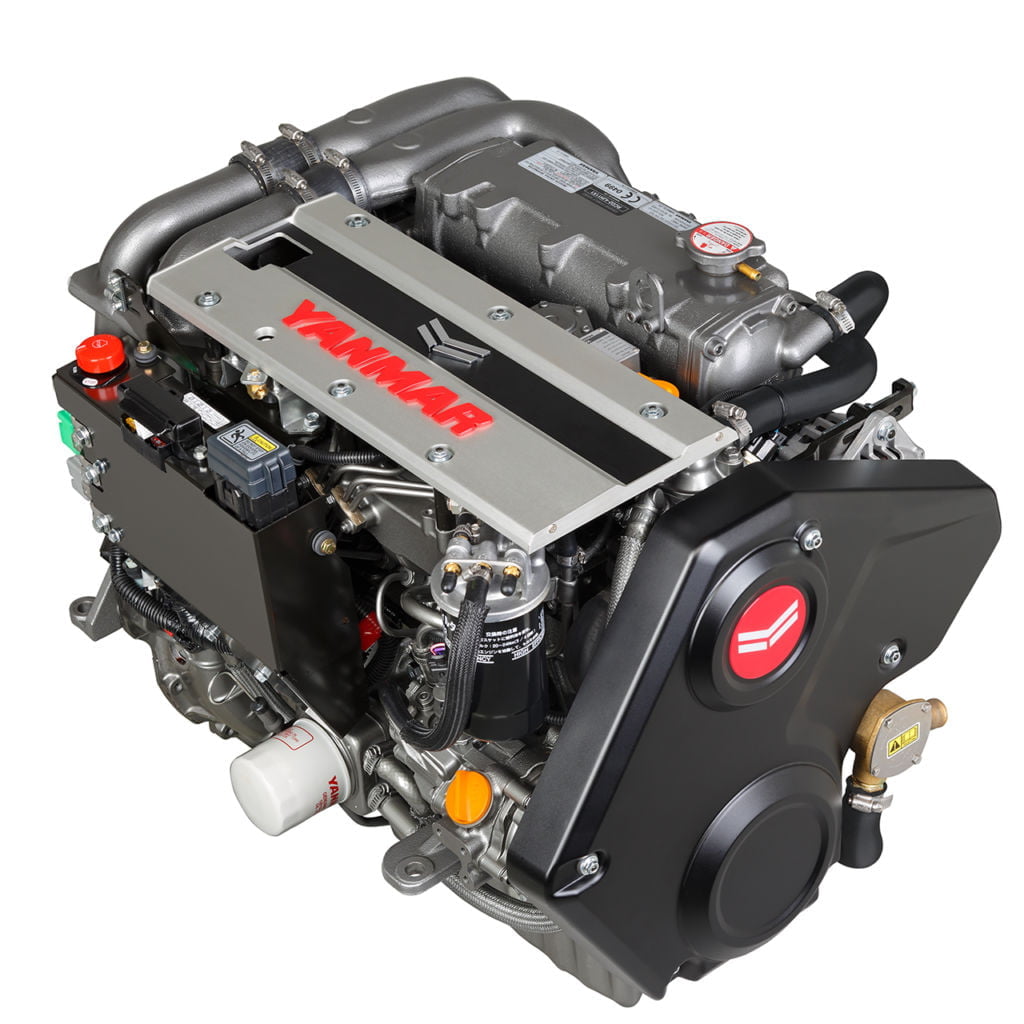
If you have spent any time walking the docks, browsing sailboat listings, or reviewing the specs of modern mid-sized cruisers, you have undoubtedly run across the phrase “Powered by Yanmar.” Among their lineup, the Yanmar 4JH Series stands out as the absolute backbone of the auxiliary marine diesel world.
Spanning several decades of engineering evolution – from purely mechanical workhorses to modern, digitally controlled common-rail engines – the 4JH family is widely regarded as the gold standard for sailboats from 35 to 60 feet, as well as light-duty trawlers and pocket cruisers.
Here is our comprehensive specialist review of the Yanmar 4JH Series, how to decode the model variant matrix, and the essential maintenance parts you need to keep on board.
The 4JH Legacy: Why it Rules the Cruising World
The Yanmar 4JH is a 4-cylinder, 4-stroke, vertical water-cooled diesel engine. What makes it so popular among cruisers?
- Smooth 4-Cylinder Balance: Compared to its smaller 2-cylinder and 3-cylinder siblings (like the 2YM or 3JH), the 4-cylinder configuration inherently cancels out secondary vibrations. This means less cabin rattle, quieter operation at cruise RPM, and less fatigue on your engine mounts and drivetrain.
- Power-to-Weight Ratio: Yanmar has consistently designed the 4JH block to be incredibly compact and lightweight without sacrificing structural integrity, allowing naval architects to tuck it neatly under companionway stairs.
- Global Footprint: If you are cruising the Gulf Coast, transiting the Panama Canal, or sitting in a marina in the South Pacific, chances are high that the local marine mechanic has Yanmar parts on the shelf.
Decoding the Yanmar 4JH Model Code
Yanmar’s model naming conventions can look like alphabet soup at first glance. However, once you break down the code, you can immediately identify the engine’s generation, aspiration, and exact configuration.
Here is how to decode any engine in the 4JH family tree:
1. The Core Block
- 4: Designates the number of cylinders (4 Cylinders).
- JH: The engine family/block series designation.
2. The Generation Indicator (Varies by Era)
- Classic Era (Blank, 2, 3, 4, 5): Historically, a number following the JH indicated the design generation. For example, a 4JH2 is a second-generation mechanical engine, a 4JH3 is third-generation, and a 4JH4E or 4JH5E represents the pinnacle of Yanmar’s naturally aspirated, mechanically injected engines.
- Modern Common-Rail Era (45, 57, 80, 110): In newer models, Yanmar dropped the generation digit and replaced it with the approximate metric horsepower output (e.g., 4JH45 = 45 hp, 4JH57 = 57 hp).
3. The Suffixes (Aspiration & Setup)
Following the core model code, you will find letters that reveal how the engine breathes and how it is cooled:
- E: Naturally Aspirated (Standard atmospheric air intake, highly reliable and simple).
- T: Turbocharged (Uses exhaust gas to pack more air into the cylinders, raising horsepower).
- HT / HTE: High-output Turbocharged with an Intercooler/Aftercooler.
- DT / DTE: Deluxe/Highest-output Turbocharged with an upgraded Intercooler configuration.
- CR: Common Rail. Indicates modern, electronically controlled direct fuel injection (delivers zero smoke, less odor, and better fuel economy).
- -C (CE or SD): Saildrive configuration (e.g., mated to a Yanmar SD60 saildrive instead of a traditional shaft-drive marine gear).
Example Breakdown:
If a boat listing says Yanmar 4JH4-TE, you are looking at a 4-cylinder, JH-series, 4th-generation engine that is Turbocharged and built for Export/Environmental compliance.
| Model Generation | Specific Engine Model | Rated Horsepower | Aspiration Type | Fuel System Type |
| First Gen (1980s) | 4JH-E | 44 hp @ 3,600 RPM | Naturally Aspirated | Mechanical Injection |
| 4JH-TE | 55 hp @ 3,600 RPM | Turbocharged | Mechanical Injection | |
| 4JH-HTE | 66 hp @ 3,600 RPM | Turbocharged & Intercooled | Mechanical Injection | |
| 4JH-DTE | 77 hp @ 3,600 RPM | Turbocharged & Intercooled | Mechanical Injection | |
| Second Gen (1990s) | 4JH2-E | 51 hp @ 3,600 RPM | Naturally Aspirated | Mechanical Injection |
| 4JH2-TE | 63 hp @ 3,600 RPM | Turbocharged | Mechanical Injection | |
| 4JH2-HTE | 76 hp @ 3,600 RPM | Turbocharged & Intercooled | Mechanical Injection | |
| 4JH2-DTE | 88 hp @ 3,600 RPM | Turbocharged & Intercooled | Mechanical Injection | |
| 4JH2-UTE | 100 hp @ 3,600 RPM | Turbocharged & Intercooled | Mechanical Injection | |
| Third Gen (Early 2000s) | 4JH3-E | 56 hp @ 3,000 RPM | Naturally Aspirated | Mechanical Injection |
| 4JH3-TE | 75 hp @ 3,200 RPM | Turbocharged | Mechanical Injection | |
| 4JH3-HTE | 100 hp @ 3,800 RPM | Turbocharged & Intercooled | Mechanical Injection | |
| 4JH3-DTE | 125 hp @ 3,800 RPM | Turbocharged & Intercooled | Mechanical Injection | |
| Fourth Gen (Mid 2000s) | 4JH4-E / 4JH4AE | 54 hp @ 3,000 RPM | Naturally Aspirated | Mechanical Injection |
| 4JH4-TE | 75 hp @ 3,200 RPM | Turbocharged | Mechanical Injection | |
| 4JH4-HTE | 110 hp @ 3,200 RPM | Turbocharged & Intercooled | Mechanical Injection | |
| Fifth Gen (2010s) | 4JH5E | 54 hp @ 3,000 RPM | Naturally Aspirated | Mechanical Injection |
| Modern Common Rail | 4JH45 | 45 hp @ 3,000 RPM | Naturally Aspirated | Electronic Common Rail |
| 4JH57 | 57 hp @ 3,000 RPM | Naturally Aspirated | Electronic Common Rail | |
| 4JH80 | 80 hp @ 3,200 RPM | Turbocharged & Intercooled | Electronic Common Rail | |
| 4JH110 | 110 hp @ 3,200 RPM | Turbocharged & Intercooled | Electronic Common Rail |
Common Maintenance Parts & Cross-Reference Guide
To ensure your 4JH runs flawlessly, routine preventative maintenance is non-negotiable. Below is a handy cross-reference chart for the most common service items across the popular mid-generation (4JH4-E / 4JH5E) and modern Common Rail (4JH45 / 4JH57) platforms.
Note: Always verify your exact engine serial number before ordering parts, as Yanmar occasionally varies water pump styles mid-production run.
| Maintenance Part | Yanmar OEM Part Number | Popular Aftermarket Cross-Reference | Recommended Service Interval |
| Primary Engine Fuel Filter | 129470-55703 (Mechanical) 119802-55810 (Common Rail) | Wix 33338 Sierra 18-7738 | Every 250 hours or annually |
| Engine Oil Filter | 129150-35153 | Wix 51064 Sierra 18-7913 Fram PH3980 | Every 100-150 hours or annually |
| Raw Water Impeller Kit | 129670-42531 (Standard) 129470-42532 (Screw-on cover) | Jabsco 1210-0001-P Sierra 18-3055 | Inspect annually, replace every 2 years |
| Alternator / V-Belt | 128990-77580 | Gates 3VX400 | Inspect for cracking every 100 hours |
| Zinc Anode (Heat Exchanger) | 27210-200300 | Sierra 18-3799 | Inspect every 6 months, replace at 50% waste |
| Primary Crankcase Oil | 15W-40 Marine Diesel Oil | Shell Rotella T4 / Chevron Delo 400 | Every 100-150 hours or annually |
The Murray Yacht Sales Verdict
Whether you are looking at a brokerage boat built in 2005 featuring a bulletproof, mechanical 4JH4-E, or buying a brand-new cruiser equipped with a whisper-quiet 4JH57 Common Rail, you are investing in a propulsion system designed to take you across oceans. They are easy to bleed, highly responsive, and hold their resale value better than almost any alternative on the market.