

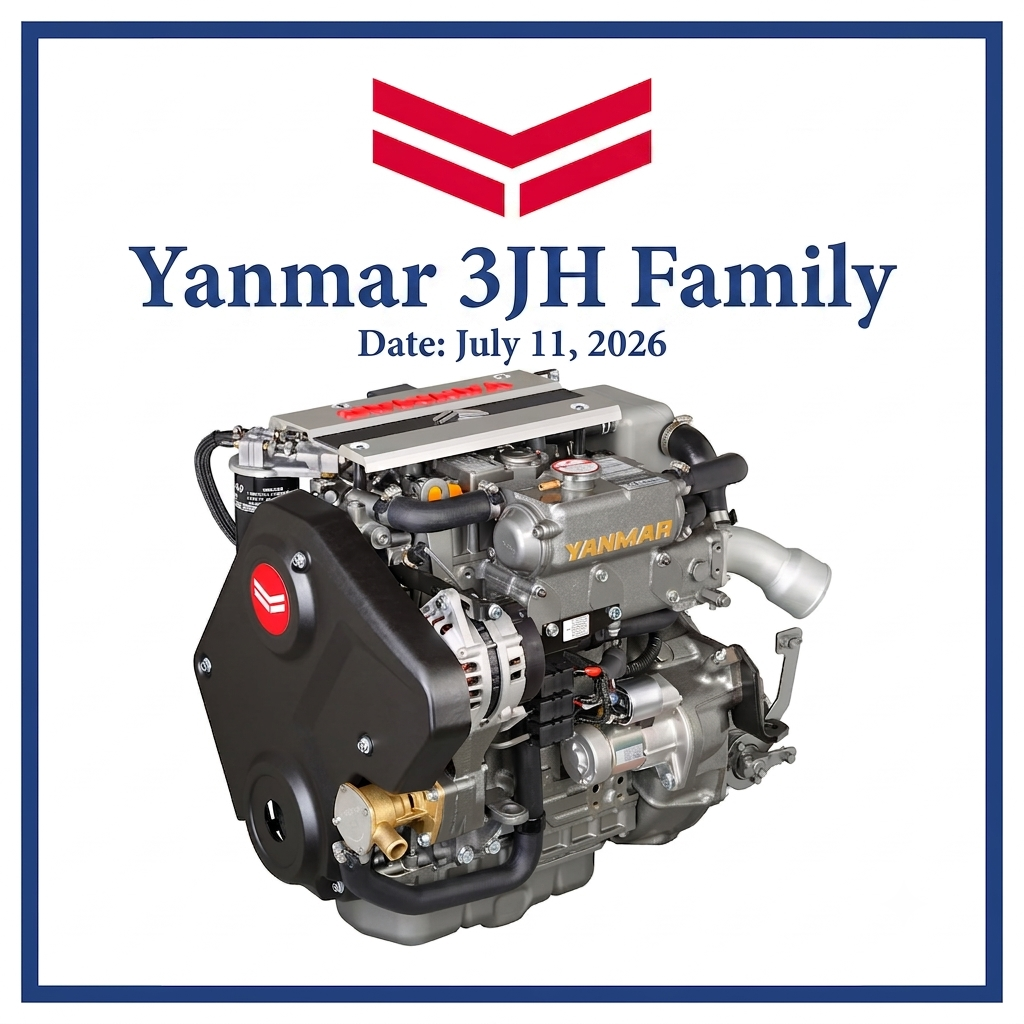
When it comes to auxiliary power for mid-sized sailboats, cruisers, and catamarans between 35 and 45 feet, the Yanmar 3JH family is arguably the most successful 3-cylinder marine diesel lineup ever designed. Celebrated for their compact footprints, legendary durability, and smooth power delivery, these engines have evolved across multiple decades.
While many sailors are familiar with the classic mechanical 3JH4E or the high-tech, common-rail 3JH40, the 3JH family spans several generations—including the widely deployed 3JH5E and the early 3JH2 and 3JH3 workhorses.
Here is a complete look at the entire Yanmar 3JH family, tracking how they changed, what makes each unique, and how to maintain them.
The 3JH Family Timeline & Legacy
Yanmar’s 3JH engineering philosophy focuses on evolutionary continuity. Instead of reinventing the wheel with every new emissions standard, Yanmar systematically refined the internal combustion design, fuel delivery, and electrical components of the same fundamental 1.642-liter block layout. This means that physical engine footprints have remained remarkably similar, making generational repowering surprisingly painless.
The Early Legends: 3JH2 & 3JH3 Series (1990s–Early 2000s)
- The Blueprint: These early models established the 3-cylinder framework. The 3JH2 (offered in naturally aspirated and turbocharged versions like the 3JH2-TE) and the subsequent 3JH3E were high-RPM, indirect-injection engines.
- The Reputation: Simple, mechanical, and highly robust. They run slightly louder and smoke a bit more on cold starts than their younger siblings, but their mechanical fuel systems will run on almost anything resembling diesel fuel.
The Direct-Injection Staple: 3JH4E (Mid-2000s)
- The Upgrade: The introduction of the 3JH4E brought a crucial shift to Direct Injection. By spraying fuel directly into the combustion chamber rather than a pre-chamber, Yanmar improved thermal efficiency, dropped fuel consumption, and achieved faster starting.
- The Verdict: A favorite among blue-water cruisers. It retained a fully mechanical governor and injection pump, meaning a complete electrical failure wouldn’t shut the engine down.
The Refined Transition: 3JH5E (2009–2010s)
- The Upgrade: Designed to meet stricter EPA Tier 3 and EU RCD environmental standards, the 3JH5E was built around a redesigned block and an improved mono-plunger fuel injection system.
- The Verdict: The 3JH5E represents the absolute peak of mechanical marine diesel refinement. It features significantly reduced noise levels and lower engine vibration compared to the 3JH4E, all while avoiding the need for an Electronic Control Unit (ECU).
The Electronic Revolution: 3JH40 (Current Generation)
- The Upgrade: The 3JH40 shattered industry norms by becoming the world’s smallest common-rail electronic marine diesel engine. It relies on a high-pressure common-rail fuel system and an ECU to deliver perfectly timed micro-bursts of fuel.
- The Verdict: Unmatched luxury and efficiency. It produces zero smoke, zero soot, and eliminates the traditional diesel smell in the cockpit, all while integrating natively with modern chartplotters via NMEA 2000 digital networking.
Technical Specifications Comparison
| Feature / Spec | 3JH2E / 3JH3E | 3JH4E | 3JH5E | 3JH40 |
| Displacement | 1.496L (3JH2) / 1.642L | 1.642 Liters | 1.642 Liters | 1.642 Liters |
| Horsepower | 38 hp / 40 hp | 40 hp | 39 hp | 40 hp |
| Rated RPM | 3400 RPM / 3000 RPM | 3000 RPM | 3000 RPM | 3000 RPM |
| Fuel System | Mechanical Indirect | Mechanical Direct | Mechanical Direct | Electronic Common Rail |
| Aspiration | Naturally Aspirated | Naturally Aspirated | Naturally Aspirated | Naturally Aspirated |
| Dry Weight | ~186 kg (with gear) | ~184 kg (with gear) | 173 kg (bobtail) | 192 kg (bobtail) |
| Emissions | Tier 1 / Unregulated | EPA Tier 2 / RCD 1 | EPA Tier 3 / RCD 1 | EPA Tier 3 / RCD 2 |
Common Maintenance Parts & Cross-References
One benefit of Yanmar’s evolutionary design is that many routine maintenance parts are shared across several generations of the 3JH family. However, key differences exist in the fuel filtration systems due to the tighter tolerances required by modern injection setups.
Pro Tip: When ordering aftermarket equivalents, always ensure they meet or exceed the micron rating required for your specific generation, especially for the common-rail 3JH40, which is highly sensitive to fuel contamination.
| Maintenance Component | Yanmar OEM Part Number | Engine Model Compatibility | Common Aftermarket Cross-Reference |
| Engine Oil Filter | 119305-35170 | All Models (3JH2 to 3JH40) | Sierra 18-7913, Fram PH3593A, Baldwin B1400 |
| Secondary Fuel Filter | 129470-55810 | 3JH2E, 3JH3E, 3JH4E | Baldwin BF940, WIX 33338, Sierra 18-7767 |
| Secondary Fuel Filter | 119802-55810 | 3JH5E | Sierra 18-79915, WIX 33262 |
| Secondary Fuel Filter | 129A00-55800 / -55810 | 3JH40 | WIX 33261 |
| Raw Water Impeller Kit | 129670-42610 | 3JH3E, 3JH4E, 3JH5E, 3JH40 | Johnson 09-1028B-1, Sierra 18-3079 |
| Thermostat | 129470-49801 | 3JH3E, 3JH4E, 3JH5E, 3JH40 | Sierra 18-3630 |
| Alternator V-Belt | 25152-004300 | 3JH4E, 3JH5E (Early Serial #s) | Gates 7430, NAPA 25-7430 |
| Serpentine Alt. Belt | 129271-77680 | 3JH5E (Late Serial #s), 4JH5E | Dayco 5040350 |
| Serpentine Alt. Belt | 129675-42280 | 3JH40 (Front Mounted Pump) | Bando 4PK845 |
Choosing the Best 3JH Variant For Your Vessel
- The Cruiser’s Direct Choice (3JH4E & 3JH5E): If you are buying a used boat or looking for a replacement mechanical engine, the 3JH5E offers the sweetest spot of low vibration, quiet operation, and total mechanical simplicity. It provides peace of mind for off-grid operations where simple mechanical tools are all you have.
- The Modern Repower Winner (3JH40): If you are pulling an old, tired engine out of a premium cruising hull, skipping the intermediate generations and going directly to the common-rail 3JH40 is highly recommended. The lack of vibration, smoke, and transom soot completely modernizes the handling and comfort of an older boat.
Specifications:
Transmissions
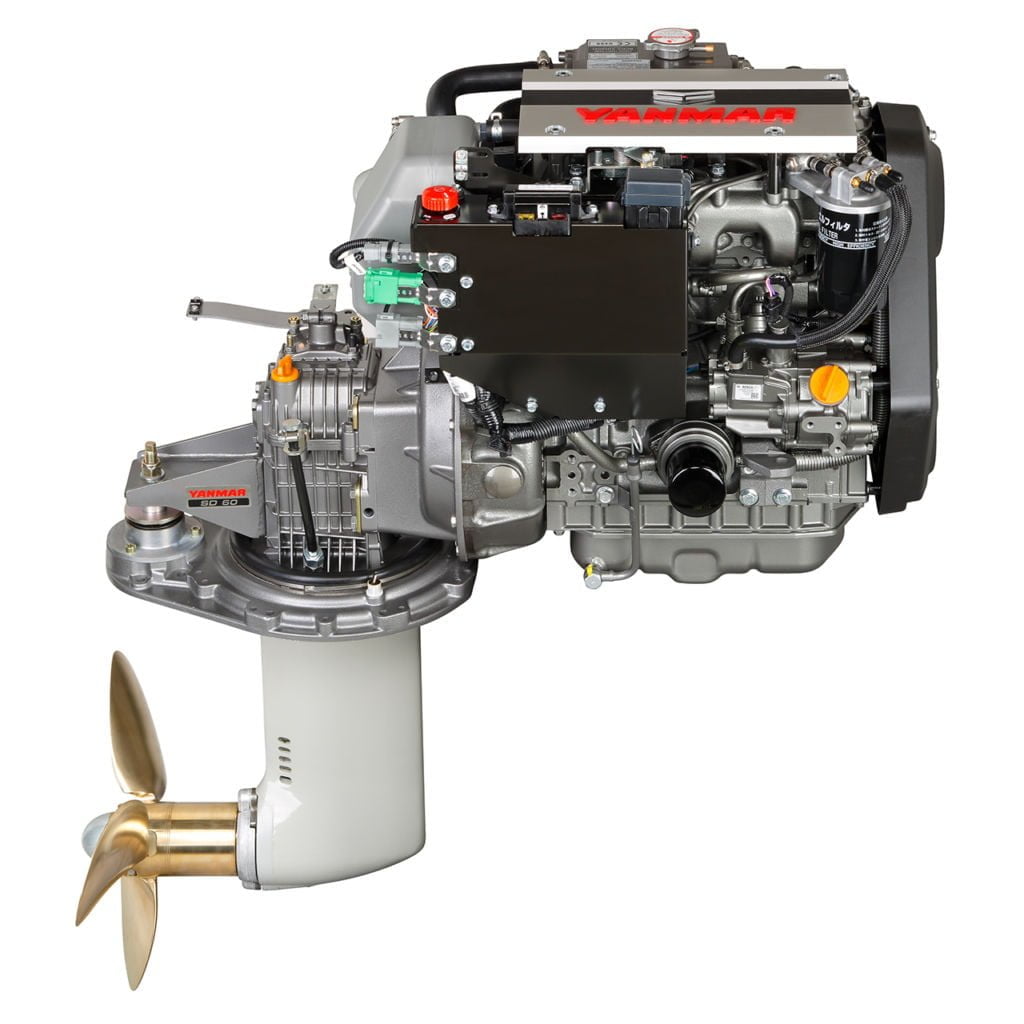
Frequently paired with KM35A/P gears or SD50/60 sail drives.
Vessels Commonly Powered by the Yanmar 3JH4E & 3JH40
These engines are the global standard for propulsion in small to mid-sized leisure craft, offering reliable output in a compact size.
Sailboats and Catamarans powered by the modern 3JH40:
- Beneteau – The engine of choice for the modern Beneteau Oceanis 37.1
- Jeanneau – Since Groupe Beneteau likes to buy engines in bulk, they’re also on the Sun Odyssey 380.
- Dufour – The 390 and 412 frequently use the 3JH40 as well.
- Hanse – Standard engine on the Hanse 410.
Those powered by the 3JH4E:
- Beneteau – Commonly found in 37-foot Oceanis models like the 373.
- Jeanneau – Frequently powering the Sun Odyssey 389 and early versions of the 39i.
- Lagoon – You’ll find twin 3JH4E engines on the Lagoon 380 S2 and Lagoon 420.
- Bavaria – These are standard on Bavaria’s 37 and 38 foot cruisers of the late 2000’s.
Conclusion
The Yanmar 3JH4E and 3JH40 represent the gold standard of auxiliary power for the 35 to 45 foot sailing segment, marking the transition from rugged mechanical simplicity to high-tech electronic efficiency. While the older 3JH4E is celebrated for its bulletproof reliability and ease of DIY repair, the modern 3JH40 offers a more refined experience with virtually no smoke, less vibration, and integrated digital diagnostics. Owners of either engine can expect longevity and reliability, backed by a global service network that is second to none.
Ultimately, these engines define their class by balancing the heavy-duty demands of cruisers with the space and weight constraints of performance hull designs.