

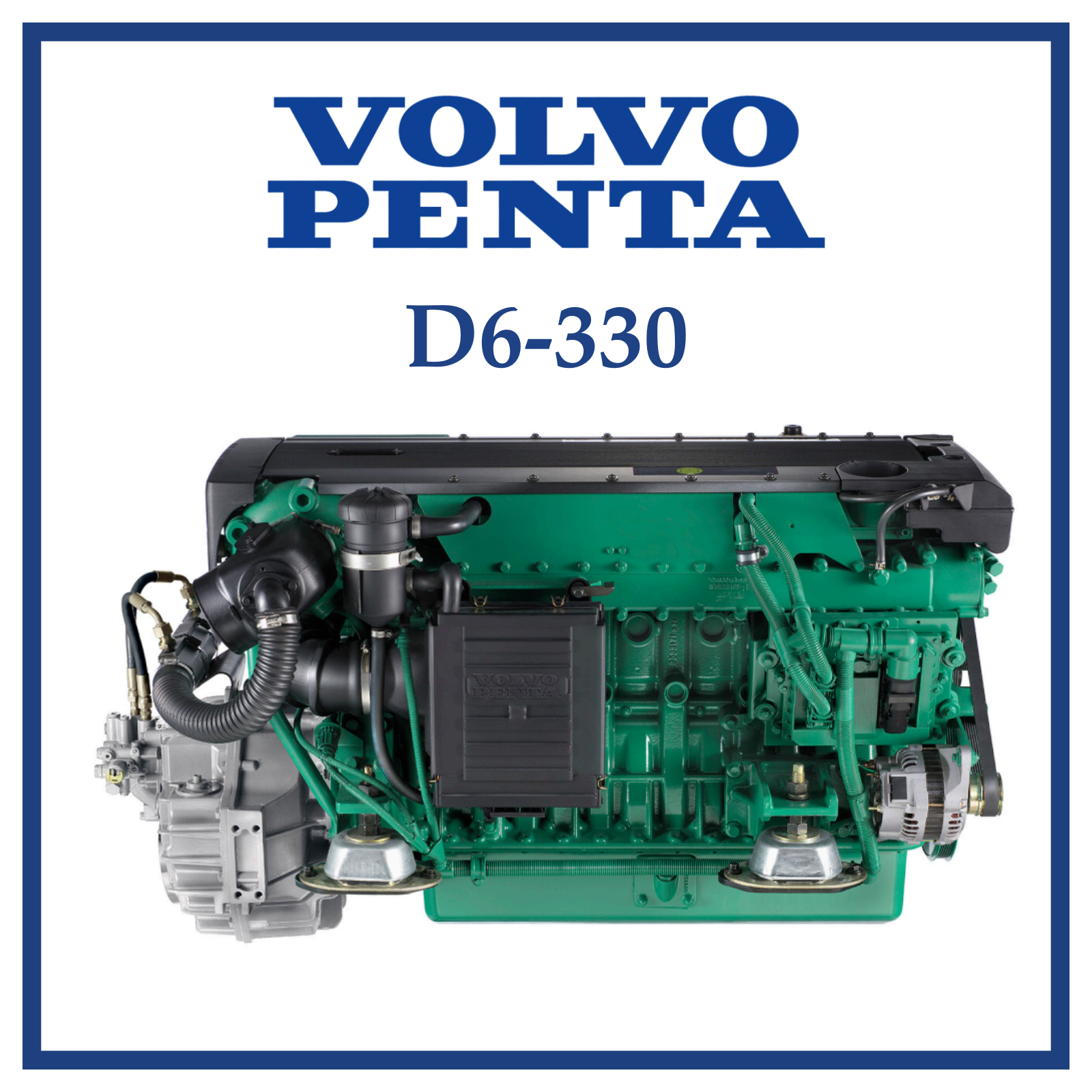
Twin Volvo Penta D6-330s on a 38 to 42-foot vessel is a pairing that shows up regularly in the brokerage market, and for good reason. This is a refined, purpose-built marine diesel in a configuration that defined a generation of hardtop express boats from builders like Princess, Sealine, Cranchi, and Absolute. The engine is straightforward mechanically, delivers real maneuvering advantages, and is pleasant to operate.
This guide covers the engine, the drive, the boats it came in, and what ownership and survey look like in practice.
ENGINE BACKGROUND
The D6 platform launched in 2003 and has been in continuous production since. The D6-330 is the 330 HP output variant, produced across multiple generations — the -A, -B, -C, and onward suffix letters denote successive refinements, with the -F suffix confirming freshwater cooling. The D6-330A-F represents the F-generation of the sterndrive-paired D6-330, produced approximately 2012 to 2015 before being superseded by the 370 HP and 400 HP variants as output expectations in the express cruiser segment rose.
Unlike the higher-output D6-370 and D6-435, the D6-330 is naturally aspirated within the D6 family — no turbocharger. This is not a performance compromise so much as a design choice suited to the mid-range output bracket. It means one fewer belt, simpler turbo-related maintenance, and a slightly different power delivery character — linear and predictable rather than surge-forward. Owners who have run both variants consistently describe the 330 as the smoother, quieter daily-use engine.
The D6-330A-F uses common-rail direct injection, double overhead camshafts, four valves per cylinder, and Volvo Penta’s Electronic Vessel Control (EVC) system, which integrates throttle, shifting, trim, and joystick docking into a single coordinated package.
Specs at a Glance
| Configuration | Inline 6-cylinder, 4-stroke diesel |
| Displacement | 5.5 liters (335.6 cu in) |
| Bore x Stroke | 103 mm x 110 mm |
| Crankshaft Power | 243 kW / 330 HP @ 3,500 RPM |
| Aspiration | Naturally aspirated (no turbocharger) |
| Fuel System | Common-rail direct injection |
| Valvetrain | Double overhead camshafts, 4 valves per cylinder |
| Compression Ratio | 17.5:1 |
| Cooling | Freshwater-cooled with heat exchanger (-F designation) |
| Drive Configuration | Aquamatic sterndrive (A designation); typically DPH Duoprop |
| Electronics | Volvo Penta EVC (Electronic Vessel Control) |
| Emissions | IMO NOx, EU RCD Stage II, US EPA Tier 3 |
| Approximate Production Years | 2012 to 2015 (F generation) |
VARIANTS AND MODEL DESIGNATIONS
The Volvo Penta naming convention for the D6-330 tells you exactly what you are looking at once you know how to read it:
D6 = diesel, 6-cylinder. 330 = output in horsepower. The letter after the dash designates drive type: A for Aquamatic sterndrive, D for IPS pod drive, I for inboard shaft. The letter after the second dash is the generation version, sequential from A onward. F is the sixth revision. So D6-330A-F means: D6 diesel, 330 HP, sterndrive configuration, F-generation.
The practical significance: earlier generations (A through E) share much of the same hardware but may carry older EVC software and pre-updated DPH drive components. If you are comparing two boats with D6-330 sterndrives and one is an earlier letter revision, it is worth checking DPH drive generation — the drive improvements across versions are meaningful (see the drive-specific notes in the problems section).
The closest siblings in the D6 family are the D6-330I-F (inboard shaft, same engine and output) and the D6-370A-F (sterndrive, 370 HP with turbocharger added). The D6-330 and D6-370 are different engines in a meaningful sense — the turbocharger on the 370 changes the service picture, belt count, and power delivery. They are not simply a calibration difference the way some families handle output ratings.
What Boats Use The Penta D6-330?
Vessels Featuring A-F
The D6-330A-F in sterndrive configuration was a dominant engine choice for European sportscruiser and hardtop express builders during its production window. These are the most common boats in brokerage carrying this setup:
| Boat Make and Model | Years | Notes |
|---|---|---|
| Princess V39 / V40 / V42 | 2010 to 2016 | Twin D6-330 DPH standard fit; one of the most common brokerage pairings |
| Sealine F380 / F430 | 2013 to 2016 | Twin D6-330 EVC; F380 won Motorboats Awards Best Flybridge 2015 |
| Cranchi 40 Smeraldo / E40 Endurance | 2011 to 2016 | Twin D6-330 DPH; Italian express cruiser, popular in Med brokerage |
| Absolute 40 / 40 STL | 2012 to 2016 | Twin D6-330 DPH; also found on Absolute 41 transitional hulls |
| Nimbus 42 Nova | 2013 to 2017 | Twin D6-330 sterndrive; Swedish builder, strong North Sea specification |
| Windy 37 Grand Mistral | 2012 to 2016 | Twin D6-330 DPH; hardtop configuration, noted for 37-knot top speed on test |
The D6-330A-F also appeared in various Galeon, Bavaria Sport, and Jeanneau Leader models during this period. Builder specifications varied — some boats offered the D6-330 alongside D4 options as a performance upgrade, so confirming the actual installed engine before applying this guide is always worthwhile.
Common Problems & What To Watch For
The D6-330 itself has a genuinely solid reliability record, particularly in the naturally aspirated configuration. Most of the issues owners and surveyors encounter with these boats center on the DPH Duoprop sterndrive rather than the engine, and on the EVC electronics surrounding both. Knowing the difference matters for budgeting and negotiation.
DPH Drive Steering Ram Leaks and Sensor Failures
The DPH Duoprop drive’s hydraulic steering ram is the most consistently reported service item on these boats. The ram seals are known to weep, and the external position sensors mounted on the ram are expensive to replace if they fail. The sensors are also vulnerable to corrosion where they are exposed to the elements. On survey, check for oil residue around the ram body and ask specifically about steering ram service history. Replacement rams and updated seal kits are available, but the labor is meaningful because the drive often needs to be lowered for access.
Heat Exchanger and Oil Cooler Corrosion at Filter Adaptor
A specific and well-documented corrosion failure point on the D6-330 is at the oil filter adaptor where it meets the oil cooler. Electrolytic corrosion between dissimilar metals at this junction causes pitting and eventual weeping, which can go unnoticed until it becomes an oil contamination or overheating problem. Inspect this area closely on any D6-330 survey — look for staining, residue, or corrosion deposits around the filter head and cooler junction. It is a known issue and a known repair, but it needs to be caught before it progresses.
EVC Fault Codes and Communication Errors
As with the D6-370 discussed elsewhere in this series, the EVC system generates fault codes that range from nuisance level to genuine operational issues. Common presentations include intermittent warning lights, throttle hesitation, and in some cases failure to engage gear due to a sensor reading the transmission as already in gear. The VODIA diagnostic tool is required for proper fault code reading and clearing — a Volvo dealer is the right resource for anything beyond basic resets. Ask for EVC fault code history on any used boat, and confirm that any stored codes have been diagnosed and resolved rather than simply cleared.
DPH Drive Exhaust Horn Corrosion
The exhaust horn where it meets the transom shield is a corrosion-prone area on DPH-equipped boats. Volvo Penta updated the horn design with an integrated anode in later revisions, but earlier installations may not have the updated part. Replacement requires the engine to come out, which makes it a significant labor event. Visually inspect the top of the exhaust horn and the transom shield connection at survey. Softness, staining, or active corrosion in this area is worth noting.
Water in DPH Drive Oil
Drive oil contamination with water is the key indicator of seal health on any sterndrive, and the DPH is no exception. A drive oil sample at survey — checking color, viscosity, and emulsification — is a five-minute step that can save a significant repair bill. Milky or discolored oil indicates water intrusion through the drive seals and warrants further investigation before purchase.
PARTS AVAILABILITY AND SERVICEABILITY
The D6-330A-F is an actively supported engine within the current Volvo Penta parts catalog. The D6 platform has sold over 100,000 units since its 2003 introduction, and the dealer network reflects that scale. Consumables, EVC components, cooling system parts, and DPH drive components are all available through Volvo Penta dealers and quality aftermarket suppliers.
The naturally aspirated configuration is a genuine serviceability advantage. One belt rather than two, no turbocharger service to plan for, and a power delivery that is easier on the drivetrain at lower speeds. Independent marine mechanics with D6 experience can handle routine maintenance. EVC diagnostics and DPH drive overhauls are dealer-level work, but day-to-day ownership is accessible.
DPH drive service—oil changes, zinc replacement, bellows inspection, and prop removal—should be performed annually. Bellows replacement is a haul-out job and is typically due every three to five years, depending on use and water temperature. Budget for this as a routine cost of ownership rather than an exceptional one.
Buyer’s Perspective
A well-maintained pair of D6-330s with documented service history is a positive finding. The combination of the naturally aspirated engine’s smoothness, the Duoprop drive’s low-speed maneuverability, and EVC joystick docking makes these boats genuinely capable and pleasant to use. For buyers coming from gas sterndrives, the fuel economy and range differences are immediately noticeable.
On value: the D6-330A-F boats in the 38- to 42-foot range represent a compelling used-market segment. The engines are proven, parts and dealers are accessible, and the boats they power were well specified by quality European builders. Boats with patchy DPH service history should be discounted accordingly — drive work is not catastrophic, but it is not cheap either.
The Volvo Penta D6-330A-F is a clean, well-sorted diesel in a configuration that works well. The engine rewards basic attentiveness, and the DPH drive rewards annual service discipline. Know the drive history, check the heat exchanger junction, pull a drive oil sample, and read the EVC fault codes — that four-item list covers the majority of what matters on these boats.
Questions about a Princess, Sealine, Absolute, or Cranchi powered by the D6-330? Our team at Murray Yacht Sales is happy to talk through what you are looking at. Reach out anytime.