

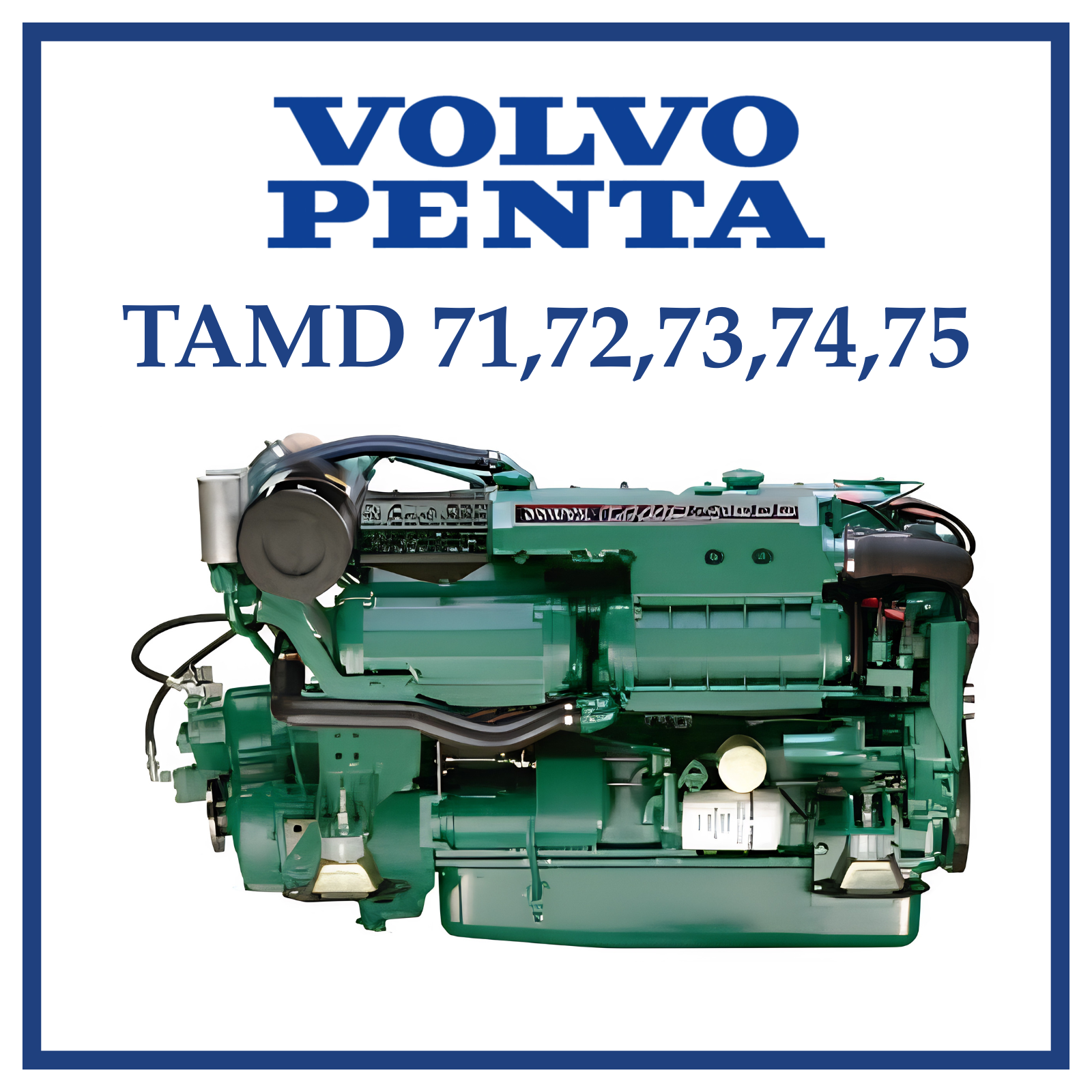
The Volvo Penta TAMD family has powered some of the most capable motor yachts over the last four decades. TAMD71s in Fairline 43s, TAMD72s in Princess flybridge cruisers, TAMD74s in Carver and Silverton convertibles, TAMD75s in Precision sportfishers — these are serious engines in serious boats, and they show up regularly in brokerage. The problem is that the naming conventions are confusing enough that buyers, surveyors, and even some technicians struggle to tell them apart.
This guide breaks down how to read the Volvo Penta TAMD code, explains what changed between the major variants, covers the EDC upgrade in plain language, and tells you which vessels these engines were installed aboard.
How to Read The Volvo Penta TAMD Code
Every letter and number in a Volvo Penta TAMD designation carries a specific meaning. Once you understand the system, you can decode any variant at a glance.
Starting from left to right in this example: TAMD74P EDC:
- T stands for Turbocharged. This confirms a turbocharger is fitted — all engines in this family are turbocharged.
- A stands for Aftercooled, also called intercooled. The intake charge is cooled after turbocharging, increasing air density and allowing more fuel to be burned efficiently. All engines in this family are aftercooled.
- M stands for Marine. Purpose-built for marine propulsion.
- D stands for Diesel.
The two-digit number that follows — 71, 72, 74, or 75 — is the series designator. Within the same block family, a higher number indicates a higher output variant or a revised specification. The 71 and 72 share the same 7.28-liter displacement but differ in output ratings. The 74 is a refined version of the same 7.28-liter block. The 75 is a further development of the 74, sharing the same displacement but featuring significant improvements in injection and cooling.
The letter after the number — A, B, C, L, P — designates the output rating or specification variant within a series. Within the TAMD74 family specifically, C is roughly 400-430 HP, L is approximately 430 HP, and P is the highest-output variant at 480 HP. In the TAMD71 family, A and B designate successive revisions, with the B being a later variant.
EDC, when it appears at the end, stands for Electronic Diesel Control. This is Volvo Penta’s electronically controlled fuel injection system, which replaced mechanical injection pumps on the TAMD74 and TAMD75. It is not just a trim level—it is a fundamentally different fuel system. More on this below.
So when you see TAMD74P EDC, you are reading: Turbocharged, Aftercooled, Marine, Diesel, 74 series, P-rated (highest output), with Electronic Diesel Control.
Engine Background
Volvo Penta introduced the 71 Series in 1986, designed from the ground up using Finite Element Analysis—the same engineering approach applied to the smaller TAMD61 Series launched simultaneously. The 71 Series was Volvo Penta’s flagship inboard marine diesel for recreational and light commercial use through the late 1980s and into the 1990s.
The TAMD72 arrived in 1991 as a higher-output variant of the same platform, delivering 430 HP to meet demand from larger flybridge and sportfishing hulls. The TAMD71 and TAMD72 share identical displacement and mechanical architecture; the main differences are calibration and turbocharger specifications.
The TAMD74 series followed and represented a meaningful technical step forward, retaining the proven 7.28-liter block while introducing the EDC system as the key differentiating feature. EDC allowed far more precise fuel metering than mechanical injection, unlocking better fuel economy, lower emissions, and improved power consistency across operating temperatures. The TAMD74 became the dominant engine in its power class through the late 1990s.
The TAMD75 launched in 2002 as the culmination of the family, featuring a revised high-pressure injection pump, redesigned nozzles with smaller orifices for finer fuel atomization, enhanced charge-air cooling, and a refined second-generation EDC system. Volvo Penta quoted five percent lower fuel consumption at cruise compared to the TAMD74P, and total exhaust emissions were reduced across the board. The TAMD75 remained in production through approximately 2005.
| Specification | TAMD71A / TAMD71B | TAMD72A | TAMD73P EDC | TAMD74C / L / P EDC | TAMD75P EDC |
|---|---|---|---|---|---|
| Configuration | Inline 6, 4-stroke diesel | Inline 6, 4-stroke diesel | Inline 6, 4-stroke diesel | Inline 6, 4-stroke diesel | Inline 6, 4-stroke diesel |
| Displacement | 6.7 L (444 cu in) | 6.7 L (444 cu in) | 6.7 L (409 cu in) | 7.28 L (444 cu in) | 7.28 L (444 cu in) |
| Bore x Stroke | 104.7 mm x 130 mm | 104.7 mm x 130 mm | 104.7 mm x 130 mm | 107 mm x 135 mm | 107 mm x 135 mm |
| Aspiration | Turbocharged and aftercooled | Turbocharged and aftercooled | Turbocharged and aftercooled | Turbocharged and aftercooled | Turbocharged and aftercooled |
| Fuel System | Mechanical direct injection | Mechanical direct injection | EDC (electronic) | EDC (electronic) | EDC (electronic, revised) |
| Rated Output | 357 to 375 HP @ 2,500 RPM | 430 HP (316 kW) @ 2,500 RPM | 430 HP (316 kW) @ 2,600 RPM | 430 to 480 HP @ 2,500 to 2,600 RPM | 480 HP (353 kW) @ 2,600 RPM |
| Rated RPM | 2,500 RPM | 2,500 RPM | 2,600 RPM | 2,500 to 2,600 RPM | 2,600 RPM |
| Fuel System | Mechanical injection | Mechanical injection | EDC | EDC | EDC (revised) |
| Cooling | Freshwater with heat exchanger | Freshwater with heat exchanger | Freshwater with heat exchanger | Freshwater with heat exchanger | Freshwater with heat exchanger |
| Drive Options | Shaft (reverse gear) | Shaft (reverse gear) | Shaft (TAMD73P) or waterjet (TAMD73WJ) | Shaft (reverse gear) | Shaft (reverse gear) |
| Dry Weight (engine only) | 880 kg / 1,940 lbs | 880 kg / 1,940 lbs | 880 kg / 1,940 lbs | 860 kg / 1,896 lbs | 860 kg / 1,896 lbs |
| Production Years | 1986 to approx. 1995 to 2000 | 1991 to approx. 1995 | 1997 to 1999 | Approx. 1998 to 2005 | 1998 to approx. 2005 |
The displacement story here is one of the most important things to understand about this engine family: all four variants share the same 7.28-liter, 107mm bore, 135mm stroke architecture. What changes across the lineup are fuel delivery, output calibration, and RPM rating—not the fundamental block. The TAMD71A produces 357 HP at 2,500 RPM from that block. The TAMD75P EDC produces 480 HP at 2,600 RPM from what is, at its core, the same block. The 100-RPM increase in rated speed from older mechanical engines to the EDC variants is modest but meaningful — the EDC system’s precise fueling allows the engine to operate more confidently at the higher end of its RPM range without the thermal and mechanical compromises that mechanical injection would impose.
The TAMD71 and TAMD72: Mechanical Injection Variants
The TAMD71A and TAMD71B are mechanically injected engines in the classic tradition — a Bosch mechanical injection pump meters fuel based on rack position, governed by a mechanical speed governor. These engines are honest in a way that purely mechanical systems tend to be: what you see is what you get, and a competent marine diesel mechanic can service them with conventional tools and no proprietary software.
The TAMD71A was produced from 1986 to approximately 1994, with a 357 HP rating. The TAMD71B followed as a revised variant, running from approximately 1995 to 2000, and is also rated at 375 HP in some specifications. The B suffix indicates a production revision rather than a fundamental redesign.
The TAMD72A arrived in 1991 and pushed output to 430 HP from the same block, primarily through a higher-output turbocharger and revised injection pump calibration. It was produced through approximately 1995. The TAMD72 is the engine buyers most frequently encounter in larger European motor yachts from the early 1990s — Fairline Squadron 55s, larger Princess models, and comparable flybridge cruisers that needed more output than the TAMD61A offered.
Both the TAMD71 and TAMD72 use conventional mechanical direct injection. There is no EDC module, no throttle position sensor, no electronic control unit. This is simultaneously their greatest serviceability advantage and the primary reason they were eventually succeeded by the TAMD74 EDC.
The TAMD73: An Evolving Platform
The TAMD73 occupies a narrow but important place in the family. Produced from 1997 to 1999 — a production run of roughly two years — it was introduced as Volvo Penta brought EDC to the 7-liter class.
The key fact buyers need to understand is this: the TAMD73 uses a 6.7-liter block, not the 7.28-liter block shared by the later engines in this lineup. The bore and stroke are different. It is a smaller engine by displacement, producing similar output to the TAMD72A — approximately 430 HP — but with higher specific output from the EDC-controlled, smaller-block engine. Parts from the TAMD71, 72, 74, or 75 will not simply transfer to the TAMD73. If you are sourcing parts for a TAMD73, the 6.7-liter designation is the critical detail.
The TAMD73P is the shaft-drive configuration, paired with conventional reverse gearing. The TAMD73WJ is configured for waterjet propulsion—the only engine in the recreational TAMD family with this designation. The WJ configuration was intended for high-speed commercial ferry and patrol boat applications and is rarely encountered in the recreational brokerage market.
Because of its brief two-year production run, the TAMD73 is far less common in brokerage than the TAMD71, 72, or 74. If you encounter one, treat it as a specialist platform: parts require careful sourcing with attention to the 6.7-liter block designation, and experienced TAMD73 mechanics are fewer than those familiar with the more widespread family members. The EDC system on the TAMD73 shares its architecture with the TAMD74 EDC, so the fault code patterns and diagnostic approach described in the TAMD74 section below apply equally to the TAMD73.
The TAMD74 EDC: What The Electronic Upgrade Actually Means
The TAMD74 series introduced EDC — Electronic Diesel Control — to the 7.28-liter platform, and this is the most important thing to understand about the transition from TAMD71/72 to TAMD74.
EDC replaces the mechanical injection pump’s fuel metering function with an electronic control unit that continuously reads engine speed, throttle position, boost pressure, intake air temperature, coolant temperature, and other inputs, then calculates and delivers precisely the right quantity of fuel at exactly the right injection timing for those conditions. The result is consistent power output regardless of load variation, ambient temperature, or altitude — something mechanical injection cannot match.
For owners, this translates into noticeably better throttle response, smoother power delivery across the RPM range, improved fuel economy at cruise, and reduced black smoke under hard acceleration. Volvo Penta’s own testing showed the TAMD74P EDC at 480 HP delivered the same peak output as a mechanically injected engine of comparable spec, but with better consistency and lower emissions across the operating range.
The TAMD74 family covers three output levels: the TAMD74C at approximately 430 HP (2,500 RPM), the TAMD74L also at 430 HP with different gearing options, and the TAMD74P at 480 HP (2,600 RPM), which is the variant most commonly encountered in US brokerage boats from this era. All TAMD74 variants use EDC.
The TAMD75: The Final Form
The TAMD75P EDC, introduced in 2002, is a direct development of the TAMD74P. The block, bore, stroke, and displacement are unchanged. What Volvo Penta revised was the injection system and charge air cooling.
The TAMD75 runs a higher-pressure injection pump. The injector nozzles have smaller orifices, which produce a finer fuel mist that atomizes more completely and burns more efficiently. The charge-air cooling system was reworked to improve heat rejection. The EDC system received its own upgrade — faster processing, more precise timing control, and better integration with the transmission. The result was a five percent reduction in fuel consumption at cruise compared to the TAMD74P, measurably lower exhaust emissions, and improved resistance to power loss in hot climates — a weakness of the TAMD74 that owners in the Gulf of Mexico and Caribbean had flagged.
The TAMD75 was produced from 2002 to approximately 2005 before the platform was succeeded by the modern D9 and D11 series. It is the most refined version of the 7.28-liter TAMD engine and the one that, all things equal, a buyer would prefer to find in a used boat.
What Boats Use These Engines
The TAMD71/72/74/75 family powered an enormous range of production motor yachts across European and American builders. These are the most frequently encountered in brokerage:
| Boat Make and Model | Years | Engine (sorted by) | Notes |
|---|---|---|---|
| Fairline Squadron 43 / 55 | 1988 to 1996 | Twin TAMD71A / TAMD72A | TAMD71 in 43, TAMD72 common in larger 55 builds |
| Princess 45 / 470 Flybridge | 1990 to 1997 | Twin TAMD71A / TAMD72A | Both variants are found depending on the year and build spec |
| Storebro Adler 43 / Royal 420 | Late 1980s to 1995 | Twin TAMD71 / TAMD72 | Swedish builder |
| Sea Ray 410 and 450 Express Bridge | 1999 – early 2000’s | Twin TAMD73 | Offered as a factory alternative |
| Riviera 4000 Offshore | Late 90s | Twin TAMD73 | |
| Fairline Phantom 46 | 2000 to 2005 | Twin TAMD74P EDC (480 HP) | |
| Carver 466 / 506 Motor Yacht | 1999 to 2004 | Twin TAMD74P EDC (480 HP) | |
| Carver / Trojan 440 Express | 1998 to 2003 | Twin TAMD74P EDC (480 HP) | |
| Regal Commodore 4160, 4260, & 4460 | 2000 to 2006 | Twin TAMD74P or TAMD75P EDC | |
| Silverton 42 / 45 Convertible | 2000 to 2006 | Twin TAMD74P or TAMD75P EDC | |
| Precision 40 Flybridge | 1998 to 2003 | Twin TAMD74P EDC | Australian-built cruiser / sportfish |
| Voyager 530 Motor Yacht | 2000 to 2004 | Twin TAMD74P EDC |
The TAMD74 and TAMD75 also appeared in numerous Riviera, Maritimo, and Baia builds during this period, particularly in the Australian and European markets. If you know of additional specific pairings from direct brokerage experience, this list is worth expanding.
Common Problems / What To Look For
TAMD71 / TAMD72: Heat Exchanger Maintenance
The TAMD71 and TAMD72 share the same cooling system architecture as the TAMD61A covered elsewhere in this series. The heat exchanger and air cooler should be cleaned, and all O-rings replaced, every 5 years. Neglected exchangers cause overheating that goes undetected until it causes head gasket or cooler damage. Use only Volvo green coolant, and do not mix it with the yellow VCS formula — mixing causes gelling and cooling system blockages.
TAMD71 / TAMD72: Injection Pump and Injector Wear at High Hours
At higher hours — typically above 3,000 — the mechanical injection pumps on the TAMD71 and TAMD72 develop calibration drift. The symptoms are gradual: increased black smoke under load, uneven running between cylinders, rising fuel consumption, and declining power at cruise. Injection pump reconditioning or replacement is a significant expense, but a known job with straightforward parts availability. It is not an emergency failure mode, but buyers of high-hour TAMD71 and TAMD72 boats should budget for it.
TAMD74 EDC: Turbo Boost Pressure Sensor Failures
The most consistently reported EDC fault on the TAMD74 involves the turbocharger boost pressure sensor. A failing sensor causes the EDC system to limit engine RPM, typically to around 2,000-2,050 RPM, as a protective response to what it reads as out-of-spec boost pressure. The engine otherwise runs cleanly — no smoke, no vibration — but it simply will not pull past that RPM ceiling regardless of throttle input.
The fix is to replace the sensor, followed by a full EDC software reset using Volvo’s VODIA diagnostic tool. There is an important software note here: the EDC module should be flashed with the P-A firmware version specifically. Earlier software versions contain documented bugs that can cause recurring boost pressure faults even after sensor replacement. If a VODIA-equipped technician has not confirmed that the correct firmware version is installed, that is worth doing.
TAMD74 EDC: Throttle Potentiometer Fault (Error Code 27)
A second common EDC fault involves the throttle position potentiometer at the gearbox. Fault code 27 indicates an out-of-range throttle position signal, which puts the engine into limp mode — it runs but will not respond normally to throttle input. This fault is intermittent in many cases, clearing after a battery reset, and can go weeks without recurring before returning unpredictably. Volvo Penta issued a wiring loom recall affecting some TAMD74P-A installations. Confirm whether the wiring loom update has been performed on any pre-2002 TAMD74 boat.
TAMD74 / TAMD75 EDC: Software and Module Sourcing
The EDC control module itself is a known failure point on older TAMD74 installations. Modules have been failing due to age and heat cycling, and genuine Volvo Penta replacement modules are increasingly difficult to source at a reasonable cost. Third-party rebuilt modules are available from specialist Volvo Penta diesel shops, but confirm compatibility with the specific engine serial number and software version before purchasing. On the TAMD75, the refined second-generation EDC is considered more reliable than the TAMD74’s first-generation system, but it shares the same dealer-tool dependency for diagnostics.
TAMD75: MAP Sensor RPM Ceiling
A specific issue reported on TAMD75 installations involves the Manifold Absolute Pressure sensor, which causes an RPM ceiling at approximately 2,000 RPM — identical to the TAMD74 boost sensor fault but caused by a different component. The MAP sensor is a Bosch part and is generally available. When a TAMD75 suddenly will not rev past 2,000 RPM with no active fault codes, the MAP sensor is the first thing to check.
Parts Availability and Serviceability
The TAMD71 and TAMD72 are in legacy territory — out of production since the mid-1990s — but they are well-supported by an active aftermarket. The mechanical injection system means that any competent marine diesel mechanic, independent of the Volvo dealer network, can perform full engine service, injector reconditioning, and injection pump rebuild. Filters, belts, heat exchanger components, thermostats, raw water impellers, and gasket sets are all available from Volvo Penta dealers and aftermarket suppliers in Europe and the US.
The TAMD74 and TAMD75 require a more considered serviceability assessment. Routine maintenance — oil, filters, belts, impellers, heat exchanger service — is all dealer-independent. But EDC fault diagnosis, module replacement, software flashing, and calibration all require the VODIA diagnostic tool, which is Volvo Penta dealer equipment. This is not unique to the TAMD74/75 — it is the reality of any electronically managed marine diesel of this era — but it is a practical consideration for owners based far from a Volvo Penta dealer.
Parts availability for the TAMD74 is generally good. The TAMD75, having been out of production for approximately 20 years, requires greater diligence in sourcing, particularly for EDC-specific components. Specialist Volvo Penta diesel shops in the UK, Scandinavia, and parts of the US maintain a deeper inventory of legacy EDC components than general marine parts suppliers.
Buyer’s Perspective
A pair of well-maintained TAMD71s or TAMD72s in a boat from the late 1980s or early 1990s is a known quantity. The mechanical injection makes these engines transparent to troubleshoot, and their long production history means problems are well documented, and solutions are findable. The primary buyer concern is heat exchanger history, injection pump condition at high hours, and general cooling system maintenance.
For TAMD74 and TAMD75 boats, the questions shift:
- Is there an accessible Volvo Penta dealer with VODIA capability near your home port?
- Has the EDC software been confirmed as the P-A version on TAMD74 engines?
- Has the wiring loom recall been completed on pre-2002 TAMD74P-A installations?
- What is the EDC module condition, and is there any history of fault codes?
- On the TAMD75, has the MAP sensor been replaced recently?
On value: TAMD71 and TAMD72 boats are priced lower than their TAMD74 and TAMD75 equivalents, for reasons partly about age and partly about perceptions of electronic complexity. A TAMD72A boat with documented heat exchanger service and a clean injection pump can represent real value. A TAMD74P EDC boat with a clean EDC history and dealer-confirmed software is genuinely worth a premium over one with gap-filled records or unresolved fault codes.
For either generation, compression testing and an oil analysis at survey are non-negotiable. These are large, heavy engines in large, expensive boats. The cost of getting that right is trivial compared to what comes after.
CLOSING
The TAMD family represents the long arc of Volvo Penta’s 7-liter inboard marine diesel — from the honest mechanical simplicity of the TAMD71 to the refined electronic precision of the TAMD75. Each generation improved on the last, and the progression from 357 HP mechanical injection to 480 HP EDC happened without ever changing the fundamental block. That speaks well of the original architecture.
Know which engine you have, understand what the suffix letters tell you, and get the service history in hand before committing to a purchase. The engines are capable and rebuildable. The question is always whether they have been treated accordingly.
Questions about a Fairline, Carver, Silverton, Princess, Regal, or any other boat powered by this engine family? Our team at Murray Yacht Sales is glad to help. Reach out anytime.