
The architectural lineage of the Kadey-Krogen 42 began in April 1974, when naval architect James S. Krogen completed preliminary design drawings in his Miami office. Developed in collaboration with Florida yacht broker Art Kadey, the vessel was conceptualized as a full-displacement, long-range powerboat derived from the functional hull lines of commercial shrimp trawlers and North Sea fishing vessels. Krogen’s background, which encompassed commercial vessel architecture as well as utilitarian custom projects such as a Navy whaleboat-to-motorsailer conversion, deeply informed the project. The design ethos prioritized sea-kindliness, structural integrity, and long-range efficiency over high speed and fashionable styling, adhering strictly to a philosophy where form follows function.
The architectural lineage of the Kadey-Krogen 42 began in April 1974, when naval architect James S. Krogen completed preliminary design drawings in his Miami office. Developed in collaboration with Florida yacht broker Art Kadey, the vessel was conceptualized as a full-displacement, long-range powerboat derived from the functional hull lines of commercial shrimp trawlers and North Sea fishing vessels. Krogen’s background, which encompassed commercial vessel architecture as well as utilitarian custom projects such as a Navy whaleboat-to-motorsailer conversion, deeply informed the project. The design ethos prioritized sea-kindliness, structural integrity, and long-range efficiency over high speed and fashionable styling, adhering strictly to a philosophy where form follows function.
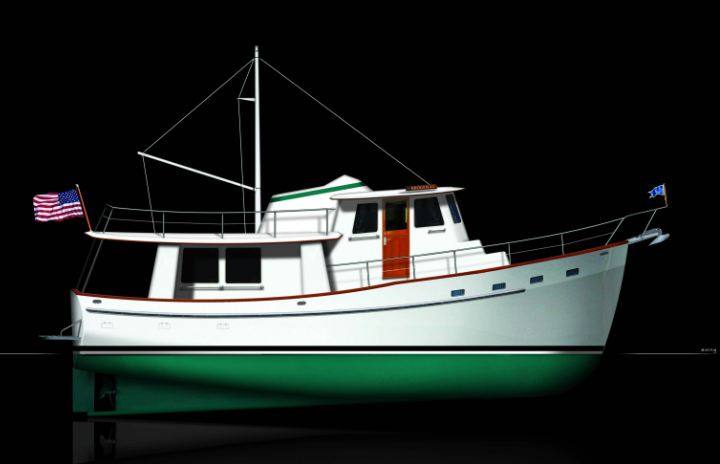
When the Kadey-Krogen 42 debuted in 1976/1977, it established a new category in the recreational powerboat market. The signature exterior profile features a sweeping, unbroken sheer line rising from moderate freeboard aft to a high, flared bow with heavy bulwarks. This configuration yields substantial forward reserve buoyancy, enabling the hull to ride over oncoming seas while keeping the decks dry during offshore operations. The raised pilothouse incorporates a three-panel forward windshield and triple side windows, reflecting commercial vessel design while providing panoramic visibility from the helm.
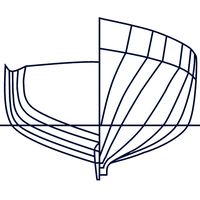
Hydrodynamically, the Krogen 42 is defined by a soft-chine, round-bottom full-displacement hull paired with a full-length protective keel and a wineglass transom. In contrast to hard-chine or flat-transom semi-displacement trawlers—which can exhibit a sharp, jerky roll and pounding motion in beam or quartering seas—the rounded bilges and fine entry of the Krogen 42 deliver a smooth, low-frequency rolling motion. Flatter hull sections between the keel and the rounded chine generate initial roll resistance without requiring excessive ballast. As a result of this hydrodynamic efficiency, the vessel requires approximately 60 horsepower to reach hull speed, despite a total displacement of approximately 40,000 pounds. The deep, ballasted keel fully encapsulates and protects the propeller and rudder from underwater impacts and grounding.
Hydrostatic evaluations demonstrate that the vessel possesses favorable physical characteristics for blue-water passagemaking. With a displacement/length ratio () of 294 and a prismatic coefficient (
) of 0.60, the hull balances cargo-carrying capacity with low wave-making resistance at displacement speeds. The vessel retains positive righting energy up to 85 degrees of heel, an exceptional stability margin for a power vessel of its class.
| Hydrostatic, Dimensional, and Stability Parameters | Metric / Value |
| Length Overall (LOA) | 42′ 4″ (12.90 m) |
| Length on Waterline (LWL) | 39′ 2″ (11.94 m) |
| Beam | 15′ 0″ (4.57 m) |
| Draft | 4′ 7″ (1.40 m) |
| Displacement Weight | 39,500 – 40,000 lbs (17.6 metric tons) |
| Encapsulated Lead Ballast | 2,500 lbs (1,134 kg) |
| Displacement / Length Ratio ( | 294 |
| Area / Buoyancy Ratio ( | 2.2 |
| Prismatic Coefficient ( | 0.60 |
| Metacentric Height ( | ~3.9 ft |
| Range of Positive Stability | Up to 85° |
| Air Draft / Bridge Clearance (Mast Up) | 22′ 9″ (6.93 m) |
| Air Draft / Bridge Clearance (Mast Down) | 14′ 0″ (4.27 m) |
| Gross Tonnage / Net Tonnage | 32.9 Gross / 26.3 Net |
Production Evolution, Shipyard Operations, and Structural Metamorphosis
Over a 21-year production span from 1977 through 1998, a total of 206 Krogen 42 hulls were constructed. Manufacturing was based in Kaohsiung, Taiwan, which emerged during this era as a major center for recreational yacht construction. Early production was contracted across regional yards, including Chien Hwa, before shifting to Asia Harbor Yacht Builders. Founded by Lin Kao Shui, Asia Harbor entered into an exclusive manufacturing agreement with Kadey-Krogen Yachts in 1991, standardizing layup techniques, joinery quality, and system installations across the product line.
The composite layup and structural detailing of the Krogen 42 underwent major engineering revisions throughout its production life cycle to improve structural longevity, eliminate water-intrusion risks, and refine interior acoustic isolation.
| Chronological Era | Hull Numbers | Core Structural Construction & Engineering Modifications |
| 1977–1979 | Hulls 1–6 | Initial production utilizing fiberglass sandwich hull construction cored with closed-cell PVC foam both above and below the waterline. Main decks constructed with wooden deck beams, plywood sub-decks, fiberglass overlays, and screwed teak planking. Boat deck constructed with a 4″x4″ plywood square core. |
| 1979–1984 | Hulls 7–64 | Hand-laid fiberglass sandwich hull with PVC foam coring. Decks constructed with fiberglass laid over marine plywood. Features unmolded interior headliners. |
| 1984 | Hull 66+ | Introduction of molded fiberglass interior headliners. Replacement of cable lifelines with solid teak handrails forward, later transitioning to welded stainless steel tubing. |
| 1985–1988 | Hull 65+ | Major structural revision shifting deck and superstructure construction from glass-over-plywood to fully cored composite fiberglass sandwich structures, eliminating structural plywood from weather decks. |
| 1989 | Widebody Introduction | Introduction of the Widebody configuration. The salon was expanded portside directly to the hull gunwale, replacing the port covered side deck to increase the interior living area while retaining the starboard side deck for fore-and-aft deck access. |
| 1993/95–1998 | Late Production | Transition of underwater hull layup from PVC foam-core sandwich to solid fiberglass construction below the waterline, eliminating long-term core-saturation risks. |
The primary hull structure was executed via heavy hand-layup utilizing woven roving and glass mat impregnated with polyester resin. Closed-cell PVC foam coring was retained in the topsides above the waterline to provide structural stiffness, thermal insulation, and sound attenuation without adding excessive top weight. In 1998, production ceased as the complex multi-piece tooling molds became economically inefficient to maintain relative to evolving ergonomics, leading directly to the introduction of the Krogen 44.
Propulsion Systems, Performance Profiles, and Stabilization Dynamics
The vast majority of Krogen 42 hulls were built with a single, normally aspirated marine diesel engine, a layout that maximized fuel economy, structural space, and shaft protection. Only five hulls were custom-ordered with twin-engine installations. The single-engine layout provides an expansive engine room offering 550 cubic feet of volume and 54 inches of vertical headroom, allowing 360-degree maintenance access around the main engine, transmission, auxiliary generator, and fuel manifolds.
The standard powerplant selection evolved through three distinct phases:
- Ford-Lehman 120 hp: Fitted to early hulls from 1977 to approximately 1985, driving a single bronze propeller through a stainless steel shaft.
- Ford-Lehman 135SP: Standardized around 1985, offering 135 horsepower at 2,600 RPM with improved fuel atomization and combustion efficiency.
- Post-Lehman Alternatives: Following the termination of Ford-Lehman production, factory installations shifted to American Diesel 135, Perkins 130, or Sabre 135 powerplants.
| Speed (Knots) | Engine RPM (FL 135) | Fuel Consumption (GPH) | Cruising Range (700 Gal Fuel) | Operational Profile |
| 6.0 kts | ~1,400 RPM | 1.0 – 1.2 GPH | 4,500 – 5,000 NM | Transoceanic passage speed; maximum fuel efficiency. |
| 7.0 kts | ~1,700 RPM | 1.4 – 1.6 GPH | 3,000 – 3,200 NM | Extended coastal and offshore cruising speed. |
| 8.0 kts | ~2,100 RPM | 2.5 – 3.0 GPH | 2,000 – 2,200 NM | Standard displacement cruise speed at maximum efficiency threshold. |
At a standard displacement cruise speed of 7.0 to 7.5 knots, the single-engine Krogen 42 consumes between 1.3 and 1.6 gallons per hour. This yield translates to an economical operating cost baseline of roughly $1.00 per nautical mile under historic fuel cost baselines, enabling extended offshore passages.
To mitigate single-shaft propulsion vulnerability during ocean crossings, Kadey-Krogen offered an optional auxiliary emergency drive system. Driven by a dedicated 12-kW generator, this system engaged the main propeller shaft via a hydraulic or belt-driven power take-off, providing a speed of 3 to 4 knots to reach port in the event of a main engine mechanical failure.
Because soft-chine displacement hulls exhibit pronounced rolling motions in beam or quartering seas, many owners outfitted their vessels with passive paravane stabilization systems (“flopper stoppers”). These systems feature hinged aluminum outrigger booms deployed horizontally from the hull sides, towing delta-wing underwater “birds”. As a wave attempts to roll the vessel, the submerged bird resists upward displacement, dampening roll acceleration by up to 80 percent without requiring electrical or hydraulic generator power. This mechanical simplicity renders paravanes an effective choice for long-distance passagemaking.
Spatial Ergonomics and Interior Accommodation Variations
The interior layout of the Krogen 42 utilizes a tri-level layout engineered to separate operational, living, and sleeping areas. Interior joinery is built from solid teak trim, teak face veneers, and parquet soles.
The raised pilothouse serves as the navigation and command center. Situated forward and above the main salon, it houses a centerline helm station equipped with an expansive chart table and space for navigation electronics. Immediately aft of the helm seat is a watch berth that extends into a double berth while at anchor. Heavy weather-tight doors to port and starboard grant immediate access to the side decks. The pilothouse can be completely isolated from lower living spaces, preventing interior night-lighting from compromising the helmsperson’s night vision.
Double teak doors open from the covered aft cockpit into the main salon. In the Standard configuration, symmetrical covered side decks flank the salon on both sides. In the Widebody variant, the salon is offset to the port gunwale, expanding the interior living room while retaining a wide starboard deck for fore-and-aft access. The salon features an L-shaped settee with a dining table to starboard, while a U-shaped galley is situated forward on the starboard side. The galley includes a three-burner propane range with oven, an upright refrigerator/freezer, dual stainless steel sinks, Corian or laminate countertops, and a built-in pantry.
The lower accommodation level was offered in three main factory layouts:
- Standard Two-Stateroom Layout: Configured with a master stateroom forward featuring a double berth offset to starboard, built-in storage drawers, and hanging lockers. A guest stateroom to starboard contains upper and lower single bunks. To port, a head compartment includes a stall shower and space for a combination washer/dryer unit.
- Single Head / Centerline Queen Layout: Replaces the offset double with a island queen berth in the forward stateroom, utilizing a single large head compartment to maximize master cabin volume.
- Mid-Ship Master Variant: Custom layout built on at least seven hulls, placing the master stateroom amidships beneath the pilothouse and featuring a spiral staircase leading directly up to the helm station.
The covered aft cockpit provides access to the upper boat deck and flybridge via a vertical ladder. The flybridge provides a secondary helm station with sightlines forward and aft for tight docking maneuvers. The aft boat deck can store tenders up to 11 feet in length, managed by an aluminum mast and boom lifting assembly rated for up to 500 pounds.
Structural Vulnerabilities, Maintenance Engineering, and Modernization Protocols
Despite its reputation for seaworthiness and structural longevity, legacy Krogen 42 hulls present specific age-related maintenance areas that require systematic inspection and refitting.
Hulls constructed prior to 1985 (Hulls #1 through #64) featured teak planking fastened with hundreds of screws directly through fiberglass into plywood sub-decks. Over decades of exposure, bedding compounds beneath the teak can degrade, allowing water to migrate through fastener holes into the sub-deck core. This moisture penetration leads to localized rot, deck delamination, and interior leaks. Corrective remediation requires stripping the teak planks, removing compromised plywood core materials, re-coring with composite materials, and laying new fiberglass cloth. Post-1985 hulls (#65 onwards) avoid this issue by utilizing fully cored fiberglass sandwich structures without sub-deck plywood.
A critical system vulnerability involves the factory-installed black iron fuel tanks, which carry the vessel’s 700-gallon diesel capacity. The tanks are situated in lower bilge compartments beneath the salon sole. A design issue on certain hulls allows rainwater to leak past upper-deck fashion panels and drain into undrained bilge pockets surrounding the fuel tanks. Prolonged contact with standing bilge water can cause severe external rusting, leading to seam failure and fuel leakage. Tank replacement requires cutting access openings through the main salon teak sole or engine room bulkheads to remove the failed iron tanks and install new aluminum or fiberglass replacements.
Early hulls built with underwater PVC foam coring require inspection for osmotic blistering and core saturation. If water penetrates the outer fiberglass skin through unsealed thru-hull penetrations or stress cracks, the foam core can become waterlogged, leading to structural delamination or localized flex (“oil canning”) under heavy hydrodynamic loads. Modernizing these hulls involves peeling the outer gelcoat layer, drying or replacing wet core sections, and applying epoxy barrier coatings. The transition to solid fiberglass bottom layups after 1993–1995 eliminated this structural vulnerability on later builds.
Long-distance cruising owners frequently execute electrical and energy management refits to support modern off-grid operations. Legacy automotive-style alternators and flooded lead-acid battery banks are replaced with large-capacity Lithium Iron Phosphate ( LiFePO4) or AGM battery banks ranging from 800 to 1,000 Amp-hours. These setups are paired with high-output alternators managed by external multi-stage regulators, inverter/chargers, and rooftop solar arrays rated between 500 and 800 Watts installed on the pilothouse roof. Additionally, replacing energy-intensive original refrigeration with DC variable-speed compressor units significantly reduces daily generator runtime.
Secondary Market Valuation and Legacy Analysis
The secondary brokerage market for the Kadey-Krogen 42 demonstrates value retention driven by limited supply, high brand recognition, and owner loyalty. With 206 hulls produced, owners hold onto these vessels for extended periods, resulting in low inventory turnover. Approximately 75 percent of Kadey-Krogen owners use their vessels as full-time or part-time liveaboards, undertaking extended passages through the Bahamas and the Caribbean, the Inside Passage to Alaska, and ocean crossings.
Brokerage values vary based on build year, deck construction type, structural hull layup, and system refit history.
| Secondary Market Tier | Valuation Range (USD) 2026 | Primary Condition and Valuation Drivers |
| Early Models (1977–1984) | $137,000 – $220,000 | Values are determined by teak deck integrity (re-cored vs. original plywood), iron fuel tank replacement status, and engine hours on original Ford-Lehman powerplants. |
| Mid-Era Models (1985–1992) | $220,000 – $320,000 | Features factory fiberglass cored decks (post-hull #65), Ford-Lehman 135SP engines, and updated galley configurations. |
| Late Models (1993–1998) | $320,000 – $495,000 | Commands top valuations due to solid fiberglass underwater hull layups, Widebody salon layouts, modern electrical conversions, and updated navigation suites. |
The enduring market presence of the Krogen 42 is supported by owner organizations such as Krogen Cruisers, which maintain technical databases, coordinate annual rendezvous events, and document refit procedures.
The Kadey-Krogen 42 established the viability of the full-displacement recreational trawler, proving that a medium-sized powerboat could achieve transoceanic range while maintaining comfortable accommodations. Its design balance of soft-chine hydrodynamic efficiency, robust construction, and functional spatial layout allowed it to remain in continuous production for over two decades, making it a benchmark against which modern passage-making trawlers are measured.