

The Freedom 20—officially designated as the Freedom Independence 20 or Independence 20—is a specialized 20.5-foot trailerable keelboat engineered specifically to expand access to competitive sailing and naval instruction for individuals with physical or visual disabilities. Designed in 1999 by naval architect Gary Mull, the vessel stands out in marine engineering as a purpose-built adaptive daysailer rather than a retrofitted conventional hull. By combining Freedom Yachts’ signature freestanding rig principles with specialized ergonomics, mechanical counterweights, and tactile feedback systems, the design established a benchmark for adaptive fleet racing and learn-to-sail programs.
Historical Genesis and Class Origin
Development and Manufacturing
Commissioned in the late 1990s to create a standardized single-design class for adaptive sail training and regattas, the Freedom Independence 20 was initially manufactured in the United States by Tillotson Pearson Inc. (TPI) for Freedom Yachts. Production was later transferred to Catalina Yachts. To optimize tooling costs and manufacturing efficiency, the Independence 20 was built using the same underlying fiberglass hull mold as the Catalina Aero 20.
Freedom Yachts was founded in 1976 by sailor Garry Hoyt, who championed freestanding, unstayed carbon-fiber masts. The design philosophy aimed to eliminate complex standing rigging—such as shrouds and stays—thereby reducing hull compression loads, minimizing rigging maintenance, and simplifying sail handling. Gary Mull adapted these core brand principles for the Freedom Independence 20, incorporating a freestanding fractional sloop rig that maximizes mainsheet efficiency while keeping deck space clear of obstructing stays.
Naval Architecture and Technical Specifications
Hull Geometry and Stability Architecture
The Freedom Independence 20 features a fixed fin keel carrying 900 pounds of lead ballast out of a total displacement of 2,080 pounds. This ballast ratio of over 43% provides a strong righting moment and initial stability, allowing the boat to resist heel forces under heavy wind conditions and preventing knockdown or capsize.
| Vessel Parameter | Gary Mull Freedom Independence 20 |
| Naval Architect | Gary Mull |
| Year Introduced | 1999 |
| Primary Builders | Tillotson Pearson Inc. (TPI) / Catalina Yachts |
| Length Overall (LOA) | 20.50 ft (6.25 m) |
| Length Waterline (LWL) | 17.75 ft (5.41 m) |
| Beam (Hull Width) | 8.00 ft (2.44 m) |
| Draft (Maximum) | 4.00 ft (1.22 m) |
| Total Displacement | 2,080 lb (943 kg) |
| Ballast Weight | 900 lb (408 kg) fixed fin lead keel |
| Hull Material | Fiberglass |
| Rig Style | Freestanding fractional rigged sloop |
| Rudder Configuration | Transom-hung rudder |
| Total Sail Area | 230.0 sq ft (21.37 m²) |
| Theoretical Hull Speed | 5.65 knots (10.46 km/h) |
| Crew Capacity | 3–4 persons (suited for training or racing transitions) |
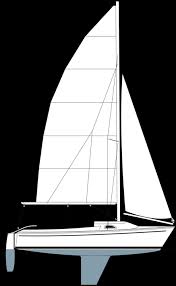
Adaptive Systems Engineering
The defining aspect of Gary Mull’s Freedom 20 design is its integrated deck hardware and control mechanisms, engineered specifically for sailors with physical, mobility, or visual impairments.
1. Counterweighted Transverse Seating
To assist sailors with limited lower-body mobility or paraplegia who cannot easily cross the cockpit during maneuvers, the boat features two custom transverse seats.
- Pivoting Track System: Mounted on transverse deck tracks, the counterweighted seats swing smoothly from side to side (port coaming to starboard coaming) during tacks and gybes.
- Positional Locking: Mechanical extender bars run from the base of the seats to deck-mounted cleats, allowing crew members to lock the seat firmly in position once positioned on the windward side.
- Safety Restraints: Integrated harnesses secure sailors in the seat during heavy winds or heel angles.
2. Self-Tacking Foresail Assembly
Handling foresail sheets during tacks requires significant, rapid hand-over-hand movement. The Freedom 20 integrates a self-tacking jib-boom mechanism derived from Paralympic 2.4mR class designs.
- When tacking or gybing, the jib-boom pivots automatically across the centerline along a curved deck track.
- This setup removes the need for manual foresail sheet trimming across tacks, enabling single-handed operation or allowing crew members with limited upper-body dexterity to focus on steering or mainsheet adjustment.
3. Tactile and Rebound Steering for Visually Impaired Sailors
The transom-hung rudder assembly incorporates mechanical steering aids designed specifically for visually impaired or blind helmsmen:
- Rebound Bungee Lines: Dual shock-cord (bungee) tension lines attach to either side of the tiller coamings, exerting equal force to pull the rudder back to dead center whenever helm pressure is released.
- Tiller Tabs (Audible Feedback): Small mechanical tabs mounted at the base of the rudder post engage as the rudder passes through the dead-center alignment, producing a distinct physical and audible “click”. This provides immediate sensory confirmation of rudder position without requiring visual feedback.
Historical Disambiguation
When researching Gary Mull’s design, it is necessary to distinguish the Freedom Independence 20 from another vessel sharing a similar name:
- Freedom Independence 20 (Gary Mull, 1999): Built in the US by TPI/Catalina Yachts; features an 8.00-foot beam, an unstayed freestanding carbon rig, fixed lead fin keel (900 lb ballast), and integrated adaptive seating and steering mechanisms.
- Independent 20 (Peter Stevenson, 1978): Built in the UK by Independent Yachts Ltd; features a narrower 6.80-foot beam, a conventional stayed fractional rig, a lighter 2,000-lb displacement, and standard cockpit seating designed as a general pocket cruiser.
Role in Adaptive Sailing Programs
The Freedom Independence 20 remains a foundational platform within adaptive sailing organizations. Because of its high initial stability, room for 3 to 4 crew members, and forgiving handling characteristics, the vessel serves as a transitional bridge for sailors learning basic skills before moving into competitive Paralympic or open classes such as the Sonar or 2.4mR. Gary Mull’s design demonstrates how targeted naval engineering can make helm controls and sail handling accessible without sacrificing competitive performance.