

September 1, 2026
by Stanton Murray
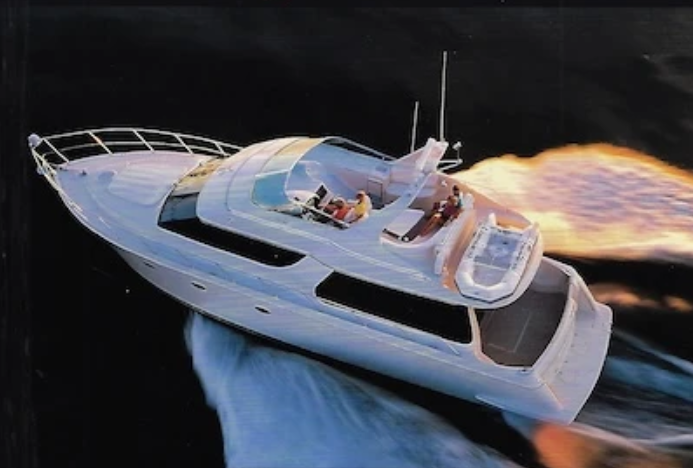
The Carver 530 Voyager Pilothouse served as Carver Yachts’ flagship motor yacht, combining a raised pilothouse design with high-volume interior accommodations.
Technical & Production Specifications
Production Years: 1998 – 2005.
Production Volume: Estimated ~200+ units produced.
Production Facility: Carver Yachts Manufacturing Plant, Pulaski, Wisconsin, USA.
Design Team: Carver Yachts In-House Naval Architecture & Design Team.
Model Evolution:
- 1998: Introduced as Carver’s flagship 53-foot pilothouse.
- 2001: Hull platform extended to create the Carver 570 Voyager Pilothouse. Both 530 & 570 were offered simultaneously.
- 2004: Added Cummins QSM11 common-rail electronic engine option and updated pilothouse window sealing mechanisms.
- 2005: Both the 530 & 570 evolved into the Carver 560 Voyager, featuring an integrated hydraulic platform, revised salon arrangement, and updated electronics.
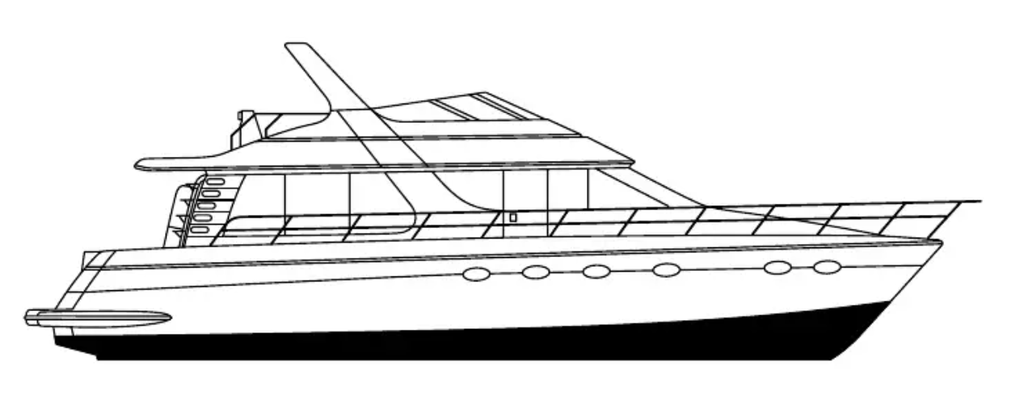
Layout Configurations:
- Standard 3-Stateroom / 2-Head: Full-beam midships master stateroom with queen berth and en-suite head/shower; forward VIP stateroom with queen berth; port guest stateroom with over/under twin bunks.
- Office/Den Conversion: Third stateroom optional factory conversion into a dedicated office/study with built-in desk and storage.
- Crew Quarters Option: Single-berth crew quarters with private head located under the aft cockpit sole.
- Flybridge Configurations: Open flybridge with Bimini top, flybridge hardtop, or factory enclosed Sky Lounge.
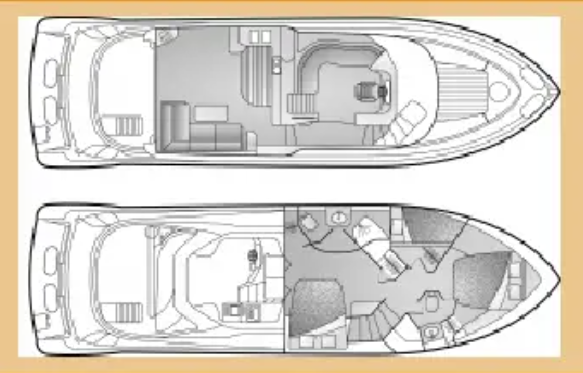
Draft: 4 ft 9 in (1.45 m). (Planing modified-V hull with shallow prop pockets and 13° transom deadrise).
Air Draft: Fixed molded fiberglass radar arch. Bridge clearance with arch: 19 ft 0 in (5.79 m).
Engine Options Offered:
- Twin Cummins 6CTA 8.3L / 450C Turbo Diesels (450 HP each)
- Twin Cummins QSM11 Turbo Diesels (635 HP / 660 HP / 670 HP each)
- Twin Volvo Penta TAMD 73P / TAMD 74P Turbo Diesels (480 HP each)
- Twin Volvo Penta D9 / D12 Turbo Diesels (575 HP – 715 HP each)
Engine Drive Systems: Inboard straight-shaft with V-drive configuration, 2.25-inch stainless steel propeller shafts, bronze struts, manganese-bronze 4-blade propellers, bronze rudders.
Engine Option Comparison
| Engine Model | Horsepower | Key Pros | Key Cons |
| Cummins 6CTA 8.3 / 450C | 2x 450 HP | Mechanical reliability; low maintenance costs; widespread parts availability in North America. | Cruising speed is modest (18–20 knots) when heavily loaded; requires strict 2-year aftercooler servicing. |
| Cummins QSM11 | 2x 635–670 HP | Exceptional power-to-weight ratio; strong planing performance (22–25 knots); smooth electronic management. | Dry exhaust manifolds can run hot under heavy loads; higher fuel burn at wide-open throttle. |
| Volvo Penta TAMD 73P / 74P | 2x 480 HP | Smooth mid-range torque; reliable inline-6 mechanical layout. | Replacement parts are significantly costlier than Cummins; fewer qualified mechanics outside major hubs. |
| Volvo Penta D12 | 2x 575–715 HP | Massive torque curve; rapid hole-shot onto plane; smooth electronic control integration. | Heavy engine block; proprietary VODIA diagnostic tools required; expensive turbocharger/aftercooler overhauls. |
Major Equipment Options:
- Side-Power bow and stern thrusters
- Hydraulic swim platform/davit system
- Flybridge davit crane 800–1,000 lb
- Kohler 13.5 kW – 20 kW diesel generator
- 4-zone reverse-cycle air conditioning (up to 52,000 BTU)
- Washer/dryer unit
Market Value Influences & Inspection Critical Points
- Deck Core Moisture: Structural balsa coring in the flybridge deck, hardtop, and stanchion bases is vulnerable to water intrusion if bedded hardware sealant degrades.
- Window & Portlight Leakage: Salon side windows and pilothouse side doors are prone to seal breakdown, resulting in moisture damage to the cherry wood interior paneling and salon sole.
- Engine Exhaust Mixers: Early-year exhaust mixer elbows require inspection for corrosion or weld failures to prevent water back-siphoning into engine cylinders.
- Sanitation System Hoses: Original permeating sanitation hoses degrade over time, requiring replacement to resolve bilge odor issues.
Geographical Influence:
- Freshwater vs. Saltwater: Great Lakes and inland river vessels command a substantial market premium over saltwater-exposed units due to lower hardware oxidation, absence of shaft electrolysis, and preserved heat exchangers.
- Regional Equipment Demands: Pacific Northwest buyers prioritize lower-helm visibility, internal heat systems, and Cummins QSM11 powerplants; Sunbelt buyers prioritize multi-zone air conditioning throughput and Bimini/hardtop shade structures.
Competitive Model Comparison
| Specification | Carver 530 Voyager | Sea Ray 530 Sedan Bridge | Meridian 580 Pilothouse | Ocean Alexander 53 Pilothouse |
| Production Years | 1998–2005 | 1999–2004 | 2003–2008 | 1998–2006 |
| Length Overall (LOA) | 53′ 9″ | 53′ 0″ | 54′ 4″ | 53′ 8″ |
| Beam | 15′ 4″ | 15′ 3″ | 17′ 4″ | 15′ 6″ |
| Draft | 4′ 9″ | 4′ 4″ | 4′ 9″ | 4′ 6″ |
| Displacement | 48,500 lbs | 50,000 lbs | 56,000 lbs | 52,000 lbs |
| Hull Type | Modified-V (13°) | Modified-V (15°) | Modified-V (14°) | Semi-Displacement |
| Standard Power | 2x Cummins 450C | 2x CAT 3196 (660 HP) | 2x Cummins QSM11 | 2x CAT 3208TA / 3196 |
| Cruising Speed | 18–22 knots | 22–24 knots | 20–22 knots | 14–18 knots |