

September 1, 2026
by Stanton Murray
Production Years: 2002–2010
Production Volume: ~100 hulls completed
Production Facility: Raymond, Maine, USA
Design Team: Jim Taylor Yacht Design
Hull Construction: Vacuum-bagged E-glass with Divinycell foam core (Sabre’s first vacuum-bagged hull), inward-turning flange joint bonded with 3M 5200 and capped with teak toerail.
Configuration & Options
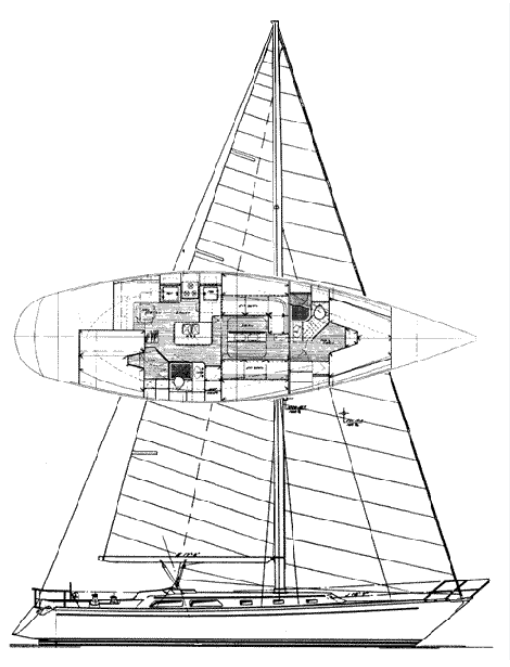
Layout: Two-cabin/single-head owner layout featuring forward master cabin with en-suite head/shower, aft starboard double guest cabin, midship U-shaped galley, full nav station, and central salon with symmetrical settees.
Keel Options:
- Deep Fin Lead Keel: Draft 6 ft 10 in (24,000 lbs displacement / 8,400 lbs ballast)
- Wing / Shoal Lead Keel: Draft 5 ft 2 in (24,500 lbs displacement / 8,650 lbs ballast)
Mast & Rigging Options:
- Standard Triple-Spreader Hall Spars Aluminum Rig (Air draft: ~59 ft)
- Standing Rigging: Continuous Navtec rod rigging
- Optional Hall Spars Carbon Fiber Mast
Engine & Drive:
Drive System: Direct shaft drive through traditional P-bracket and stuffing box
- Standard Engine: Westerbeke 55A / 55B diesel (~55 hp)
- Optional Engine: Yanmar 4JH series diesel (~56 hp)
Major Equipment Options:
- Lewmar electric halyard winches
- carbon-fiber rudder stock
- Generator
- air conditioning
- bow thruster,
- in-mast or slab reefing mainsail configurations.
Model Evolution: Successor to the earlier Sabre 42 and 425 models. Introduced vacuum-bagged resin infusion techniques and Divinycell foam coring to improve structural stiffness while reducing overall weight.
Value-Influencing Factors
- Tight Engine Maintenance Access: Space around the engine compartment—particularly for routine oil changes, filter access, and impeller replacement—is constrained.
- Bilge System Flow Rate: Factory manual bilge pumps have modest capacity, and electric bilge hose plumbing routing can restrict discharge flow during heavy water ingress.
- Lightning Grounding Gauge: Factory bonding wire between chainplates and grounding plate was specified to AWG 6 (minimum ABYC standard), whereas AWG 4 is preferred.
Competitive Market Comparison
| Specification | Sabre 426 | J/42 | Tartan 4100 | Hallberg-Rassy 43 |
| LOA | 42 ft 6 in | 42 ft 3 in | 41 ft 3 in | 43 ft 2 in |
| LWL | 36 ft 0 in | 35 ft 0 in | 35 ft 9 in | 38 ft 6 in |
| Beam | 13 ft 5 in | 12 ft 2 in | 13 ft 6 in | 13 ft 5 in |
| Draft (Deep / Shoal) | 6’10” / 5’2″ | 6’6″ / 5’0″ | 7’0″ / 5’0″ | 6’7″ / 5’3″ |
| Displacement | 24,000 lbs | 18,600 lbs | 20,400 lbs | 28,000 lbs |
| Ballast | 8,400 lbs | 6,800 lbs | 7,600 lbs | 9,900 lbs |
| Hull Core | Divinycell / Vacuum Bag | Balsa / Scrimp | Balsa / Epoxy | Divinycell / Hand-layup |
| Design Focus | Luxury Performance Cruiser | Performance Cruiser | Offshore Cruiser | Bluewater Center Cockpit |
Three distinct evolutionary generations of Sabre’s premier ~42-foot sailing cruisers
The Sabre 42, 425, and 426 represent three distinct evolutionary generations of Sabre’s premier ~42-foot sailing cruisers, transitioning from Roger Hewson’s classic 1980s designs to Jim Taylor’s modern 2000s performance-cruising platform.
| Model | Production | Designer | LOA | LWL | Beam | Displacement | Transom Style |
| Sabre 42 | 1987–1989 | Roger Hewson | 41′ 9″ | 34′ 0″ | 12′ 8″ | ~18,800 lbs | Closed / Traditional |
| Sabre 425 | 1990–1995 | Roger Hewson | 42′ 5″ | 34′ 8″ | 12′ 10″ | ~19,200 lbs | Walk-Through / Raked Step |
| Sabre 426 | 2002–2012 | Jim Taylor / Sabre | 42′ 6″ | 36′ 0″ | 13′ 5″ | ~24,000 lbs | Open Walk-Through |
Sabre 42: The Original Classic
Designed by Sabre founder Roger Hewson, the original 42 established Sabre’s reputation for high-end American production cruisers combining fine entry, moderate displacement, and hand-crafted teak joinery. It features a traditional closed transom, lower freeboard, a keel-stepped mast, and a sea-kindly two-cabin/two-head layout optimized for traditional offshore passage-making.
Sabre 425: Evolutionary Refinement
The 425 is an updated modification of the original 42 hull (a rare model with only ~29 built) created to increase living space and modern boarding convenience. Sabre raised the freeboard by 7 inches at the bow and 3 inches at the stern to improve saloon headroom and reduce deck spray.
Key upgrades include:
- A walk-through reverse transom step for easier dinghy and water access.
- Moving the mast slightly forward to enable mid-boom sheeting, keeping the companionway clear.
- Subtle interior adjustments, including an offset double V-berth option.
Sabre 426: Modern Ground-Up Redesign
Introduced in 2002, the 426 is a clean-sheet design by naval architect Jim Taylor that completely replaced the earlier Hewson hull shapes. It carries a wider beam further aft and extends the waterline length by two full feet, delivering greater hull speed, form stability, and usable cabin volume. The 426 features a higher-aspect tall rig, modern underbody options (deep fin or wing), and modern deck ergonomics while retaining signature Maine craftsmanship.
Core Comparisons
Boarding & Transom: The 42 relies on a fixed closed transom. The 425 adds a transom step, while the 426 incorporates a modern open swim platform layout.
Interior Space: The 425 gains headroom over the 42 via added freeboard. The 426 provides the largest interior overall due to its 13′ 5″ beam and broader aft sections.
Sailing Dynamics: While all three point well and handle blue water, the 426 offers noticeably higher speed potential and stiffer upwind performance due to its modern hull geometry and longer waterline.