


August 30, 2026
by Stanton Murray
Introduction and Portfolio Evolution
The Beneteau Oceanis 37.1 represents the concluding development in Beneteau’s seventh-generation Oceanis series of cruising yachts. Positioned as the successor to the Oceanis 38.1—a mainstay in both private ownership and global charter fleets for nearly a decade—the Oceanis 37.1 incorporates ten years of structural refinement, naval architecture innovation, and interior space optimization. Developed through a collaborative effort between naval architect Marc Lombard and the Italian design firm Nauta Design, the vessel balances ease of short-handed operation with responsive handling and increased interior volume.
As the eighth model launched in the seventh-generation lineup since 2017, the Oceanis 37.1 reflects a broader industry trend toward wider hull beams carried far forward, backstay-less rigs, and alternative propulsion integrations. Designed to meet Category A CE certification for up to 8 persons and Category B/C for up to 10 persons, the vessel caters to coastal cruisers, offshore sailors, and commercial charter operators seeking modern hull dynamics without sacrificing livability.
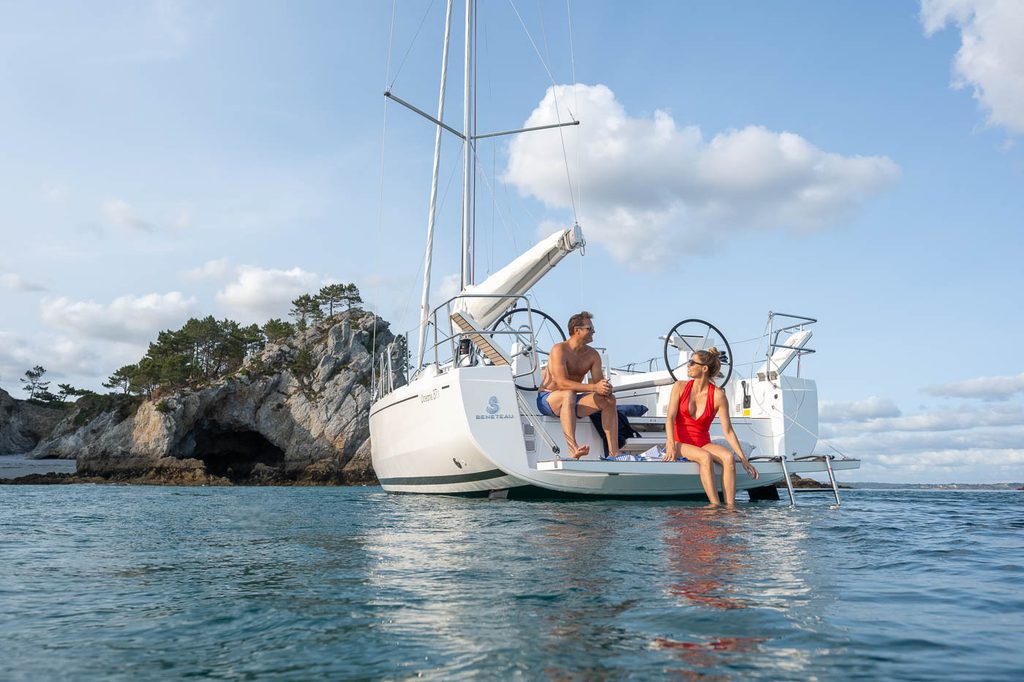
Above photo: Beneteau Oceanis 37.1
| Technical Parameter | Metric Specification | Imperial Specification |
| Length Overall (L.O.A.) | 11.93 m | 39′ 2″ |
| Hull Length | 10.99 m | 36′ 1″ |
| Waterline Length (L.W.L.) | 10.82 m | 35′ 6″ |
| Hull Beam | 3.92 m | 12′ 10″ |
| Light Displacement | 6,864 kg | 15,128 lbs |
| Ballast Weight (Deep Draft) | 1,970 kg | 4,342 lbs |
| Deep Draft | 2.10 m | 6′ 11″ |
| Shallow / Shoal Draft | 1.63 m | 5′ 4″ |
| Air Draft (Bridge Clearance) | 16.60 m | 54′ 6″ |
| Fuel Capacity | 130 L | 34 US Gal |
| Fresh Water Capacity | 355 L | 94 US Gal |
| Standard Engine | Yanmar 3JH40 (40 HP) | Yanmar 3JH40 (40 HP) |
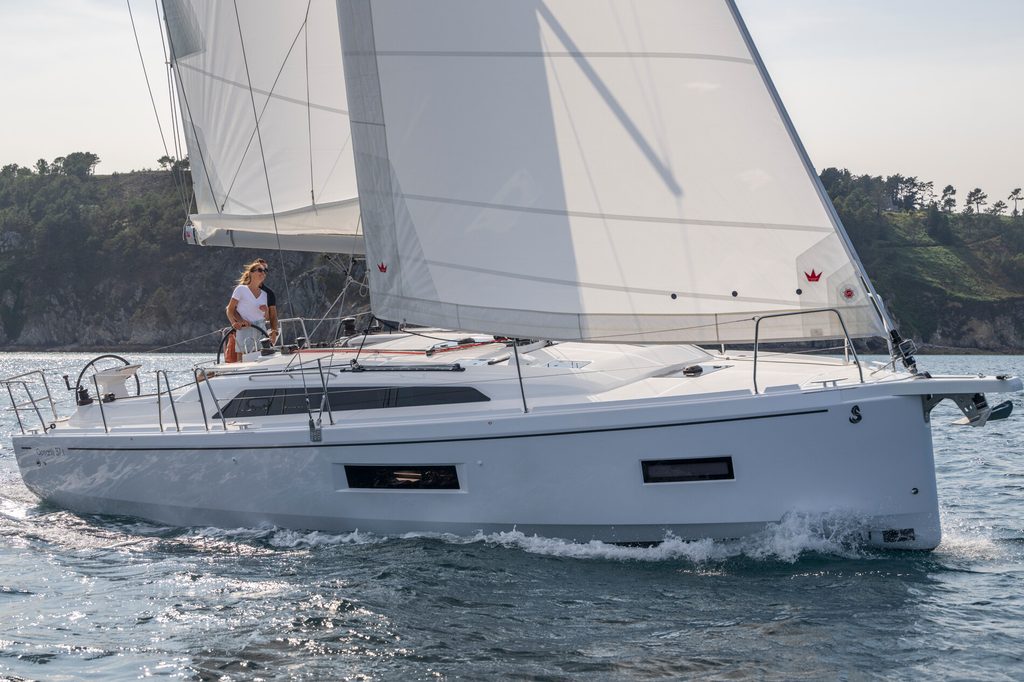
Above photo: Beneteau Oceanis 37.1
Naval Architecture and Hull Dynamics
Hull Geometry and Hydrodynamics
The architectural signature of the Oceanis 37.1 lies in its hull form, designed by Marc Lombard. The design incorporates full-length hull chines complemented by pronounced, muscular bow chines above the static waterline. This hull geometry serves several dual hydrodynamic and structural functions that dictate how the boat moves through varying sea states.
When the boat is sailing upright in light air, the narrow lower hull footprint minimizes wetted surface area, significantly reducing skin friction drag and enhancing performance in light breezes. As wind pressure increases and the vessel heels, the lower hull chines and flared bow sections submerge, rapidly increasing form stability. This dampens heel angles beyond moderate limits, creating a powerful righting moment without necessitating an excessively heavy ballast ratio in the keel. Furthermore, flaring the upper topsides via deck-edge bevels expands the internal forepeak volume. This architectural choice enables accommodation options—such as an en-suite forward head or a spacious centerline berth—that were historically unfeasible on a 37-foot monohull.
To visually manage the high topsides required to maintain a continuous 1.93 m (6′ 4″) interior headroom, Nauta Design incorporated deck-edge beveling alongside strategic hull graphics. This approach softens the vessel’s visual profile while maintaining high structural rigidity across the injected fiberglass deck sandwich structure.
Steering and Underbody Configuration
To maintain precise helm control across a range of heel angles, Lombard specified a twin-rudder system driven by twin 800 mm steering wheels. On wide-beam hulls where the beam is carried aft, a single centerline rudder tends to ventilate and lose grip as the boat heels. The twin-rudder arrangement guarantees that the leeward blade stays fully submerged and vertical under load, offering direct steering response and preventing control loss during sudden gusts.
To accommodate different cruising environments, the underbody can be configured with one of two appendage options. The standard deep fin keel draws 2.10 m (6′ 11″) and provides maximum hydrodynamic lift and upwind efficiency. Alternatively, a winged shallow draft keel drawing 1.63 m (5′ 4″) allows access to thin-water regions such as coastal bays and estuaries without compromising basic ballast stability.
Rigging Mechanics, Aerodynamics, and Performance
Rig Architecture and Mechanics
The Oceanis 37.1 utilizes a Z-Spars 9/10ths fractional anodized aluminum deck-stepped mast configured entirely without a backstay. Widespread chainplates provide structural support, linked to spreaders swept aft at roughly 40 degrees.
Eliminating the backstay removes physical obstructions near the helm stations, opening an unimpeded passage between the twin wheels and the folding transom platform. Aerodynamically, the absence of a backstay allows owners to select a high-roach or square-top mainsail in the optional “First Line” performance package, which increases total upwind sail area to 73.50 m².
Mainsail sheet control is managed via a German-style mainsheet system anchored to a companionway bridle rather than a traditional cockpit traveler, routing running rigging back to winches near the helm positions for single-handed management.
| Sail Plan Configuration | Mainsail Area | Headsail Area | Total Upwind Area | Hardware & Trim Features |
| Standard Cruising | 37.00 m² (In-mast furling or slab) | 23.00 m² (Self-tacking jib) | 60.00 m² | Single coachroof winch, self-tacking track, Dacron C-breeze cloth |
| Upwind/Downwind Pack | 37.00 m² (In-mast furling or slab) | 30.00 m² (110% Genoa) | 67.00 m² | Towable genoa tracks, primary winches at helm, bowsprit for Code 0/Asymmetric |
| First Line Performance | 42.50 m² (Square-top) | 31.00 m² (Flatdeck furling genoa) | 73.50 m² | Performance hardware, upgraded running rigging, extended sail area |
Empirical Sea Trial Performance
Sea trials conducted under solid wind conditions of 14 to 16 knots demonstrate the operational capabilities of the hull and rig combinations. When sailing close-hauled using an overlapping genoa, the boat maintains a steady speed of 6.5 knots, which accelerates to 7.5 knots when bearing off slightly. On a tight reach between 60 and 75 degrees apparent wind angle, the vessel reaches speeds approaching 9.0 knots, using its chines to maintain tracking stability. Downwind on a broad reach, working sails sustain speeds between 6.7 and 7.2 knots, with higher speeds achievable when flying an asymmetric spinnaker off the integrated bowsprit.
Auxiliary Power Systems and Environmental Engineering
Diesel Mechanical Systems
Standard auxiliary power is delivered by a Yanmar 3JH40 three-cylinder, direct-injection marine diesel engine producing 40 HP, paired with a Sail Drive or direct shaft installation and a three-blade fixed propeller. Supplied by a 130-liter (34 US gallon) fuel tank, this powertrain yields a motoring cruise speed of roughly 7.0 knots at standard cruising RPM, offering reliable range for offshore transit.
Electric Propulsion Options
For environmentally sensitive coastal waters or inland waterways, Beneteau offers an all-electric auxiliary drive option. This configuration replaces the diesel engine with a 48-Volt Torqeedo Pod 12 kW electric motor powered by a 10 kWh lithium battery bank.
This zero-emission propulsion system provides silent operation and eliminates direct carbon emissions, making it well-suited for calm coastal waters and protected lakes. However, the energy density of the 10 kWh battery bank limits continuous motoring range compared to the standard 130-liter diesel capacity. As a result, electric propulsion is primarily geared toward short harbor maneuvers and inland cruising, whereas the 40 HP Yanmar diesel remains the preferred installation for extended offshore passage-making.
Sustainable Decking Alternatives
In response to teak conservation concerns, Beneteau utilizes an engineered wood alternative named Iro-Deck for cockpit flooring and seating surfaces. Constructed from sustainably harvested Iroko—an African hardwood—using specialized bonding techniques, Iro-Deck offers high resistance to chemical staining, cracking, and splintering under heavy ultraviolet exposure while maintaining a uniform appearance across the deck.
Deck Ergonomics, Cockpit Architecture, and Interior Spatial Planning
Cockpit Ergonomics and Layout
The cockpit architecture balances working lines with guest comfort. Twin steering pedestals are positioned outboard to maximize forward visibility, leaving a wide central walkway through the cockpit. Integrated pedestal consoles accommodate 7-inch Raymarine Axiom chartplotters, autopilot controls, and bow thruster interfaces within reach of the helmsman.
At the stern, a manually operated folding transom opens to reveal a wide swim platform measuring 2.69 m by 0.77 m, matching the transom dimensions found on the larger Oceanis 51.1. This folding platform also provides access to dedicated liferaft storage built into the aft structure. Running rigging, reefing lines, and halyards run aft under protective deck covers to line stoppers and a coachroof winch, while primary mainsheet and headsail lines lead directly to winches positioned next to the helm seats for short-handed management.
Interior Accommodations and Spatial Layouts
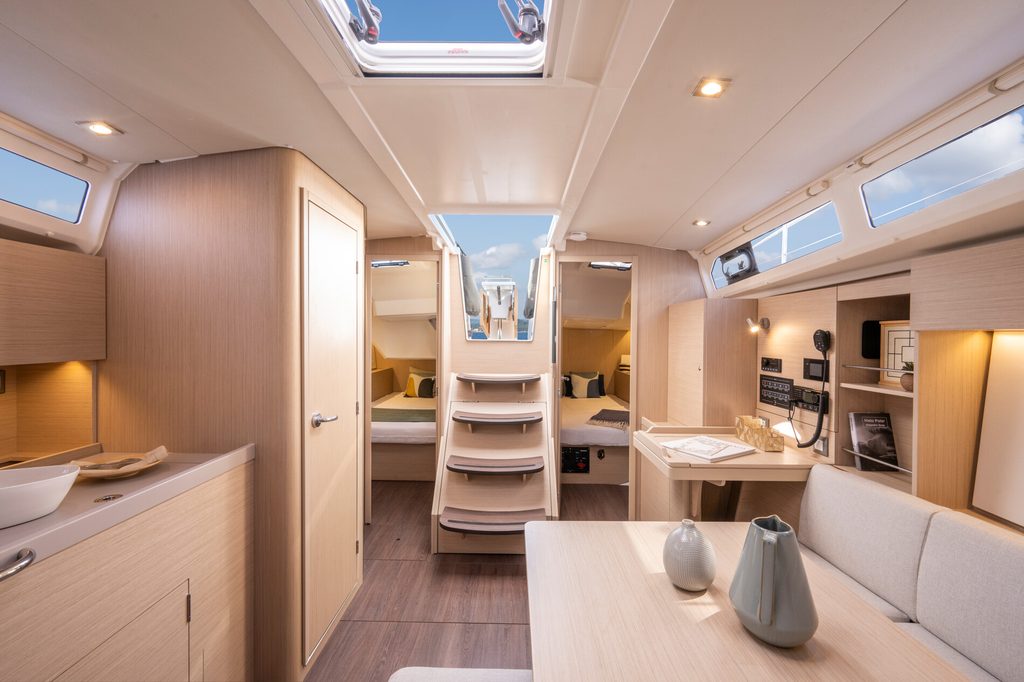
Nauta Design structured the interior accommodations around a central salon featuring 1.93 m (6′ 4″) headroom, illuminated by hull portholes and overhead deck hatches. The layout features a linear galley running along the starboard side, paired with a portside U-shaped dinette that seats six people around a folding dining table. A central bench seat slides beneath the dining table when not in use, maximizing saloon floor space.
The expanded forepeak volume from Marc Lombard’s forward chine design gives the boat three distinct interior layout options, meeting different private ownership and charter demands.
| Layout Version | Forward Cabin Design | Aft Cabin Configuration | Head & Shower Facilities | Primary Target Use Case |
| 2 Cabins / 1 Head | Centerline double berth with panoramic views | Single port aft cabin with king berth; starboard workshop/storage area | Single aft head with dedicated large shower cubicle | Long-distance cruising couples requiring storage capacity |
| 3 Cabins / 1 Head | Centerline double berth with hanging lockers | Symmetrical port and starboard aft double guest cabins | Single aft head with shower accessible from salon | Family cruising requiring maximum guest sleeping capacity |
| 3 Cabins / 2 Heads | Offset diagonal double berth to port | Symmetrical port and starboard aft double guest cabins | En-suite forward head + second aft head with wet locker | Charter operations, multi-couple cruising, and large families |
Telemetry Integration and Commercial Market Analysis
Digital Infrastructure and Telemetry
The Oceanis 37.1 comes standard with Beneteau’s SEANAPPS telemetry system. This integrated hardware package routes real-time onboard system data to a mobile application via cellular and GPS signals. Owners and charter managers can remotely monitor parameters such as GPS positioning, bilge pump activity, battery state-of-charge, shore power connectivity, and maintenance interval tracking. This digital connectivity helps streamline routine servicing and improves fleet oversight for commercial charter managers.
Conclusions
The Beneteau Oceanis 37.1 demonstrates how modern naval architecture can maximize interior space and sailing efficiency in a mid-30-foot footprint. Marc Lombard’s use of full-length bow chines and a twin-rudder design creates a hull that offers strong form stability, smooth helm tracking, and expanded interior volume fore and aft.
Removing the backstay simplifies cockpit movement and allows for the optional performance square-top main, though it introduces minor trade-offs in downwind sail angles and active forestay tuning. Inside, the choice between 2-cabin and 3-cabin layouts—including a 3-cabin, 2-head variant—gives the vessel versatility for private owners, charter fleets, and short-handed sailors alike. Paired with smart telemetry via SEANAPPS and sustainable materials like Iro-Deck, the Oceanis 37.1 stands as a highly practical, modern cruising yacht.
FAQ’s
Question: Is the Beneteau 37.1 grounded for lightning?
Answer: Beneteau builds its yachts to comply with CE and American Boat and Yacht Council (ABYC) safety standards. The Beneteau Oceanis 37.1 features a built-in grounding system designed to mitigate damage from a direct strike:
- The Down-Conductor: Because the Oceanis 37.1 features a deck-stepped aluminum mast, the lightning current travels down the mast section to the deck step. From there, Beneteau installs a heavy, large-gauge copper grounding wire or bonding strap that runs vertically down through the compression post into the bilge.
- The Keel Connection: This heavy cable is securely bolted directly to one of the main structural keel bolts. The massive surface area of the external cast iron keel acts as the primary grounding electrode to discharge the strike safely into the surrounding seawater.
- Standing Rigging Bonding: Heavy bonding wires also typically connect the chainplates (where the stainless steel shrouds meet the hull) down to the keel grounding network. This helps maintain equal electrical potential and reduces the chance of dangerous “side flashes” leaping through the cabin interior.
- The Inline Fuse Protection: Beneteau traditionally incorporates a very large, high-capacity fuse inline on the grounding network. This is a safety feature specifically designed to protect the vessel and crew in case the mast accidentally contacts a low-hanging overhead power cable at a marina or boatyard.
Safety Recommendations for Owners: While the boat is grounded out of the factory, lightning is notoriously unpredictable. To ensure your protection system is fully functional:
- Inspect the Bilge Connections: Lift your cabin floorboards to inspect the keel bolts. Ensure the heavy copper grounding straps are free of corrosion, tight, and treated with a protective marine electrical grease.
- Electronics Vulnerability: The grounding system is meant to protect the hull’s structural integrity (preventing lightning from blowing a hole through the fiberglass to find water). It does not completely shield sensitive NMEA 2000 networks, chartplotters, or masthead VHF antennas, which are still highly susceptible to frying via electromagnetic induction during a nearby or direct strike.
Question: How does the refrigerator (coolbox) drain on the Beneteau Oceanis 37.1?
Answer: On the Beneteau Oceanis 37.1, the refrigerator (coolbox) drains using one of two factory setups, depending on how the vessel’s galley options are configured.
Galley Foot Pump & Diverter Valve (Factory Option)
If the boat is fitted with Beneteau’s optional galley foot pump system, the refrigerator drain is integrated directly into the galley plumbing:
- Selector Valve: A diverter valve located in the cabinet under the galley sink switches the pump’s intake source.
- Pumping Out: Turning the valve to the “Coolbox” setting isolates the foot pump line to the bottom of the refrigerator. Depressing the foot pump draws out condensation or meltwater and discharges it straight into the sink drain, preventing dirty water from sitting in the bilge.
- Seawater Rinsing: Switching the valve back restores the foot pump function to draw raw seawater into the galley sink for dish rinsing.
Direct Bilge Sump Gravity Drain (Standard Setup)
On models without the foot pump package:
- Gravity Run: A flexible hose attached to the bottom fitting of the coolbox runs down beneath the interior floorboards into the central main bilge sump.
- Evacuation: Once water collects in the bilge sump, it is pumped overboard using either the 12V electric bilge pump (activated via the float switch or nav panel switch) or the manual emergency bilge pump in the cockpit.
Interior Drain Plug Management
- Air Seal: Inside the bottom of the coolbox container, a rubber stopper or plug is installed over the drain port.
- Operation: Keep the plug seated during normal refrigeration to prevent cold air from sinking down the drain pipe and causing the compressor to overwork. Unplug it only when clearing out condensation or flushing out the compartment during maintenance.