


September 25, 2025
By: Stanton Murray
Outbound Yachts is one of the most respected semi-custom, purpose-built offshore passage makers imported to North America. Engineered specifically for shorthanded blue-water cruising couples, Outbound bridged the gap between heavy, traditional, slow-moving double-enders and high-volume, lightly built coastal production boats.
Brand Origins & Philosophy
Outbound Yachts was founded in the late 1990s by Phil Lape, an experienced offshore sailor and broker based in the United States. Lape identified an unmet demand in the blue-water market: experienced cruisers wanted the offshore safety, tankage, and seaworthiness of traditional ocean cruisers, but with modern performance under sail and power, ease of shorthanded handling, and a light, functional interior that avoided deep, cavernous “cave-like” layouts.
To realize this concept, Lape teamed up with renowned naval architect Carl Schumacher—celebrated for fast, seaworthy designs that balanced speed, stability, and handling. The resulting design thesis centered on three core tenets:
- Moderate displacement with high righting moment: Quick enough to make consistent 180–200 nautical mile daily runs without beating up the crew.
- Low-center-of-gravity systems: Placing fuel, water, and waste tanks low and centered over the keel to preserve sailing characteristics and ensure open, accessible storage throughout the cabin.
- Ergonomic shorthanded safety: Deep, protected cockpits, sail controls led aft, and a dedicated, stand-up engine room/machinery space accessible without tearing apart the salon.
Construction & Importation to the United States
Rather than building domestically, where labor and overhead would drive pricing out of reach for typical cruising couples, Outbound established exclusive manufacturing partnerships overseas.
- The Yard: Outbound hulls have been constructed primarily at Show Her Offshore Yacht Building Co. in Kaohsiung, Taiwan, a yard known for composite construction and high-grade joinery. Later models also saw strategic construction partnerships with specialized composite yards in China and Taiwan.
- Import & Commissioning: Hulls were shipped via heavy freighter into primary U.S. ports, notably Newport, Rhode Island, Annapolis, Maryland, and San Diego/San Francisco, California. Final commissioning, North American electrical integration (110V/60Hz, ABYC compliance), mast stepping, and personalized commissioning were handled under direct U.S. management.

Models Imported to the United States
Outbound focused on evolutionary refinement rather than frequent, cosmetic model shifts. Each model shares Schumacher’s moderate-displacement hull form, lead fin keel, and balanced spade rudder protected by a partial skeg.
| Model | LOA / LWL | Beam / Draft | Defining Characteristics |
| Outbound 44 | 44’9″ / 40’0″ | 13’6″ / 6’6″(5’6″ shoal) | Original flagship; true ocean passagemaker designed for a 2-person crew. |
| Outbound 46 | 46’4″ / 40’0″ | 13’6″ / 6’6″(5’6″ shoal) | Extended transom iteration of the 44; features an integrated swim platform and aft lazarette. |
| Outbound 52 | 52’8″ / 47’0″ | 15’3″ / 6’6″(7’0″ deep) | Raised/deck salon liveaboard; 3-cabin layouts tailored for world expeditions. |
| Outbound 56 | 56’0″ / 50’0″ | 15’8″ / 6’9″ | Semi-custom flagship; enlarged aft deck, dedicated workshop space, and extended cruising range. |
Outbound 44
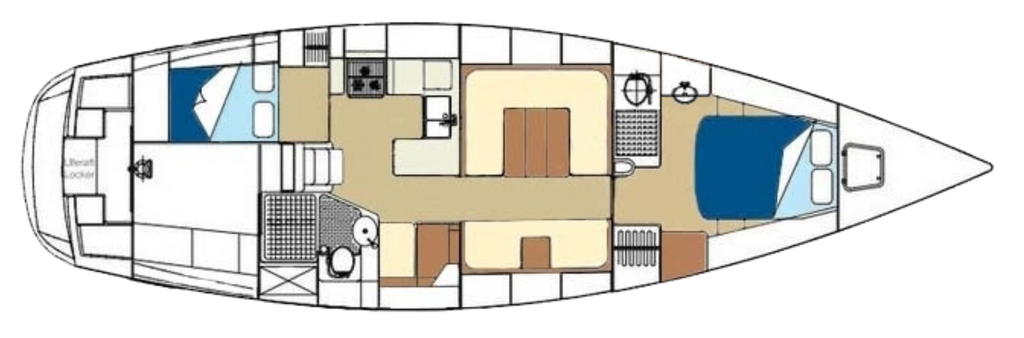
Introduced in the late 1990s and launched in 2000, the Outbound 44 set the standard for the brand. Built with a solid hand-laid fiberglass hull reinforced with Kevlar along the bow stem and forefoot, the 44 featured an integrated 6,500 lb lead ballast bulb, deep bilge, and centralized tankage (carrying 200 gallons of water and 160 gallons of fuel beneath the salon sole). The layout prioritized an aft master cabin or large quarter-berth layout with an offshore navigation station and a secure U-shaped galley.
Outbound 46
The Outbound 46 represents the natural evolution of the 44. Utilizing the proven Schumacher hull mold, Outbound extended the aft section to incorporate a molded-in transom boarding platform, swim ladder, and additional lazarette storage. The 46 rapidly became the company’s most popular hull, frequently cited by Cruising World and Sail Magazine as a benchmark for couples intending to transit the Panama Canal, cross the Pacific, or compete in rallies like the Marion-Bermuda or ARC.
Outbound 52 & 56
To accommodate clients demanding longer-range autonomy and space for visiting guests or professional crew, Outbound introduced the Outbound 52 (and later the extended 56). Designed with a pilothouse/raised salon profile, these larger models provided 360-degree visibility from the salon, walk-in engine rooms, dual-stateroom island berths, and tankage exceeding 300 gallons of fuel and water, enabling multi-month transoceanic expeditions without re-provisioning.
Notable Construction & Design Hallmarks
- Watertight Bulkhead: Forward collision bulkhead located aft of the deep anchor locker and sail locker, isolating the main cabin from forward impact.
- Low-Profile Deckhouse: Maintains sleek aesthetics while allowing large safety-glass ports to flood the interior with natural light, avoiding the high-windage profile of traditional pilothouses.
- Solent / Double-Headsail Rig: Standard configuration utilizing a working jib on an inner stay and a lightweight reacher/genoa forward, providing manageable sail plans across 5 to 45 knots of breeze.
- Machinery Access: Engine, generator, watermaker, and raw-water manifolds are accessible via dedicated walk-in engine spaces or massive hinged access doors rather than cramped companionway stairs.
Market Positioning & Brokerage Perspective
In the North American brokerage marketplace, Outbound vessels occupy the same conversation as Hylas, Hallberg-Rassy, Passport, and Pacific Seacraft.
- Resale Value: Because Outbound maintained tight quality control with fewer than 100 hulls completed across the line, secondary market availability remains low while demand from serious circumnavigators remains consistent.
- Buyer Profile: The brand attracts experienced sailors transitioning away from lighter production catamarans or racing monohulls who seek true Category A ocean-going capability without sacrificing off-the-wind speed.