


September 25, 2026
Murray Yacht Sales
For over half a century, the island of Orust on the rugged west coast of Sweden has served as the heart of blue-water sailboat building. Few yards hold the pedigree, global recognition, and high residual value of Hallberg-Rassy Varvs AB.
Known for their signature blue hull stripe, curved tempered-glass windscreens, solid mahogany joinery, and heavy ocean-going displacement, Hallberg-Rassy yachts have earned an enduring reputation among American cruisers. Whether exploring the coast of Maine, traversing the Intracoastal Waterway, or heading offshore to the Caribbean and South Pacific, they remain the benchmark for short-handed, blue-water passage making.
The Origins: Two Builders on Orust
The foundation of Hallberg-Rassy is a story of craft rivalry turned into an international brand.
- Harry Hallberg founded his boatbuilding shop in Kungsviken in 1943. After starting in wood, he became an early European pioneer of series-built GRP (fiberglass) cruising hulls, creating the popular P-28 (which gained an early American following) and the groundbreaking Olle Enderlein–designed Rasmus 35 in 1967. The Rasmus 35 was among the first production cruising boats to feature a protected center cockpit and a fixed windscreen.
- Christoph Rassy, born in Bavaria and apprenticed in wooden boatbuilding in southern Germany, migrated to Sweden in the 1960s. He established his own yard in Kungsviken—taking over the exact building Hallberg vacated when moving to a larger modern facility down the road in Ellös.
While the two operated independent, competing yards for years, they maintained mutual respect. When Harry Hallberg retired in 1972, Christoph Rassy acquired the Ellös shipyard. Recognizing the global awareness of the “Hallberg” name and the technical reputation of his own yard, Rassy merged the two into Hallberg-Rassy.
The newly merged firm launched its first collaborative design in 1975: the Hallberg-Rassy 41, an Olle Enderlein ketch that pioneered a subterranean walk-through to the aft stateroom and set the layout standard for generations of offshore cruisers.
Design Eras: Enderlein to Frers
1. The Olle Enderlein Era (1970s–1988)
Working with Swedish naval architect Olle Enderlein, Hallberg-Rassy established its foundational design principles:
- Hull & Keel Profile: Heavy displacement, moderate-to-long encapsulated lead keels integrated into deep structural bilge sumps, protected skeg-hung rudders, and pronounced sheer lines.
- Deck Layouts: Dominance of the center-cockpit configuration, providing deep, secure helm positions protected behind aluminum-framed glass windscreens.
- Construction: Solid GRP hull laminates laid up by hand, utilizing isophthalic gelcoats and thick layups designed to withstand groundings and severe North Sea conditions.
2. The Germán Frers Partnership (1988–Present)
In 1988, Christoph Rassy made the pivotal decision to contract Argentine naval architect Germán Frers. Frers introduced modern hull forms, improved hydrodynamic efficiency, and faster passage times while maintaining Hallberg-Rassy’s structural integrity:
- Hydrodynamics: Transitioned to external lead fin keels with low centers of gravity, bulbed profiles, semi-balanced spade and skeg-supported rudders (and later twin rudders), broader stern sections, and longer dynamic waterlines.
- Sail Plans: Introduction of modern fractional and cutter rigs that improved upwind performance without demanding large, unmanageable headsails for short-handed couples.
- The Turning Point: The launch of the Hallberg-Rassy 45 (1988) proved the concept by winning its division in the Atlantic Rally for Cruisers (ARC), heralding a new era of performance cruisers.
Hallberg-Rassy Yachts in the United States
In the North American market, Hallberg-Rassy has consistently occupied the upper echelon of the imported sailing yacht sector. Rather than competing in the bareboat charter market, the brand has focused exclusively on private owner-operators, offshore passage-makers, and circumnavigators.
Import Channels & Commissioning
Hallberg-Rassy yachts arrive in the United States shipped via cargo carriers into major coastal hubs: Annapolis, Maryland; Newport, Rhode Island; Fort Lauderdale, Florida; and Seattle, Washington (long anchored in the Pacific Northwest by regional specialists like Swiftsure Yachts).
Factory vessels destined for the U.S. market are configured at the Ellös yard specifically for North American use:
- Electrical Systems: Dual-frequency or dedicated 120V/60Hz AC electrical systems, USCG-compliant navigation lighting, and ABYC-compliant propane installations.
- Boat Shows & Recognition: A regular fixture at the Annapolis United States Sailboat Show, Hallberg-Rassy has repeatedly captured Cruising World and SAIL Magazine “Import Boat of the Year” honors.
Key Models Imported to the U.S. Market
The Classic Cruisers (Olle Enderlein Designs)
- Rasmus 35 (1967–1978; 760 built): Long keel, center cockpit, fixed windscreen. The design that started the modern center-cockpit movement, with many hulls crossing to the U.S. East Coast.
- Hallberg-Rassy 352 (1978–1991; 802 built): One of the most commercially successful offshore cruisers in European history. Its engine walkthrough, sea-kindly motion, and deep bilge made it a classic for U.S. East Coast and Caribbean sailors.
- Hallberg-Rassy 38 & 382 (1977–1992): Sturdy, ocean-going mid-size cruisers built to handle high-latitude conditions with generous tankage and comfortable sea berths.
- Hallberg-Rassy 42E (1980–1991; 255 built): Designed by Enderlein (often rigged as a ketch), the 42E established the archetype for liveaboard American couples planning trade-wind circumnavigations.
- Hallberg-Rassy 49 (1982–1997; 89 built): An imposing flush-deck flagship built for heavy seas, frequently found in New England and Chesapeake anchorages.
The Aft-Cockpit Performance Cruiser: Hallberg-Rassy 34
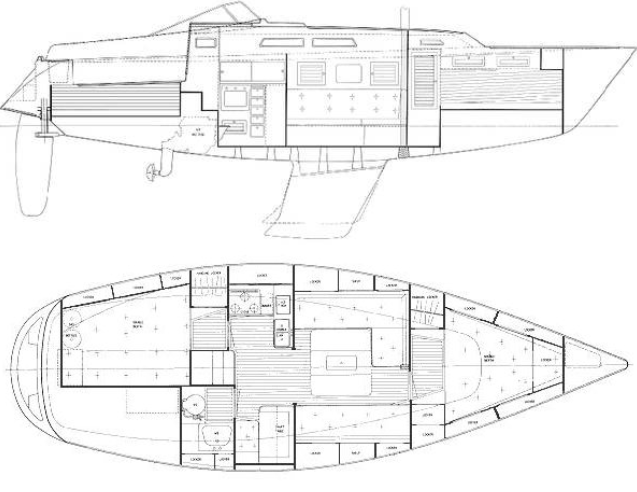
- Hallberg-Rassy 34 (1990–2005; 484 built): Designed by Germán Frers, the HR 34 marked a critical milestone as an agile, fractional-rigged, aft-cockpit design that maintained unlimited Category A ocean certification. Carrying a 39% ballast ratio on a lead bulb fin keel (drawing 6′ 1″, with an optional shallow 5′ 3″ draft), the 34 earned praise from American sailors for its balance, stiff tracking in heavy air, and responsive handling.
- Notable evolution: Early boats (1990–1992) featured a straight galley and longer cockpit; from 1993–1994 onward, the yard shortened the cockpit slightly (to 7′ 4″), shifted the companionway bulkhead aft to enlarge the interior, introduced an integrated transom bathing platform, and standardized the signature windscreen.
The Modern Frers Center-Cockpit Blue-Water Fleet
- Hallberg-Rassy 36 Mk I & Mk II (1989–2003; 602 built): A dominant model on the U.S. brokerage market. The Mk II introduced a wider stern, improved transom swim platform, and expanded aft cabin volume.
- Hallberg-Rassy 40 & 40 Mk II (2002–2018; 168 built): A perennial favorite among U.S. couples; multiple “Boat of the Year” award winner featuring an easily handled cutter or sloop rig and push-button furlers.
- Hallberg-Rassy 42F Mk I & Mk II (1991–2001; 181 built): Germán Frers’ replacement for the Enderlein 42E, incorporating a slippery underbody, external lead keel, and a brighter layout.
- Hallberg-Rassy 43 & 43 Mk II (2001–2016; 199 built): Awarded Cruising World’s “Import Boat of the Year” upon its debut, offering an engine room with walk-around service access and modern joinery.
- Hallberg-Rassy 46 & 53 (1990s–2000s): Powerful, long-range blue-water yachts equipped for trans-oceanic voyages, featuring heavy fuel and water capacity, high bridge-deck clearance, and dedicated generator compartments.
- Hallberg-Rassy 62 (1997–2011; 25 built): The yard’s flagship for over a decade, introducing push-button hydraulic sail controls for single-handed watchkeeping.
Current Generation (Twin Rudders & Wide Sterns)
- Hallberg-Rassy 40C & 44: Contemporary hull geometry featuring plumb bows, integral bowsprits, and twin rudders that maintain rudder bite when heeled.
- Hallberg-Rassy 400 & 340: Modern aft-cockpit twin-wheel alternatives designed for sailors who prefer open-cockpit handling while maintaining Swedish offshore construction standards.
- Hallberg-Rassy 50, 57, and 69: The modern flagships featuring walk-in engine rooms, dinghy garages, hydraulic platform transoms, and central helm push-button sail-handling consoles.
Construction Hallmarks & Technical Analysis
| Construction Detail | Hallberg-Rassy Yard Specification | Broker Note & Practical Benefit |
| Hull Construction | Solid hand-laid GRP laminate below waterline; Divinycell PVC foam core above waterline for insulation. | Structural hull resistance to punctures; foam topsides eliminate condensation sweating in cold waters. |
| Hull-to-Deck Joint | Overlapped and fully laminated together with GRP prior to interior woodwork fitting. | Forms a monocoque structure; eliminates mechanical fasteners and joint leaks common in high-volume production boats. |
| Keel Installation | Deep-draft lead keel secured with large-diameter stainless-steel bolts into reinforced transverse floors. | Absorbs groundings without tearing laminate; external lead absorbs impact energy rather than cracking cast iron. |
| Windscreen & Hardtop | Tempered safety glass set in custom alloy frames with opening center ventilation window. | Provides clear watch visibility in heavy spray without soft plastic hazing; anchors sprayhood and cockpit enclosures securely. |
| Joinery & Fit-Out | European Mahogany or European Oak coated in signature silk-finish two-part varnish. | Cabinetry is tabbed to hull stringers and bulkheads for rigid framing; louvers provide passive interior airflow. |
Yacht Broker Buyer Watchpoints & Due Diligence
When surveying or evaluating a used Hallberg-Rassy for prospective American buyers, brokers and marine surveyors emphasize four primary areas:
- Teak Deck Condition: Traditional Hallberg-Rassy decks through the late 1990s and 2000s were bedded and screw-fastened into the fiberglass sub-deck. Over decades, UV degradation and scrub cleaning wear down the teak grain, exposing screw heads and compromising the black caulk seams. Surveyors must sound the sub-deck for core moisture around deck penetrations (cleats, tracks, and chainplates). Complete re-caulking or replacement with glued synthetic/virgin teak is a common negotiation point on 20+ year-old hulls.
- Auxiliary Power & Saildrive Seals:
- Saildrives (e.g., HR 34, 31, 342): Volvo Penta saildrives reduce engine vibration compared to traditional shafts. However, the rubber hull diaphragm seal requires replacement intervals (recommended every 7 years by Volvo Penta). Ensure maintenance logs reflect haul-out replacements.
- Shaft Drive Alignments: On larger center-cockpit hulls (HR 36, 40, 42, 43), inspect the deep cutless bearings, P-bracket fastenings, and dripless shaft seals during haul-out.
- Mid-1990s Engine Variants & Vibration: Certain early 1990s production runs equipped with Volvo Penta 2003 series engines exhibited harmonic vibration at specific RPM bands. Many owners upgraded to the smoother four-cylinder Volvo Penta MD2030 or D2 series engines during repowers.
- Electrical Conversion & Rigging Ages: European-sourced (grey market) yachts brought into the U.S. without factory 110V/60Hz conversions may still run on European 230V/50Hz systems. Verify whether shore power is stepped via an isolation transformer or fully converted to ABYC standards. Standing rigging on world-cruising models should be inspected via dye penetrant testing or scoped for replacement if past the 10-year age mark.
The Hallberg-Rassy Legacy
Privately owned and family-operated under the leadership of Christoph’s son, Magnus Rassy, the Ellös yard remains an independent institution.
For the American cruising client, purchasing a Hallberg-Rassy is an investment in safety, engineering discipline, and blue-water independence. With comprehensive factory parts support, high historical price stability, and a design philosophy focused on short-handed open-ocean passage making, the brand remains one of the most reliable choices on the international brokerage market.