

September 25, 2026
By: Stanton Murray
I had the pleasure of meeting with Fred Peters, president of Albin Marine, during a factory tour of the Albin manufacturing facility in Portsmouth, Rhode Island. It was the early 1990s, and Albin had taken over the Pearson Yachts facility that I had visited since the 1970’s. The Albin 28 TE, 31 TE, and 35 series models were under construction.
I learned that the secret sauce for both Pearson and Albin was that a significant majority of the fiberglass laminators, assembly workers, and tradespeople at the Portsmouth boatbuilding plants—both during the Pearson Yachts era and the subsequent Albin Marine era—were of Portuguese descent.
The East Bay Boatbuilding Connection – The Bristol County and Newport County areas of Rhode Island (known locally as the East Bay) have a deep-rooted history of Portuguese immigration, predominantly from the Azores. When the fiberglass boatbuilding boom took off in the 1960s and 1970s, local shipyards drew heavily from this community.
- The Workforce Demographics: In plants like Pearson, Albin, Bristol Yachts, and Tillotson-Pearson (TPI), Portuguese-Americans made up the backbone of the shop floor.
- Specialized Skills: They were highly regarded within the marine industry for their exceptional craftsmanship, work ethic, and specialized skill sets in fiberglass lamination, gelcoat application, carpentry, and heavy assembly.
This cultural legacy remains a defining characteristic of Rhode Island’s maritime history, and many families within the East Bay area spent generations building well-known powerboats and sailboats in those exact facilities.
A bonus is the interesting influence of Portuguese and Azorean foods on the Rhode Island food scene.
Albin
Albin Marine holds a unique position in North American yachting history as a premier bridge between Scandinavian naval architecture, Asian shipyard craftsmanship, and rugged American East Coast utility. Best known in the United States for its versatile “Tournament Express” family cruisers, classic trawlers, and seaworthy pocket cruisers, the brand built a decades-long reputation for sea-kindly hulls, fuel efficiency, and uncompromising build quality. I owned an Albin 28 Tournament Express for several years. It was the smallest boat that checked all of the boxes: Diesel, Genset, Air-conditioning, Bow Thruster, Windlass. It was a joy to spend time aboard.
Early Roots in Sweden (1899–1960s)
Albin Marine’s roots trace back to 1899 in Kristinehamn, Sweden, when Albin Larsson founded Albin Motor. Initially dedicated to manufacturing reliable marine diesel and gasoline engines, pumps, and industrial equipment, the company became an integral part of Sweden’s maritime heritage.
By the mid-20th century, Albin Motor expanded into hull production to pair with its renowned internal combustion engines. They gained early international acclaim in the sailboat market, designing iconic fiberglass cruisers such as the Albin Vega 27, Albin Ballad, and Albin Singoalla. These seaworthy, Scandinavian-built pocket cruisers established Albin as a household name among offshore cruisers worldwide.
Crossing the Atlantic & Asian Shipyard Partnerships (1970s)
In the early 1970s, seeing a booming market for diesel-powered trawlers and motor yachts in North America, Albin established a dedicated presence in the United States under Albin Marine.
To meet American demand for spacious displacement and semi-displacement motor yachts, Albin partnered with Asian shipyards (principally in Taiwan). These yards offered exceptional teak woodwork and heavy fiberglass layups at competitive pricing.
- The Albin 36 Trawler: Introduced in 1978, the Albin 36 quickly became one of the most successful Asian-built trawlers imported to the U.S. Featuring classic double-cabin layouts, deep-displacement hulls, and economical Ford Lehman diesels, it established Albin as a premier brand for coastal cruisers and Great Loop navigators.
The U.S. Manufacturing Era: Portsmouth, Rhode Island (1980s–2000s)
By the mid-1980s, market tastes shifted from slow displacement trawlers toward faster, versatile, all-weather express cruisers and down-east fishing vessels. Albin Marine pivoted production directly to the U.S., establishing a manufacturing facility in Portsmouth, Rhode Island, led by industry veteran Fred Peters.
This era marked the birth of Albin’s legendary Tournament Express (TE) series:
- The Albin 27 Pocket Cruiser (1982): A mid-cabin, single-diesel cruiser that revolutionized the small powerboat market by offering stand-up headroom, a separate head, and sleeping for four on a 27-foot hull burning under 2 gallons per hour.
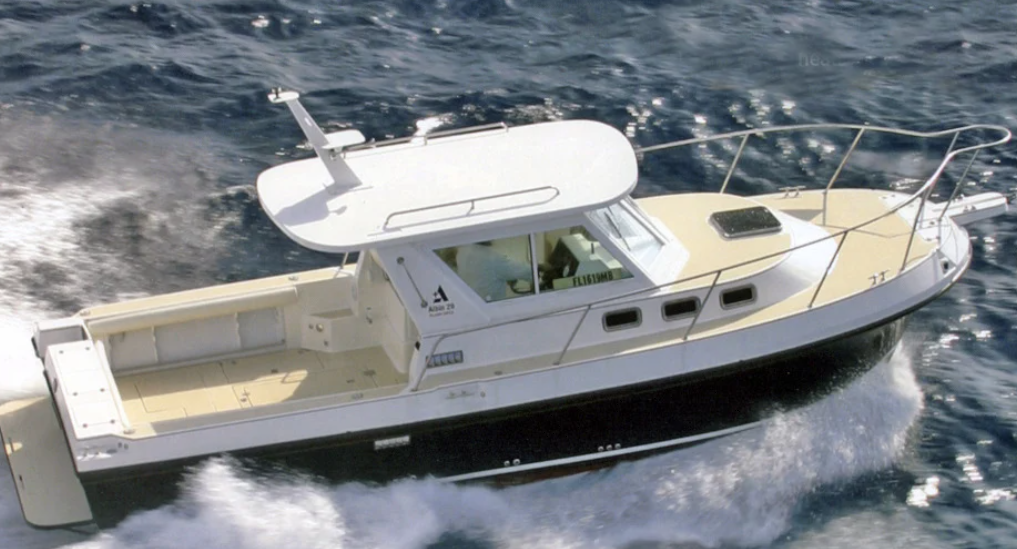
- The Albin 28 Tournament Express (1993): Widely considered one of the most commercially successful 28-foot powerboats in North American history. Designed with a modified-V hull, wide beam, flush deck, and single shaft-drive diesel, over 1,000 units were delivered to anglers and family cruisers.
- Expanded Express Lineup: Building on the 28 TE’s success, Albin introduced 26, 31, 32, 35, and 45-foot variants, offering full enclosure options, engine-box or flush-deck layouts, and unmatched rough-water performance in New England chop.
Final Chapter & Brand Legacy
After the marine industry downturn in the mid-2000s, Albin Marine ceased production at its Rhode Island facility around 2008. C&C Fiberglass Components Inc. later acquired the tooling and molds, though new vessel production under the Albin name ended.
Today, Albin vessels remain highly active in North America’s brokerage market. Thanks to their heavy hand-laid fiberglass hulls, protected propeller skegs, standard shaft-driven diesels, and timeless Down East aesthetics, Albin yachts remain a preferred choice for experienced boaters, anglers, and Great Loop cruisers.
Models Imported & Built for the United States Market
Below is an itemized breakdown of the primary Albin Sailboats, Trawlers, and Power Cruisers distributed across North America:
Sailboats (Scandinavian Built)
- Albin Vega 27: Iconic 27-foot full-keel ocean cruiser.
- Albin Ballad 30: Highly regarded 30-foot cruiser/racer.
- Albin Singoalla 34: Spacious offshore cruising sloop.
- Albin Accent 26 & Cirrus 28: Compact coastal cruisers.
Trawlers & Motor Yachts (Taiwan Shipyard Production)
- Albin 33 Trawler: Single- or twin-diesel trunk cabin cruiser.
- Albin 36 Trawler (1978–1990s): Highly popular double-cabin, flybridge trawler.
- Albin 40 Trawler / 40 Sundeck: Extended aft-cabin motor yacht designed for liveaboards.
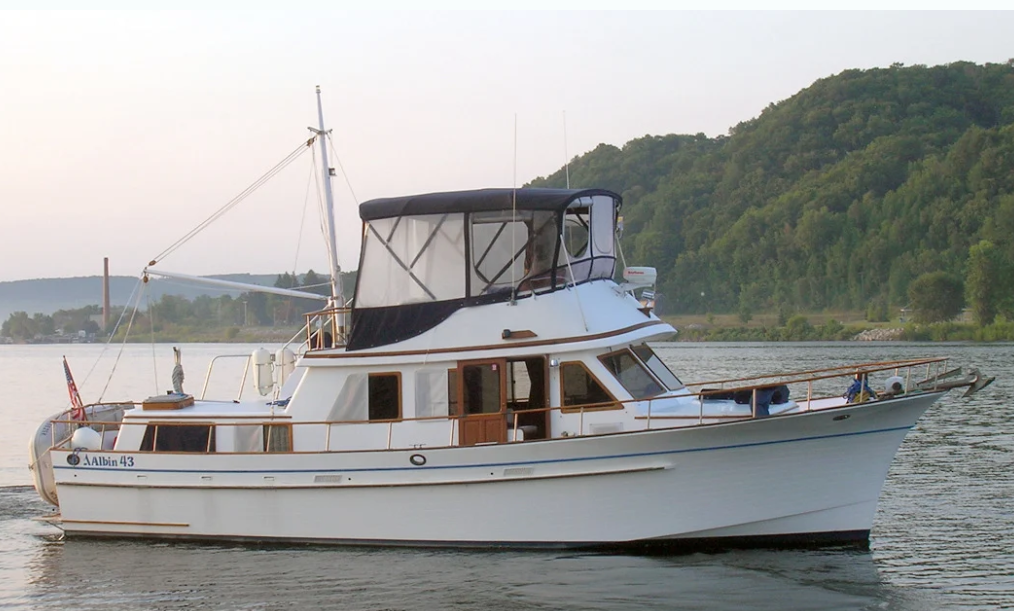
- Albin 43 & 49 Trawler: Flagship dual-engine offshore trawlers.
Express Cruisers & Down East Powerboats (Rhode Island Production)
- Albin 26 Center Console / Express: Compact offshore fishing platform.
- Albin 27 Pocket Cruiser (1982–1992): Classic aft-cabin or open-cockpit single-diesel cruiser.
- Albin 28 Tournament Express (1993–2008): The brand’s top-selling Downeast fishing/cruising boat.
- Albin 31 Command Bridge / Tournament Express: Twin or large single-diesel offshore cruiser.
- Albin 32 + 2 Command Bridge: Innovation featuring a dedicated mid-ship berth and elevated helm.
- Albin 35 Command Bridge / Convertible: Heavyweight offshore fisherman and express cruiser.
- Albin 42 / 45 Commander: Pilothouse motor yachts built for long-range passage-making.