

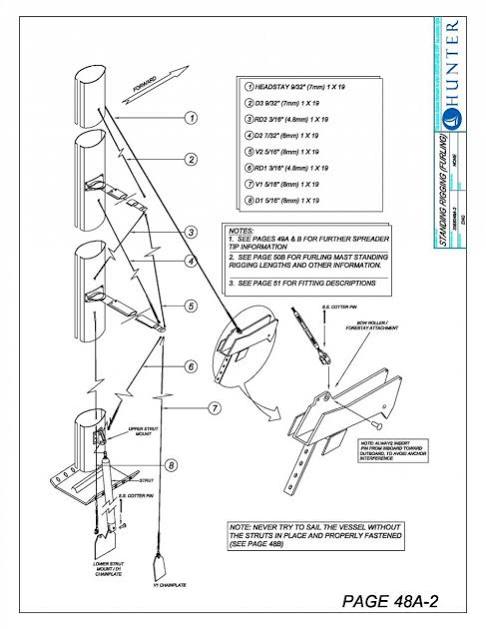
The B&R (Bergstrom & Ridder) fractional rig uses 30-degree swept-back spreaders and a wide-base shroud network to form a tripod-like structural support system, completely eliminating the need for a standing backstay. Popularized primarily by Hunter Marine, it trades downwind sail-easing depth for a massive mainsail roach, simplified deck access, and strong upwind efficiency.
How It Works
- Tripod Geometry: Spreaders swept back at 30 degrees work with wide-set hull chainplates to create a 120-degree structural tripod, managing both lateral and fore-and-aft mast loads without aft wire stays.
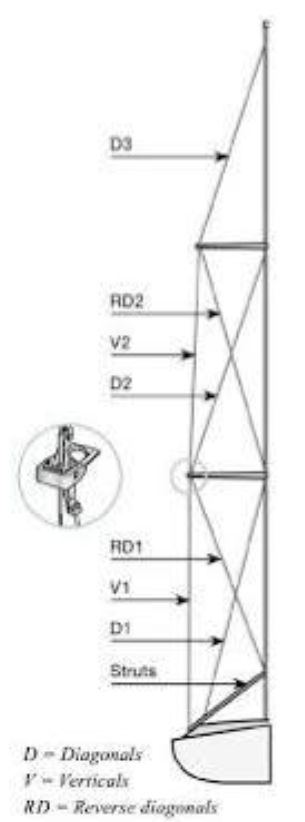
- Pre-Bent Spar Construction: The mast relies on reverse-diagonal shrouds tuned on the ground to induce a permanent pre-bend. This locks the spar into a stiff, dynamic shape before it is stepped onto the deck.
- Lower Struts & Smaller Section: Lower deck struts brace the mast section near the boom, reducing hull point-loading and permitting a smaller, lighter aluminum section higher up to decrease pitching.
Key Advantages
- Full-Roach Mainsail: Lacking a backstay to clear, the rig accommodates an aggressive, high-aspect mainsail with a large roach or square-top head, boosting aerodynamic efficiency.
- Uncluttered Transom: Discarding the backstay opens up cockpit ergonomics, bimini options, stern davits, and walk-through swim platform access.
- Simplified Tacking: Because the main generates most of the boat’s driving power, it pairs with a small, easily managed non-overlapping jib that requires minimal winching effort.
Drawbacks & Limitations
- Restricted Downwind Angles: The 30-degree swept spreaders prevent the boom from being eased out far on a dead run (180°) without severe sail-to-shroud chafe, forcing sailors to tack downwind on broad reaches.
- Fussy Rig Tuning: Tuning requires specific expertise because the shrouds, diagonals, and pre-bend interact in three dimensions. Imbalanced tensioning can distort the mast or cause premature shroud fatigue.
- High Mainsail Loads: Reliance on a large main transfers significant load to the mainsheet, traveler, and reefing systems, making early reefing critical in high winds.
The B&R rig is an exceptional choice for short-handed coastal cruisers who value responsive upwind sailing, easy tacking, and an open stern. Owners just need to ensure the standing rigging is serviced by a rigger who understands the dynamic pre-bend setup.
While developed on custom ocean racers in the 1970s and 1980s, the B&R (Bergstrom & Ridder) fractional rig was most widely popularized through its mass adoption by Hunter Marine across their production fleet.
| Builder / Category | Model(s) | Era / Years | Rig Generation & Key Features |
| Hurley Marine | Tailwind 38 | 1973–1974 | 1st Generation: Earliest production application featuring the initial swept spreader geometry. |
| AB Radab / Torkel | Windex 92, B&R 23 | 1981–1993 | 1st/2nd Gen: European sportboats engineered directly by Lars Bergström and Sven Ridder. |
| Custom Offshore Racers | Thursday’s Child (60′), Route 66 (68′), Hunter’s Child (60′) | 1982–1994 | 2nd & 3rd Gen: High-performance ocean racers utilizing tripod strut bases, carbon/Kevlar construction, and backstayless designs. |
| Hunter Marine (Early Production) | Hunter 31, Hunter 34 | 1982–1987 | First mass-produced coastal cruising sailboats to integrate early B&R rigs into mainstream manufacturing. |
| Hunter Marine (Mid-Era Fleet) | Hunter 29.5, 326, 336, 356, 376, 380, 410, 420 | 1990s–2000s | Standardized backstayless 2nd & 3rd Gen B&R rigs across small to mid-sized aft-cockpit cruisers. |
| Hunter Marine (Center Cockpit) | Passage 42, Passage 450 | 1989–2004 | Extended backstayless B&R geometry to large-displacement offshore center-cockpit models. |
| Marlow-Hunter (Modern Fleet) | Hunter 33, 37, 40, 41, 45, 50 | 2000s– | Standard production format pairing the backstayless B&R rig with Hunter’s trademark stainless steel cockpit arch. |
The Back Story
Lars Bergström and Sven-Olof Ridder were Swedish aeronautical engineers, naval architects, and inventors who revolutionized modern sailing by applying low-speed aerospace aerodynamics and structural engineering to sailboat design.
The Dynamic Partnership
The duo, along with close friend Harald Undén, founded Research and Development AB (RADAB) in 1964. Leveraging wind tunnel testing and dynamic tank facilities at the Royal Institute of Technology (KTH) in Stockholm, they brought aerospace testing methodologies to marine architecture. Their collaboration produced several defining innovations:
- The Windex Wind Vane (1964): Conceptualized by Ridder and co-developed/marketed by Bergström, this ultra-sensitive masthead wind indicator with a sapphire jewel bearing became the universal industry standard mounted atop sailboat masts worldwide.
- The B&R Rig: They developed the tripod-supported, backstayless fractional rig with 30-degree swept spreaders to reduce aerodynamic mast drag, distribute structural loads cleanly across three points, and accommodate high-roach mainsails.
- Rigid Boom Vangs: Pioneered early mechanical rigid vang systems on their test boats, eliminating the need for traditional topping lifts.
- Ultra-Lightweight Performance Boats: Engineered groundbreaking ULDB (ultra-light displacement boat) sportboats like the B&R 23 and Open 60 ocean racers, including Thursday’s Child and Hunter’s Child.
Individual Profiles
- Sven-Olof Ridder: A professor and aerodynamicist at KTH who worked extensively on military aircraft low-speed aerodynamics. Ridder focused on the mathematical and hydrodynamic aspects of their marine designs—developing custom airfoils, swept keels, and testing hull dynamics. He also helped design the Radab Windex 1200 aerobatic motor glider.
- Lars Bergström: An accomplished sailor and naval architect who pioneered early computer-aided design for hull lines and sail plans. After moving to Sarasota, Florida, he led marketing efforts and spearheaded the commercial partnership with Hunter Marine to bring B&R rigs to mass-market production sailboats. Bergström passed away in a light aircraft crash in 1997.