

Architectural Paradigm and Shallow-Draft Philosophy
The Shannon Shoalsailer series represents a pivotal development in modern production yacht design, engineered specifically to resolve the long-standing compromise between shallow-draft accessibility and upwind sailing performance. Developed by Shannon Yachts in Bristol, Rhode Island, under the direction of founder and naval architect Walter Schulz, along with co-designer George Carter, the vessel family was conceived to navigate thin-water environments without sacrificing structural integrity, passenger comfort, or windward capability.
Conventional shallow-draft sailing vessels typically rely on retractable appendages, such as centerboards or daggerboards, to generate the hydrodynamic lift required for sailing close-hauled. While these variable-draft systems allow access to shallow waters when raised, they introduce significant design trade-offs: centerboard trunks intrude into interior living spaces, mechanical lifting mechanisms present maintenance vulnerabilities, and the boards must be fully lowered into deep water to prevent excessive leeway upwind. Similarly, cruising multihulls require deep-draft daggerboards to achieve acceptable upwind angles, thereby negating their shallow-draft advantage when beating in thin water.
The Shoalsailer concept debuted with the introduction of the Shoalsailer 32 in 2001, which emerged after five years of prototype testing driven by clients demanding thin-water capability in regions like the Gulf Coast, New Jersey’s Barnegat Bay, the Florida Keys, the Chesapeake Bay, and the Bahamas. Following the success of the 32-foot platform, Schulz expanded the design into the Shoalsailer 35 in 2004 to provide increased interior volume, enhanced form stability, and higher displacement capacity for extended gunkholing and coastal cruising.
Murray Yacht Sales is connected with the Shoalsailor 32/35
The Murray Yacht Sales Team has assisted its clients in navigating the shoal draft equation for more than 50 Years. From Ted Hood, Ted Irwin & Sparkman & Stephens centerboard designs in the 1970’s to the modern Beneteau hydraulic lifting keel and centerboard series, we have sailed them all. Stanton Murray visited the Shannon Boat Company manufacturing facility in Rhode Island several times throughout the company’s history. In 2015, the company transitioned away from full-scale production-line manufacturing to technology development, engineering innovations, patent design, and brokerage services, while remaining based at its historical Bristol location. Walter Schulz’s eyes would light up when discussing the Shoalsailors. Our Team has sailed and sold several Shannon Shoalsailors over the years.
“To my eye, the Shoalsailor has always stood out as a good-looking boat with a clear purpose. Our clients who own them are in a happy place, usually in a shallow anchorage. The Shannon Shoalsailor was designed by Walter Schulz to be “The Only Boat that Sails in 3′ of Water”. Shannon Boat Company started building Yachts in Bristol, RI, in 1975. I have found memories of my first visit to Shannon and my meetings with founder Walt Schulz. Walt is a character in the best tradition of boat designer characters. According to Ferenc Mate in The World’s Best Sailboats, Vol. II, “Walter Schulz is the last of a wonderful breed- the complete boatbuilder. He designs boats … and then builds(them) – always interesting and invariably one of the world’s best yachts.” Most of Walt’s designs are narrow, deep draft, traditional yachts that most of us think about when we discuss the Shannon brand. The Shoalsailor 35 shows Walt’s genius and his flexibility in boat design. He was passionate about a 35′ boat that had a 3′ draft and 9″ more beam than his Shannon 39′.” -Stanton Murray (President, Murray Yacht Sales)
From Shannon’s Website: “The Shoalsailer provides excellent all-around sailing and, most importantly, windward performance in water less than 3 feet deep. While many other monohulls and multihulls claim shoal draft sailing, they all require lowering deep centerboards or daggerboards in order to actually sail in any direction except downwind. The Shoalsailer does not have, nor does it need, a centerboard or daggerboards. Even when compared to a deep draft monohull of similar size, …the Shoalsailer is a very safe and stable boat. The… 12′ 9″ beam allows the boat to be berthed in conventional marina slips. The hull… is designed, engineered, and constructed to be beached and withstand the rigors of shoal water sailing. The dual rudders swing up, and the propeller is protected by the shallow keel/skeg. The lead ballast in the keel was designed to absorb impact from groundings. The Shoalsailer has a huge, comfortable cockpit and a deck that was designed for ease of movement and relaxation. The trunk cabin features a sun deck for lounging. The… cabin is as spacious as a multihull and offers full 6′-5″ headroom. At Shannon, all interiors are custom-designed to suit each owner’s specific cruising needs. The Shoalsailer is built to the exact same highest quality construction standards as the Shannon offshore line of yachts that has earned an international reputation for safety, performance, and comfort since 1975.”
See the chart below for some centerboard model sailboats popular on the Gulf Coast.
| Centerboard Vessel Model | Designer | Model Years |
|---|---|---|
| Hinckley Bermuda 40 | William H. Tripp Jr. | |
| Tartan 37 | Sparkman & Stephens | |
| Pearson 35 | William Shaw | 1960’s – 1980’s |
| Kadey-Krogen 38 | Jim Krogen | |
| Beneteau Keel/Centerboard 25′ – 38′ | ||
| Bristol 38 & 41 |
Hydrodynamic Design and Patented Hull Mechanics
The central innovation of the Shoalsailer design is its patented hull geometry, which shifts the burden of generating hydrodynamic lift from deep keel appendages to the hull’s underwater body. Both the 32 and 35 models operate with a fixed, unvarying draft of 30 inches (2.5 feet), allowing them to sail upwind, reach, and run in waters less than three feet deep without adjusting underwater appendages.
The hull form features a fine, V-shaped entry at the bow that flares rapidly into broad, flat midsections. The maximum beam of 12 feet, 9 inches is carried straight aft to a broad, flat transom with virtually no aft taper. Lift is generated through a calculated twist in the hull sections that directs the laminar flow of water along the underbody as the boat heels, establishing an asymmetrical pressure field that resists leeway. To counteract the intense weather helm typically created by wide aft sections, Schulz incorporated a pronounced cutback in the forefoot, balancing the underwater lateral plane and maintaining neutral helm tracking.
Directional stability and structural protection are managed through a specialized multi-appendage configuration rather than a conventional deep keel:
- Radiused Shallow Keel: A long, shallow central keel with a generous soft radius forms the base of the hull, designed to absorb grounding loads when driving the boat onto sandy beaches or shallow flats.
- Integrated Propeller Protection: The single propeller and shafting are fully shielded inside an integrated skeg extension, preventing mechanical damage during bottom contact.
- Twin Kick-Up Rudders: Dual rudders mounted aft provide directional control across the broad beam, automatically swinging upward when an underwater obstruction or flat bottom is encountered.
- Off-Center Bilge Boards: Two short, low-aspect-ratio daggerboards are positioned off-center and raked forward. Crucially, these boards do not extend below the baseline 30-inch draft line when fully deployed. They primarily serve as secondary tracking enhancers when beating upwind in true wind speeds exceeding 18 knots, keeping the vessel’s draft constant under all operating conditions.
Technical Specifications Comparison: Shoalsailer 32 vs. Shoalsailer 35
The hydrostatic profiles of both models balance displacement with high form stability, creating vessels that heel quickly to a modest angle before locking into a powerful righting moment akin to a multihull, while preserving the ultimate positive stability of a ballasted monohull.
| Technical Parameter | Shoalsailer 32 | Shoalsailer 35 | Architectural Context & Implication |
|---|---|---|---|
| Length Overall (LOA) | 32′ 0″ (9.75 m) | 35′ 3″ (10.67 m) | Extended hull platform adding 3′ 3″ of interior volume on the 35. |
| Length Waterline (LWL) | 30′ 0″ (9.14 m) | 32′ 5″ (9.88 m) | Extended waterline maximizing hull speed. |
| Beam (Maximum) | 12′ 9″ (3.89 m) | 12′ 9″ (3.89 m) | Identical broad beam generating high initial form stability. |
| Sailing Draft | 2′ 6″ / 30″ (0.76 m) | 2′ 6″ / 30″ (0.76 m) | Ultra-shoal fixed draft across both models. |
| Displacement | 9,500 lbs (4,309 kg) | 11,500 lbs (5,216 kg) | Added displacement on 35 increases tankage & payload. |
| Ballast Type | Internal Lead | 2,500 lbs (1,134 kg) Internal Lead | Molded lead ballast lowering center of gravity without keel bolts. |
| Displacement/Length (D/L) | 157.0 | 167.1 | Light-to-moderate displacement classification favoring speed under power. |
| Sail Area / Displacement | ~19.0 | 19.2 | High ratio providing light-air sail performance. |
| Total Sail Area | 542 sq. ft. | 570 sq. ft. (52.96 m2) | Distributed across mainsail-driven rig plans. |
| Standard Engine | 38 HP Diesel | 40 HP Diesel (Opt. 100–125 HP) | Auxiliary diesel configuration. |
| Fuel Capacity | 25 Gallons | 94 – 100 Gallons | Significantly expanded range on the 35. |
| Fresh Water Capacity | 60 Gallons | 60 – 100 Gallons | Configured for extended gunkholing autonomy. |
Production Volumes and Hull Identification Records
Understanding the production numbers of the Shoalsailer line requires examining Shannon Yachts’ business model. Shannon operates as a boutique, semi-custom builder in Bristol, Rhode Island, building boats individually to customer specifications rather than mass-producing models on an automated assembly line. Over its 35+ year history, Shannon has launched roughly 250+ total sailing yachts (and nearly 400 total vessels, including powerboats) across its entire product catalog spanning 28 to 53 feet.
Because Shannon builds on a semi-custom basis, production runs for specialized niche models were relatively small:
- Shoalsailer 32 Production: Introduced in 2001, the 32 was built in limited numbers directly for owners requiring ultra-shallow draft capabilities for areas like the Gulf Coast and New Jersey’s Barnegat Bay. Production continued at low single- to double-digit levels through the mid-2000s.
- Shoalsailer 35 Production: Introduced around 2004/2005 as the successor to the 32, the 35 was similarly built to order. Murray Yacht Sales records indicate that nine hulls were built between 2004 and 2009.
Rigging Architecture and Aerodynamic Efficiency
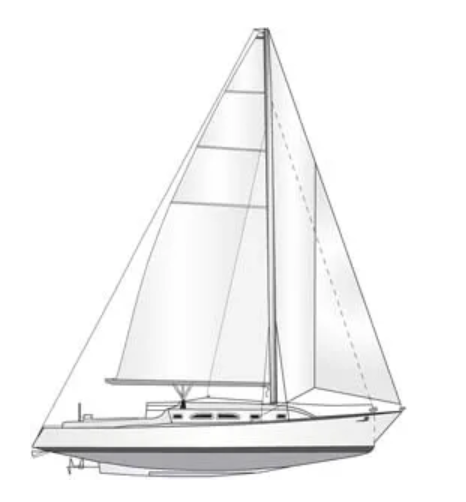
The Shoalsailer 35 was offered with two primary rig plans: a high-performance fractional sloop rig or Shannon’s proprietary “Scutter” rig. The Scutter rig—an amalgamation of the words “sloop” and “cutter”—was developed by Schulz to combine the balance and versatility of a double-headsail cutter with the operational simplicity of a single-headsail sloop.
In the Scutter configuration, the aluminum spar is stepped well forward on the foredeck, yielding a short J measurement of just 10 feet. Consequently, nearly 70 percent of the boat’s waterline length lies aft of the mast partners. This sail plan treats the mainsail as the primary engine of the boat, utilizing a high-roach full-batten mainsail to generate maximum drive.
Foresails are split across two independent roller-furling headstays:
- Inner Headsail: A 125 percent overlapping genoa tacked on the bow stemhead, used as the working sail for light-to-moderate wind conditions upwind and reaching.
- Outer Headsail: A working jib tacked forward on a short bowsprit, deployed when wind speeds increase or when clawing off a lee shore.
This split-foresail arrangement addresses a major dynamic flaw of traditional roller-furling genoas. Partial furling of a single genoa past 30 percent deforms the draft profile, turning the sail into an inefficient foil that increases heeling moment while decreasing windward drive. The Scutter rig allows sailors to douse or roller-furl the genoa completely and switch to the flat-cut outer working jib, maintaining aerodynamic efficiency without requiring deck work in severe weather.
Composite Structural Engineering and Construction Standards
The structural engineering of both Shoalsailer models adheres to Shannon Boat Company’s heavy-duty composite practices. The hull is built as a single-piece, hand-laid composite structure incorporating a linear PVC foam core sandwiched between inner and outer biaxial fiberglass laminates, bonded with high-grade vinylester resin skin coats to eliminate osmotic blistering and finished with NPG isophthalic gelcoat.
Structural loads from the rig, keel, and internal machinery are distributed through a full-length, molded fiberglass grid matrix glassed directly to the hull laminate. Unlike conventional monohulls that rely on cast keels secured via stainless steel keel bolts, the Shoalsailer encapsulates its lead ballast internally within the molded fiberglass hull superstructure. This construction eliminates the potential for keel joint leaks, bolt failure, or structural separation during severe groundings.
Because the vessels were designed for intentional beaching and sandbar groundings, the forward hull sections feature extra fiberglass reinforcement, including a specialized forward crash sole behind the stemhead. The deck is a one-piece cored fiberglass structure mechanically fastened and adhesively bonded to the hull flange on 12-inch centers, capped by an anodized aluminum toerail running the length of the sheer line.
Auxiliary Propulsion and Semi-Displacement High-Speed Hybridization
A defining characteristic of the Shoalsailer design is its ability to blend sailing mechanics with semi-displacement powerboat speeds. The standard propulsion system features a 38 HP to 40 HP Yanmar marine diesel engine providing a conventional displacement cruising speed of 6 to 7 knots. However, on the Shoalsailer 35, Shannon offered an optional “High-Speed Package” that fundamentally alters the vessel’s operational range.
The High-Speed Package upgrades the auxiliary powerplant to a 100-125 HP turbocharged Yanmar diesel (such as the Yanmar 4JH3-DTE or 4JH8-DTE) driving a four-blade bronze propeller through a direct shaft drive protected by the keel skeg. To prevent severe trim elevation and stern squatting when operating under high horsepower, the package incorporates a hydraulically operated trim tab installed directly beneath the transom swim platform.
When deployed at high engine RPMs, the hydraulic trim tab exerts downward hydrodynamic force on the water flow exiting the transom, elevating the stern and flattening the running attitude. This mechanism enables the Shoalsailer 35 to transition into a semi-displacement mode, achieving speeds under power of 10-12+ knots. Paired with an optional bow thruster and dual cockpit helm controls, the High-Speed Package gives the vessel motor-yacht-like maneuverability in tight marinas and the speed to return home quickly against strong coastal tides or approaching squalls.
Ergonomics, Deck Design, and Custom Interior Accommodation
The extension of the 12-foot, 9-inch beam carried aft yields deck space and interior living volume comparable to traditional 40- to 45-foot cruising monohulls.
The cockpit features twin steering stations, each fitted with a 30-inch Edson wheel, dual Morse engine throttle/clutch controls, and dedicated thruster and autopilot interfaces. This dual-helm arrangement creates an open central aisle through the cockpit, allowing unobstructed passage from the companionway to the transom swim platform. Primary self-tailing winches are mounted atop broad cockpit coamings, backed by 3/4-inch marine plywood core inserts, enabling short-handed control directly from the helm positions.
Below deck, both models feature custom joinerwork without standardized structural modules, allowing owners to customize cabinetry, timber selections, and soft goods. Interior finishes ranged from bright Herreshoff-style white laminates with oiled teak trim to classic solid teak or high-gloss varnished cherry.
- Shoalsailer 32 Layout: Features a galley immediately to starboard of the shallow companionway, an enclosed head to port, a main salon with opposing convertible settee berths and dining table, a forward V-berth with hanging lockers, and a transverse double berth tucked beneath the cockpit sole.
- Shoalsailer 35 Layout: Offers 6 feet, 5 inches of headroom across an expanded tri-cabin layout accommodating six passengers. Includes a private forward double V-berth cabin, a main salon with opposing settee berths and drop-leaf dining table, an L-shaped galley equipped with a Force 10 stove and SeaFrost refrigeration, a full head with shower, and a private aft double stateroom.
Secondary Market Context and Valuation
The Shannon Shoalsailer series was positioned as a semi-custom, high-end niche vessel designed for experienced sailors seeking extreme shallow-draft capability without resorting to multihulls. Reflecting its specialized hull mold, complex composite structural grid, and custom interior options, the vessels carried premium initial base prices (~$213,000 USD for the 32 and ~$368,000 USD for the 35).
Because production was limited and tailored to individual order specifications, pre-owned Shoalsailers maintain a stable secondary market presence with low depreciation rates relative to mass-production cruisers. Pre-owned valuations vary primarily based on model year, overall system maintenance, interior woodwork customization, and whether the hull was equipped with the High-Speed Package.
Conclusions and Architectural Legacy
The Shannon Shoalsailer 32 and 35 demonstrate that ultra-shoal draft capability can be achieved in a monohull platform without relying on deep retractable centerboards or compromising interior accommodations. By integrating a patented dynamic-lift hull geometry with the Scutter rig, twin kick-up rudders, and high-horsepower engine options, the design established a distinct category of shallow-water coastal cruisers.
The series provides an effective solution for shallow-water environments, delivering high form stability, reliable tracking, and exceptionally spacious deck plans. Built in small, semi-custom numbers by Shannon Yachts, the Shoalsailers remain a compelling study in naval architecture for coastal sailors who require uncompromised thin-water access, robust composite construction, and versatile performance under both sail and power.