


MURRAY YACHT SALES | Yacht Brokerage & Marine Consulting – Technical Team
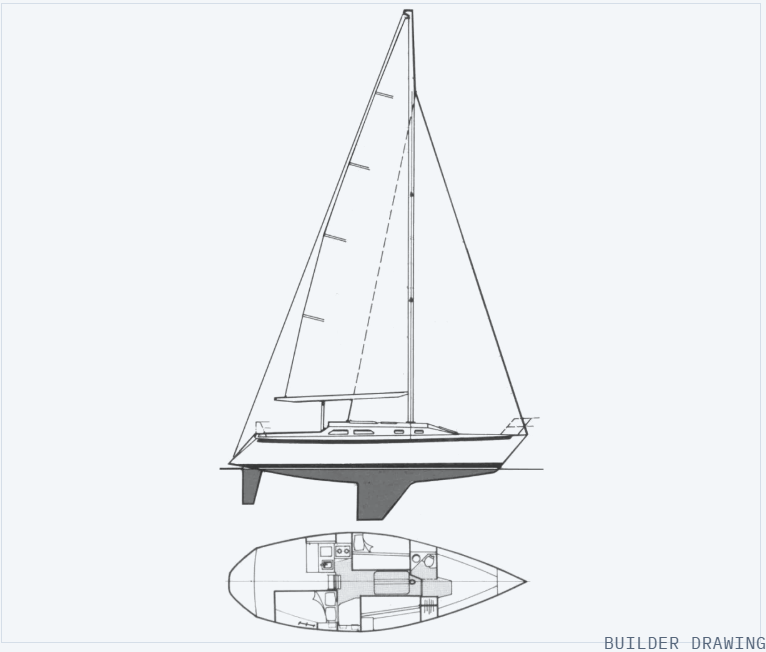
Vessel Model Overview: Ericson 33 (E33RH)
Model Specifications, Production History & Options
| Attribute | Specification / Details |
| Manufacturer | Ericson Yachts, Inc. |
| Model Designation | Ericson 33 (commonly designated E33 or E33RH to distinguish Ron Holland’s hull from Bruce King’s Ericson lineup) |
| Production Years | 1981 – 1984 |
| Production Volume | ~28 hulls produced (low-volume, semi-custom racer/cruiser run) |
| Production Facility | Santa Ana / Irvine, California (Orange County, USA) |
| Design Team | Ron Holland (Naval Architect / Hull & Rig) paired with Ericson Yachts In-House Engineering (Tri-Axial Force Grid structural engineering & interior styling) |
| Hull & Construction | Hand-laid fiberglass hull utilizing Ericson’s structural Tri-Axial Force Grid (TAF) fiberglass floor/stringer system; balsa-cored deck; spade rudder |
| Principal Dimensions | LOA: 33.50 ft (10.21 m) | LWL: 26.83 ft (8.18 m) | Beam: 11.17 ft (3.40 m) | Headroom: 6.12 ft (~6’1″) |
| Displacement & Ballast | Displacement: 9,500 lbs (4,309 kg) | Ballast: 3,950 lbs (1,792 kg) external lead fin (41.58% B/D ratio) |
| Optional Keel(s) & Draft | Standard Deep Fin Keel: 5.92 ft (5’11”) external lead fin (no factory shoal-draft option documented for the E33RH) |
| Optional Mast(s) & Rig | 7/8 Fractional Sloop (Keel-Stepped Aluminum): Standard rig • I: 39.80 ft | J: 12.70 ft | P: 43.30 ft | E: 14.00 ft • 100% Foretriangle Sail Area: ~565–573 sq ft (Mainsail: ~303–312 sq ft; 100% Jib: ~253 sq ft) • Bridge Clearance / Air Draft: ~48.5–50 ft (based on $n $P = 43.3\text{ $ + cabin/freeboard height; no factory tall-rig option) |
| Optional Engine(s) | Universal 5416 / M-25 3-cylinder, fresh-water-cooled marine diesel (16–21 hp) |
| Engine Drive Systems | Direct-drive straight inboard shaft (Hurth mechanical marine gear) with 2-blade folding or fixed propeller |
| Tankage | Fuel: ~30–40 gal (aluminum) | Fresh Water: ~40–43 gal |
| Layout Configurations | Single Standard Racer-Cruiser Layout: Forward V-berth cabin with privacy door and hanging locker; enclosed head to port with vanity/shower; main salon with opposing straight settees (port converts/extends, pilot berths/shelving outboard) and centerline drop-leaf table; L-shaped galley to port at companionway; forward-facing navigation station to starboard leading to a generous quarter-berth aft. (Note: Wheel steering was standard/most common on US cruising-trim deliveries, though tiller steering with emergency tiller provision existed for IOR/PHRF club racing). |
| Optional Major Equipment | • Rigging: Stainless steel wire vs. Navtec discontinuous rod rigging (popular factory/race upgrade) • Deck Hardware: Lewmar / Barient self-tailing primary and halyard winches, adjustable genoa tracks, backstay adjuster (hydraulic or mechanical block-and-tackle) • Galley & Systems: Alcohol or CNG 2-burner gimbaled stove with oven, icebox (refrigeration optional), 110V shore power system, hot/cold pressure water |
| Model Evolution | • Predecessor: Ericson 34T (1978, Bruce King IOR 3/4-Ton design) • Ericson 33 (1981–1984): Ron Holland’s sole design for Ericson—built to modernize Ericson’s club-racing/performance-cruising appeal with a high-aspect 7/8 fractional rig and sleeker underbody • Successors: No “Mk2” of the Holland 33 was built. Ericson returned exclusively to Bruce King designs, introducing the Ericson 32-3 (1985), Ericson 34 / 34-2 (1987, which directly replaced the 33’s market slot), and later the Ericson 333 (1989–1990, a completely different, fuller-bodied Bruce King cruiser with a winged/shoal keel option) |
Market Value Drivers & Technical Due Diligence Factors
| Factor Category | Key Findings & Impact on Market Appeal / Value |
| Scarcity & Pedigree | With only ~28 hulls built and as the only Ron Holland design ever produced by Ericson Yachts, the E33RH occupies a niche collector/enthusiast tier. Unlike mass-market cruisers, buyers actively seek out its 7/8 fractional rig and light-air/upwind speed (PHRF base ~120–129). |
| Common Structural & Mechanical Problems | 1. TAF Grid Secondary Bonds: Ericson’s Tri-Axial Force Grid provides exceptional torsional stiffness, but hard groundings can delaminate the secondary fiberglass tabbing bonding the grid to the hull shell. 2. Deck & Mast-Partner Core Moisture: Balsa-cored decks are prone to moisture intrusion around unbedded stanchion bases, genoa tracks, chainplates, and the keel-stepped mast partner boot. 3. Chainplate & Main Bulkhead Rot: Water ingress at the shroud chainplates can saturate the structural plywood bulkhead where chainplates are through-bolted. 4. Keel-to-Hull Joint (“Ericson Smile”): Oxidation/corrosion of keel bolts or slight flexing at the lead-to-fiberglass stub joint requires inspection. 5. Original Universal Diesel & Wiring: Early 1980s Universal M-25/5416 engines suffer from undersized factory wiring harnesses (glow-plug/ammeter voltage drop), heat exchanger degradation, and aging aluminum fuel tanks. 6. Spade Rudder Bearings: Upper and lower rudder post bushings/bearings wear over 40+ years, creating play at the helm. |
| Geographic Distribution & Vessel Locations | Originally built in Southern California, the surviving fleet is heavily concentrated in California / Pacific Northwest (San Francisco Bay, Southern California, Puget Sound, Columbia River), with smaller active racing/cruising pockets on the Great Lakes (Lake Erie), New England / Chesapeake Bay, and the Texas Gulf Coast. West Coast freshwater/cool-water hulls generally command stronger buyer interest due to lower UV/osmotic blister stress than warm-water Gulf/Florida hulls. |
Competitive Market Comparison Table
| Specification | Ericson 33 (E33RH) | C&C 33-2 (Mk II) | Tartan 33 | J/33 | Sabre 34 (Mk I) |
| Designer | Ron Holland | C&C Design Team (Rob Ball) | Sparkman & Stephens | Rod Johnstone | Roger Hewson |
| Production Years | 1981 – 1984 | 1984 – 1988 | 1979 – 1985 | 1987 – 1991 | 1978 – 1984 |
| LOA | 33.50 ft | 32.58 ft | 33.67 ft | 33.50 ft | 33.67 ft |
| LWL | 26.83 ft | 26.17 ft | 28.83 ft | 27.67 ft | 26.25 ft |
| Beam | 11.17 ft | 10.50 ft | 10.96 ft | 11.00 ft | 10.50 ft |
| Draft (Std / Opt) | 5.92 ft (Fin) | 6.33 ft (Fin) / 4.25 ft (CB) | 4.56 ft (Scheel) / 6.25 ft (Fin) | 6.20 ft (Fin) / 5.00 ft (Shoal) | 5.50 ft (Fin) / 3.92 ft (CB) |
| Displacement | 9,500 lbs | 9,450 lbs | 10,000 lbs | 7,800 lbs | 11,300 lbs |
| Ballast | 3,950 lbs (Lead) | 3,975 lbs (Lead) | 4,400 lbs (Lead) | 3,400 lbs (Lead) | 4,500 lbs (Lead) |
| Rig Type | 7/8 Fractional Sloop | Masthead Sloop | Fractional Sloop | 7/8 Fractional Sloop | Masthead Sloop |
| Sail Area (100% FT) | 573 sq ft | 511 sq ft | 531 sq ft | 563 sq ft | 525 sq ft |
| SA / Disp Ratio | 20.44 | 18.29 | 18.39 | 22.90 | 16.80 |
| Disp / Length Ratio | 219.59 | 235.38 | 186.30 | 164.00 | 279.00 |
| Market Positioning | High-aspect fractional racer/cruiser; rare Holland pedigree | Mainstream masthead racer/cruiser; higher volume (~200 hulls) | Beamier coastal cruiser/racer; popular Scheel keel option | Lighter, stiffer club/offshore racer with basic interior | Heavier, traditional New England performance cruiser |
.