


August 30, 2026
by Stanton Murray
Beneteau 44 CC (Center Cockpit) Design Genesis and Production
The Beneteau Oceanis 44 Center Cockpit, designated commercially as the Oceanis 44 CC, represents a strategic pivot by Groupe Beneteau during the early 1990s to capture the emerging global market for owner-dedicated, mid-displacement bluewater cruising yachts. Introduced in late 1993 for the 1994 model year and sustained in serial production through 2002 at Beneteau’s primary manufacturing complex in Saint-Gilles-Croix-de-Vie, France, the model achieved a total production volume of approximately 150 hulls.
The vessel was conceived as a center-cockpit adaptation of the aft-cockpit Oceanis 440, utilizing the foundational naval architecture of Bruce Farr (Farr Yacht Design) alongside exterior styling and interior joinery executed by French interior architect Armel Briand. While traditional center-cockpit designs of that era were often defined by heavy-displacement double-ended hulls, low prismatic coefficients, and high wetted surface areas, Beneteau adapted Farr’s contemporary IMS-influenced racing hull forms into an extended-range liveaboard platform. The result merged a plumb-radiused bow, broad aft waterplanes, and a low-resistance underbody with the elevated vantage and expansive aft cabin volume inherent to the center-cockpit configuration.
The vessel was targeted directly at cruising couples and liveaboard passage makers seeking separation of living quarters, a dry and secure helm station, and simplified short-handed sail management systems. Unlike the mass-charter versions of Beneteau’s First and standard Oceanis lines, the 44 CC was marketed predominantly to private owners. In the latter half of its production cycle, the vessel received Beneteau’s “Clipper” package, which standardized comprehensive offshore electrical installations, enhanced deck hardware layouts, and upgraded joinery finishes, establishing the model as a benchmark in production center-cockpits.
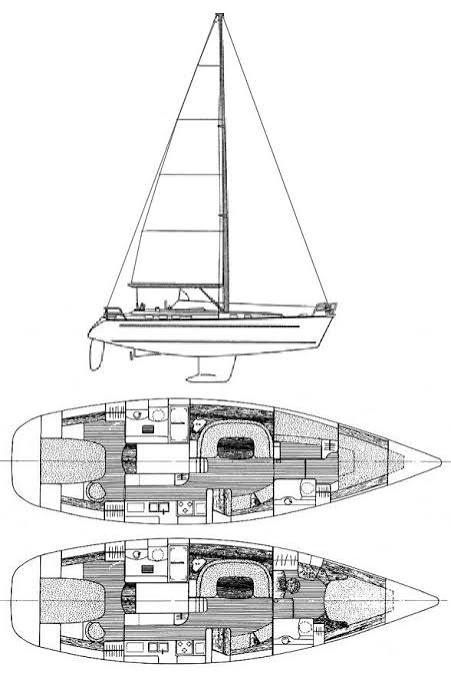
Technical Architecture and Hydrodynamic Specifications
Hydrodynamically, the Oceanis 44 CC balances moderate displacement with low form drag, utilizing an underbody optimized for passage-making velocity across a wide range of reaching and running angles. The hull form carries its 14-foot beam well aft, terminating in a reverse transom equipped with an integrated sugar-scoop swim platform and molded boarding steps. The underwater appendages combine an externally mounted, cast-iron fin keel with a low-slung hydrodynamic bulb, paired with a semi-balanced, high-aspect composite spade rudder.
| Hydrodynamic & Dimensional Parameter | Imperial Measurement |
| Length Overall (LOA) | |
| Length on Waterline (LWL) | |
| Beam Overall | |
| Standard Draft (Bulb Fin Keel) | |
| Optional Deep Fin Keel Draft | |
| Displacement (Light Ship) | |
| Displacement (Full Cruising Trim) | |
| Ballast Weight (Cast Iron Bulb) | |
| Air Draft (Masthead Clearance) | |
| Theoretical Hull Speed | |
| PHRF Base Handicap Rating |
The rig is configured as a masthead sloop with deck-stepped or keel-stepped aluminum spars, two sets of 18-degree aft-swept spreaders, and discontinuous 1 x 19 stainless steel standing wire rigging. The vast majority of production units were delivered with in-mast mainsail furling systems paired with a dedicated Lewmar electric halyard winch situated on the cabin coachroof, providing push-button sail deployment and shortening directly from the cockpit companionway.
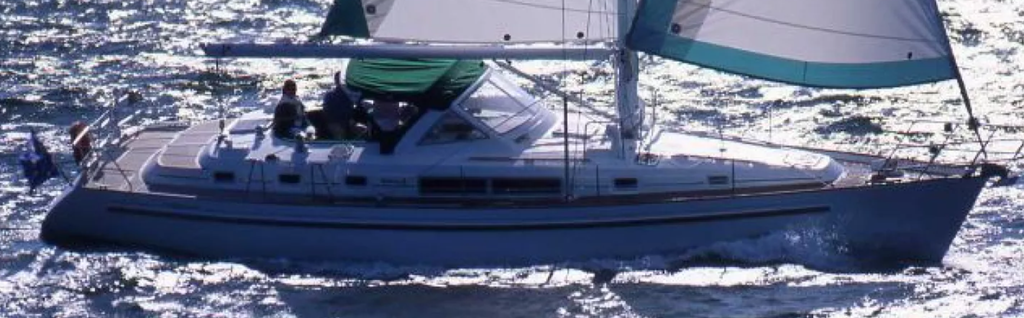
| Rigging & Aerodynamic Parameter | Dimension / Area |
| Fore-triangle Height (I) | |
| Fore-triangle Base (J) | |
| Mainsail Luff (P) | |
| Mainsail Foot (E) | |
| In-Mast Furling Mainsail Area | |
| 140% Furling Genoa Area | |
| Total Upwind Sail Area (100% Triangle) | |
| Total Working Sail Area (Main + Genoa) | |
| Downwind Spinnaker Sail Area |
Hydrodynamic stability and performance calculations place the Oceanis 44 CC squarely in the mid-displacement coastal and offshore cruising band. The calculated Sail Area-to-Displacement ratio (SA/D) is 14.68 based on 100% nominal foretriangle sail area (750 sq/ft), shifting to a moderate 21.49 when evaluating actual working canvas with an overlapping 140% genoa (1,098 sq/ft). The Displacement-to-Length ratio (D/L) of 210.19 under published empty weights (frequently cited around 188 at intermediate load waterlines) highlights a hull of moderate displacement that balances interior carrying capacity against frictional resistance.
The vessel yields a Comfort Ratio of 27.49, reflecting sea-kindly accelerations in chop, while a Capsize Screening Formula score of 1.96 confirms compliance with the internationally recognized transoceanic threshold of 2.00.
Beneteau 44 CC (Center Cockpit) Model Technical Specifications & Options
Interior Designer: Armel Briand
Optional Layout Configurations
• 2-Cabin Layout (Standard Owner Version): Centerline queen berth in forward cabin with vanity; large palatial aft master suite with centerline queen berth, hanging lockers, and ensuite head featuring a hip bath/tub.
• 3-Cabin Layout: Replaces the large forward master berth with two double cabins/V-berth configurations for charter or larger families.
Keel Options & Draft
• Shoal Draft Bulb Keel (Standard): 5’ 9”
• Deep Draft Fin Keel: 6’ 7”
Mast & Rigging Options
• Standard Deck-Stepped Rig: Air draft approx.
• In-Mast Furling System: Standard electric halyard winch setup for internal main furling.
• Classic Slab/Slab Reefing Rig: An optional conventional aluminum mast with full-batten mainsail setup.
Engine Options & Systems
• Primary Factory Diesel Engine: Yanmar 4JH2-HTE / 4JH3-TCE (75 HP to 85 HP).
• Secondary Factory Engine: Volvo Penta TMD22 (78 HP) or Perkins 4.236 (80 HP).
Drive Type: Direct shaft drive with shaft log and P-bracket (P-strut) running to a spade rudder.
Major Factory Equipment Offered
• Electric bow thruster
• Electric anchor windlass with dual cockpit controls
• Dual zone marine air conditioning/heating units
• Generator options (typically Westerbeke or Northern Lights 5–8 kW)
• Teak deck option (cockpit seats and side decks)
• Integrated aft transom swim platform with folding ladder
Model Evolution – Derived directly from the Bruce Farr-designed Beneteau Oceanis 440 (aft-cockpit hull). Adapted into the 44 CC in 1993 with raised deck superstructure and center cockpit deck mold. No distinct Mk2 designation was produced, but late-1990s models saw minor upgrades to interior wood trim and the electrical panel.
Competitive Market Comparison Table
| Feature / Spec | Beneteau Oceanis 44 CC | Jeanneau Sun Odyssey 42 CC | Catalina Morgan 440 | Hunter 430 / 450 CC |
| Production Years | 1993 – 2002 | 1996 – 2001 | 2004 – 2008 | 1995 – 2004 |
| Naval Architect | Bruce Farr | Guy Ribadeau-Dumas | Catalina Design / Morgan | Hunter Design Group |
| LOA | 44 ft 7 in | 42 ft 2 in | 44 ft | 44 ft 3 in |
| Beam | 14′ | 13’5″ | 14’2″ | 14′ |
| Standard Draft | 5’9″ | 6’7″ | 5’4″ | 5′ |
| Displacement | 23,369 lbs | 19,620 lbs | 25,500 lbs | 26,000 lbs |
| Standard Engine | 75 HP Yanmar / Volvo | 50–63 HP Yanmar or Volvo | 75 HP Yanmar | 62–76 HP Yanmar |
| Hull Material | Solid FRP Hull / Cored Deck | Solid FRP Hull / Cored Deck | Solid FRP Bottom / Cored Topsides | Solid FRP Bottom / Cored Deck |
Structural Architecture, Laminates, and Mechanical Systems
The Oceanis 44 CC was engineered around Beneteau’s production manufacturing framework, characterized by a hand-laid solid fiberglass hull shell stiffened via an extensive molded internal liner grid. The outer skin laminate was laid up using high-tensile fiberglass matting saturated with vinylester resin to create a chemical barrier against moisture ingress and prevent osmotic degradation. Subsequent structural laminations transitioned to orthophthalic polyester resin reinforcing directional woven rovings, selected to distribute cyclic loads without adding unnecessary topside mass.
Structural stiffness is provided by Beneteau’s molded structural grid system, which incorporates integrated longitudinal stringers, transverse floor frames, mast-step compression bulkheads, and engine foundations into a single composite molding. Rather than using traditional secondary tabbing laminated with wet fiberglass tape, Beneteau mated this structural grid to the cured hull shell using structural methacrylate adhesives and high-density bonding pastes. This adhesive bonding process distributes torsional and flexural loads across broad surface contact zones, provided the bonding interfaces remain uncompromised by grounding shocks or fatigue. The deck assembly is a composite sandwich utilizing an end-grain balsa core to achieve flexural stiffness while insulating the interior. High-stress deck hardware attachment zones—including sheet tracks, stanchion bases, and the anchor windlass foundation—substitute solid fiberglass laminate with heavy internal backing plates for the core.
The hull-to-deck joint utilizes an inward-turned hull flange upon which the deck molding is bedded in structural elastomeric adhesive, mechanically fastened with stainless steel through-bolts, and capped by an external solid teak rub rail. The ballast keel is a cast-iron hydrodynamic casting, secured to the reinforced floor sections of the structural grid via stainless steel keel bolts fitted with oversized rectangular load-distribution washers. Steering is executed through a wheel-driven quadrant system actuating an internally mounted composite spade rudder with a solid stainless steel rudder stock, rotating in composite sleeve bearings.
Machinery installations centered on marine diesel propulsion, standardizing on either a Volvo Penta TMD22 (78 hp to 85 hp) or a Yanmar 4JH-series four-cylinder turbocharged diesel (75 hp to 85 hp, specifically the 4JH2-DTE or 4JH3-TE). The engine drives an angled stainless steel propeller shaft via an integrated P-bracket strut, turning a fixed or feathering propeller through an oil-bath or water-lubricated dripless shaft seal. Access to the engine space is accommodated directly beneath the companionway stairs via hinged insulated panels, supplemented by secondary side panels opening into the starboard galley corridor and port-side access runs. Fuel is housed in an aluminum tank providing 72 to 95 US Gallons, while freshwater is divided between two or three polyethylene and rotomolded tanks totaling 160 US Gallons positioned down low beneath salon settees and cabin berths.
Accommodation Architecture and Interior Ergonomics
The interior design of the Oceanis 44 CC, styled by Armel Briand, maximizes the substantial internal volume provided by the raised center-cockpit deck profile, delivering a clear separation between the owner’s suite and guest accommodations. The interior joinery is crafted in marine-grade varnished teak and cherry-stained veneers, matched with white composite molded liners to preserve illumination. Cabin headroom measures 6’5” throughout the salon, galley, and aft suite, maintaining comfort for tall crew on long-term deployments.
The yacht enters from the central companionway into an expansive main salon. The starboard side features a large U-shaped dining settee wrapped around a polished dining table, seating six comfortably and converting into an auxiliary double berth when needed. The port side features two swivel barrel armchairs separated by a central storage bureau; the aft chair serves as the seat for the dedicated aft-facing navigation console. This layout positions the primary electrical switchboard, auxiliary breakers, battery monitoring displays, and navigation equipment within reach of the companionway ladder for offshore passage making.
A defining interior feature is the linear galley along the starboard walkthrough corridor leading to the aft stateroom. By placing the galley within this passage, the cook is securely braced between the engine room bulkhead and outboard counters, creating an ergonomic workspace on either tack in adverse sea conditions. The galley features dual deep stainless steel sinks near the vessel’s centerline, a gimbaled three-burner Force 10 or Eno propane stove with oven, top-loading freezer units, and a front-opening 12-volt refrigerator. Deep storage lockers, dedicated dish racks, and pull-out pantry bins line the hull side above the Corian-styled counters. Opposite the companionway to starboard, a full-length, draining wet hanging locker accommodates foul-weather gear before crew steps onto the salon sole.
The owner’s stateroom aft spans the full 14-foot beam beneath the aft coachroof, centering around an island queen berth with split mattress foundations. Settees flank the berth to port and starboard, paired with two lighted cedar-lined hanging lockers, extensive bureau drawers, and vanity mirrors. The private en-suite owner’s head is located along the port side of this stateroom and features an integrated molded hip bath and sit-down shower stall, plus marine head plumbing, vanity sinks, and dedicated linen storage.
| Interior Space / Feature | Two-Cabin Owner Configuration (Standard) | Three-Cabin Multi-Role Configuration |
| Primary Target Market | Long-range cruising couples requiring private luxury berths for owner and guests. | Large families or charter operations requiring expanded individual berth density. |
| Forward Cabin Arrangement | Centerline island queen berth with en-suite vanity desk, reading chair, and dressing bureaus. | Conventional forward V-berth cabin supplemented by a dedicated twin-bunk cabin to port. |
| Workshop / Utility Option | Forward cabin functions as a primary VIP suite; lockers used for gear storage. | Port bunk cabin is designed to be easily converted into a dedicated workshop or utility room. |
| Aft Owner’s Stateroom | Full-beam aft suite with centerline queen berth, settee seating, and expansive cabinetry. | Identical full-beam aft owner’s suite retaining the centerline queen berth and hip-bath head. |
| Sanitary Facilities | Two heads: Day/guest head forward to starboard; en-suite master head aft with hip bath to port. | Two heads: Shared forward head serving both guest cabins; private aft head with hip bath. |
| Berth Count & Berthing Capacity | 4-6 (including convertible salon dinette table conversion). | 6-8 (including salon settee conversion). |
Sailing Dynamics and Bluewater Seaworthiness
Under sail, the Oceanis 44 CC reflects the performance pedigree of Bruce Farr’s hull form, exhibiting low resistance and clean wake departure. However, because the yacht carries a dry displacement exceeding 23,000 lbs—typically swelling past 26,000 lbs under full cruising loads—and relies on an in-mast furling mainsail that lacks roach and full battens, the design exhibits noticeable inertia in light airs. In apparent breezes under 10-12 knots, the standard furling mainsail and working genoa provide modest power, requiring either the deployment of a light-air reaching sail (such as an asymmetrical spinnaker or Code Zero) or auxiliary motoring to maintain passages above 5 knots.
Once true wind speeds establish between 14-22 knots, the 44 CC settles into an efficient cruising rhythm, reaching hull speeds of 7.8-8.4 knots with predictable helm balance. On reaches and broad reaches, the yacht displays strong directional stability, tracked by its deep spade rudder and broad waterplane sections aft, which resist excessive yawing in following quartering seas. Close-hauled performance is respectable for a center-cockpit cruiser; the boat points efficiently between 42-44 degree apparent wind angle. When driven hard to windward into steep, short chop, the full forward hull sections produce occasional pounding, leading experienced skippers to fall off 5 degrees to maintain velocity and smooth out the motion.
The center-cockpit deck architecture significantly enhances personal security while underway offshore. Sitting high and forward of the stern, the cockpit remains dry when running before heavy following seas, sheltered by deep coamings, high-clearance dodgers, and broad coachroof shoulders. The helm pedestal provides clean 360-degree lines of sight across the bow and sails, with essential lines led aft through stoppers to coachroof winches within arm’s reach of the companionway.
However, because the cockpit sole is elevated above the vessel’s vertical center of gravity and roll center, angular rolling motion is amplified compared to an aft-cockpit configuration. Movement across the expansive, flat aft coachroof to manage the stern swim platform or inspect davits requires care offshore; cruisers routinely install secondary jacklines and stainless grab rails along this flat deck expanse.
The vessel’s capability as a transoceanic passagemaker has been validated by numerous open-ocean crossings and circumnavigations. A notable example is the private sailing yacht S/V Cajucito, an owner-operated 2001 Beneteau 44 CC, which completed a multi-year global circumnavigation departing Ireland, demonstrating the hull’s ability to manage sustained trade-wind passages and high-latitude offshore systems with high reliability.
Marine Survey Vulnerabilities and Maintenance Profiles
Naval architects, marine surveyors, and prospective buyers inspecting a Beneteau Oceanis 44 CC must evaluate a defined profile of mechanical, structural, and cosmetic wear points characteristic of mid-1990s production construction. While the hull shell is protected against osmosis by its outer vinylester barrier skin, secondary structures, hardware attachments, and mechanical steering links require thorough pre-purchase scrutiny.
| Component / Subsystem | Known Defect / Failure Mode | Inspection & Survey Protocol | Corrective Maintenance Action |
| Hull-to-Grid Adhesive Bonding | Delamination or shearing of structural adhesive fillets between hull pan and hull shell, particularly following hard groundings. | Percussion hammer sounding along transverse floors; visual check of bilge bays for cracked tabbing or white stress crazing. | Grind out failed bonding compound; laminate heavy bi-axial fiberglass tabbing using structural epoxy resin. |
| Quadrant Rudder Stops | Mechanical quadrant stops mounted to non-structural interior joinery; stops tear out under shock loads. | Inspect quadrant foundation during hard-over helm tests; verify stop attachment backing points. | Re-engineer stops onto structural fiberglass bulkheads with through-bolted backing plates. |
| External Teak Rub Rail | Solid teak rail lacks a stainless-steel striker bar, leading to crushing, splitting, and water entry into hull-deck joint. | Visual survey along entire sheer line; moisture check at interior ceiling fasteners. | Repair or scarf broken teak sections; install external 316 stainless-steel hollow-back rub strake. |
| Balsa-Cored Sandwich Deck | Water intrusion through unsealed penetrations (stanchions, deck fills, hatches), causing balsa core rot. | Capacitive moisture meter scanning of foredeck and aft sundeck; acoustic percussion testing. | Unstep hardware; rout out rotten balsa; inject epoxy or lay solid fiberglass inserts before re-bedding. |
| Cast-Iron Keel & Bilge Sump | Surface oxidation and barrier breakdown; crevice corrosion of keel bolts in standing bilge water. | Scrape keel joint to detect weeping; inspect internal bolt nuts and washers for rust and pitting. | Sandblast iron keel; apply 5-coat epoxy barrier system; clean bilge sumps and replace corroded fasteners. |
| Engine Outboard Systems | Restricted physical access to raw-water pumps, heat exchangers, and generators housed beneath cockpit. | Operational thermal checks; visual inspection of coolers, engine mounts, and shaft alignment. | Remove side joinery panels to facilitate raw-water loop acid flush; service heat exchanger bundles. |
The primary structural concern centers on the internal fiberglass grid system. Because this pan carries dynamic rigging loads, the compression forces from the mast, and the moment forces exerted by the cast-iron keel, the integrity of its adhesive bond to the outer hull shell is paramount. If the vessel has experienced a grounding, the impact can shear the methacrylate or polyurethane adhesive bond along the transverse floors adjacent to the keel stub, introducing hidden flex. Surveyors must lift all cabin sole access boards to verify that bonding fillets are intact and check that the mast compression post step has not suffered deflection.
A well-documented engineering vulnerability lies within the steering quadrant stops. Rather than securing the rudder stops to structural bulkheads or dedicated hull grid returns, factory production fastened these aluminum stops into non-structural plywood joinery. Under heavy autopilot correction loads or when backing down against heavy swells, these stops can rip free, risking jamming of the steering quadrant or chain linkage. Corrective refits mandate securing the stops to reinforced composite plates glassed directly into the transom structure.
Additionally, the external solid teak rub rail presents routine maintenance challenges. Because it was installed without a stainless steel or bronze striker strip, ordinary contact with pilings or floating docks splits the wood and breaks the sealant bond, which can allow rainwater to track behind the rail and seep into the hull-to-deck flange fasteners.
Moisture intrusion into the balsa-cored deck sandwich represents another key inspection focus. The expansive, flat surfaces of the aft coachroof and foredeck incorporate numerous penetrations for deck hatches, handrails, lifeline stanchions, and halyard turning blocks. Where factory bedding compounds have cured and degraded under UV exposure, water can wick into the balsa core, yielding localized delamination and soft spots.
In the bilges, the deep, molded keel bolt sumps can collect standing water from shaft packing drips or condensation. If water is allowed to pool around the keel bolt washers, crevice corrosion can develop on the stainless steel fasteners threading into the cast-iron keel, necessitating thread inspection and ultrasonic non-destructive testing during refits.
For sailors operating along the U.S. Gulf Coast, the coastal waters of Florida, and the shallow passages of the Bahamas, the Oceanis 44 CC offers a practical combination of draft, air clearance, and tank capacity. The vessel’s standard draft of 5’9” provides a balance between windward lift and shoal navigation, allowing access to the Gulf Intracoastal Waterway (GICW), the shallow channels of Charlotte Harbor and Tampa Bay, and the shoal routes across the Great Bahama Bank, where deeper-draft yachts face navigational restrictions. Furthermore, the bulb keel profile is well-suited to soft grounding events: if the vessel settles into mud or silt, the rounded bulb releases more easily than wing or deep fin keels with squared trailing tips.
Air draft is another operational asset. The vessel’s mast height above water of <60’ provides clearance beneath many standard 65’ fixed highway bridges spanning the Atlantic and Gulf Intracoastal Waterways, facilitating protected inland passages when open-ocean gales cross the Gulf of Mexico.
The vessel’s factory tank capacities—accommodating 160 US Gallons of potable water and upwards of 75-90 US Gallons of diesel—support extended autonomy along the Exuma Cays or out in the Dry Tortugas without relying on daily watermaker operation. The center cockpit is also easily protected with a full canvas bimini and dodger enclosure with side shade panels, providing shelter against the high solar loads and squall lines typical of subtropical cruising grounds.
Compared to the Jeanneau Sun Odyssey 42 CC, the Beneteau delivers significantly larger salon and aft stateroom volume, supported by an extra 3,700 lbs of displacement and broader beam sections. While the Catalina Morgan 440 offers raised deck-salon views, it commands a price premium and exhibits higher windage.
Against the Hunter 450 CC, which incorporates an overhead stainless steel arch and a backstay-less B&R fractional rig, the Oceanis 44 CC provides a more traditional masthead rig geometry with split backstays and deck-mounted traveler controls, a configuration favored by offshore riggers for its simplicity of inspection and straightforward tuning at sea.
Brokerage Summary and Conclusions
The Beneteau Oceanis 44 Center Cockpit remains an enduring option in the mid-range production cruising yacht category. Bruce Farr’s efficient hull architecture prevents the boat from suffering the sluggish performance often associated with mid-displacement center-cockpit designs, while Armel Briand’s interior provides practical liveaboard accommodations, highlighted by its full-beam aft owner’s suite and protected sea galley.
Prospective buyers must approach potential purchases with an understanding of the vessel’s construction details. The structural hull grid and adhesive bonding system perform well during passage making, but they demand focused marine survey verification to confirm the absence of grounding damage or adhesive delamination. Essential pre-purchase refit planning should include checking quadrant stop mountings, testing balsa-cored deck surfaces for moisture, and budgeting for the replacement of aging mechanical systems.
For liveaboards and cruising couples seeking to operate in the waters of the Gulf Coast, the Bahamas, and the wider Caribbean basin—or preparing for an ocean circuit—the Oceanis 44 CC offers an attractive balance of comfort, interior volume, and offshore capability. When validated by a professional survey that confirms a sound structural grid, a dry deck core, and a well-maintained auxiliary diesel, the yacht represents a compelling and cost-effective entry point into blue water cruising.
FAQ’s
Question:
Answer: