

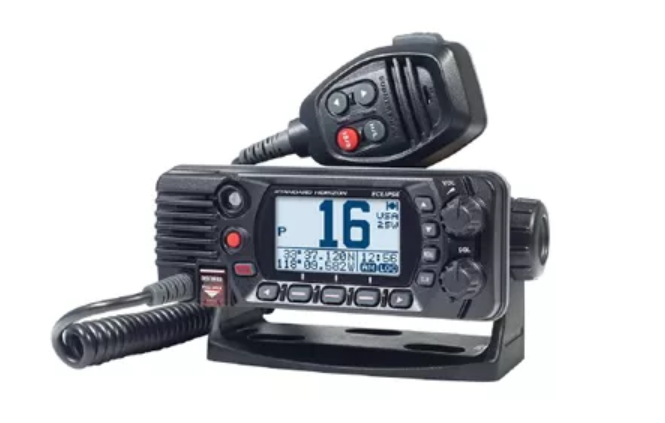
1- Channel 16 is for Distress and Hailing Only
Monitored by the United States Coast Guard, Channel 16 is the universal emergency frequency monitored 24/7 by search-and-rescue agencies and surrounding traffic. You may use Channel 16 (or Channel 9 for recreational craft in many regions) to establish initial contact with another vessel, but you must immediately move the conversation to an open working channel (such as 68, 69, 71, or 72).
A marine VHF (Very High Frequency) radio is one of the most critical safety tools on a boat, outperforming cell phones in range, reliability, and broad-range emergency response capabilities. A VHF radio is capable of broadcasting openly to every vessel and rescue authority within range.
Calling for Help: Securite (Safety Signal); Pan Pan (Urgent Information); MayDay (Distress Signal)
2- VHF Radios are a good source for Weather Information
On a marine or handheld VHF radio, continuous weather broadcasts from NOAA or local maritime agencies are located on dedicated WX channels or high-band VHF frequencies ranging from 162.400 MHz to 162.550 MHz.
Most marine radios feature a dedicated WX key that cycles through weather channels. The active channel in your area depends on your location relative to the nearest transmitter:
- WX1: 162.550 MHz
- WX2: 162.400 MHz
- WX3: 162.475 MHz
- WX4: 162.425 MHz
- WX5: 162.450 MHz
- WX6: 162.500 MHz
- WX7: 162.525 MHz
- WX8–WX10: 161.650 MHz, 161.775 MHz, 163.275 MHz (Used in select regions and Canadian waters)
US Coast Guard Weather Broadcasts – Channel 16 Callouts: The Coast Guard will announce an upcoming weather or safety broadcast on VHF Channel 16 before instructing mariners to switch to Channel 22A/1022 to listen.
VHF Channel 22A (Channel 1022): Transmits routine weather reports, gale warnings, and severe weather advisories on 157.100 MHz.
3- Antenna Height Matters More Than Power Output
VHF radio waves travel via line-of-sight, meaning signal distance is limited by the curvature of the Earth. Fixed-mount radios output 25 watts while handheld units max out around 5 to 6 watts. However, antenna height dictates true range: an antenna mounted high on a sailboat mast will transmit up to 20 miles, whereas a handheld unit at water level reaches only 3 to 5 miles.
4- A DSC enabled VHF needs an MMSI number and GPS connection
What is DSC?
Digital Selective Calling (DSC) is a digital paging standard integrated into modern marine VHF radios that allows boaters to send automated emergency alerts, position data, and direct boat-to-boat calls on a dedicated digital channel (Channel 70).
Key Capabilities
- One-Touch Emergency Distress: Pressing and holding the dedicated red “Distress” button for 3 seconds transmits an automated Mayday signal to the Coast Guard and all nearby vessels. When paired with GPS, it automatically sends your exact GPS coordinates and vessel identification continuously until acknowledged.
- Direct Vessel-to-Vessel Calling: Operates much like a phone number lookup system using a unique 9-digit ID. You can hail a specific boat directly without broadcasting over open voice channels; once accepted, both radios automatically switch to a designated working channel.
- Position Request & Sharing: Permits sharing your exact GPS location with specific “buddy boats” or requesting another vessel’s position, which can display directly as a waypoint on connected chartplotters.
- Group & All-Ships Alerts: Allows targeted transmissions to specific groups (like a fishing tournament fleet) or broadcasting urgent safety announcements (Pan-Pan or Sécurité equivalent) to all nearby vessels.
Setup Requirements
- MMSI Number: A Maritime Mobile Service Identity (MMSI) is a unique 9-digit registration number assigned to your vessel. DSC functionality requires entering this registered number into the radio’s menu.
- GPS Link: The VHF unit must either have an internal GPS receiver or be wired to your boat’s chartplotter/NMEA network to supply active location data.
What is MMSI?
An MMSI (Maritime Mobile Service Identity) is a unique nine-digit identification number assigned to a vessel or coastal radio station, functioning like a digital phone number for marine communications. It is programmed directly into VHF radios equipped with Digital Selective Calling (DSC) and into Automatic Identification System (AIS) transponders.
Key Functions
- Emergency Distress Calling: Pressing the red DSC button on a VHF radio automatically broadcasts your MMSI alongside your GPS coordinates. Search and rescue agencies (such as the Coast Guard) immediately use your MMSI to pull up your boat details, registration, and emergency contacts.
- Direct Radio-to-Radio Calls: You can enter another vessel’s MMSI into your radio to call them directly without hailing them publicly over Channel 16.
- AIS Vessel Tracking: AIS units broadcast your MMSI to nearby vessels, allowing their navigation screens and chartplotters to display your vessel’s identity, speed, and heading.
Structure of an MMSI
An MMSI always consists of nine digits:
- First 3 Digits (MID): The Maritime Identification Digits represent the country of registry (e.g., 366–369 for the United States, 232–235 for the United Kingdom).
- Remaining 6 Digits: A unique sequence assigned to your specific vessel, handheld radio, or shore station.
5- Essential Rules for Radio Owners
- It Belongs to the Boat: An MMSI is tied to the vessel, not the owner. If you sell your boat, the MMSI stays with the ship, and you must transfer the account registration to the buyer.
- One-Time Entry Warning: Most VHF manufacturers only allow an owner to enter an MMSI into the radio’s memory once. If entered incorrectly, the radio typically must be sent back to an authorized dealer or manufacturer to be reset.
- How to Get One: In the U.S., recreational boaters operating strictly in domestic waters can obtain a free MMSI through authorized organizations like BoatUS or Sea Tow. Boaters traveling internationally must register through the FCC to receive an MMSI bundled with an official Ship Station License.
Radio Transmissions Are Public and Regulated
Every broadcast over a VHF radio is public. Etiquette calls for listening to a channel before transmitting to avoid speaking over others. Keep chatter brief, use plain language instead of CB-style slang, and note that profanity and false distress calls carry heavy federal penalties.