

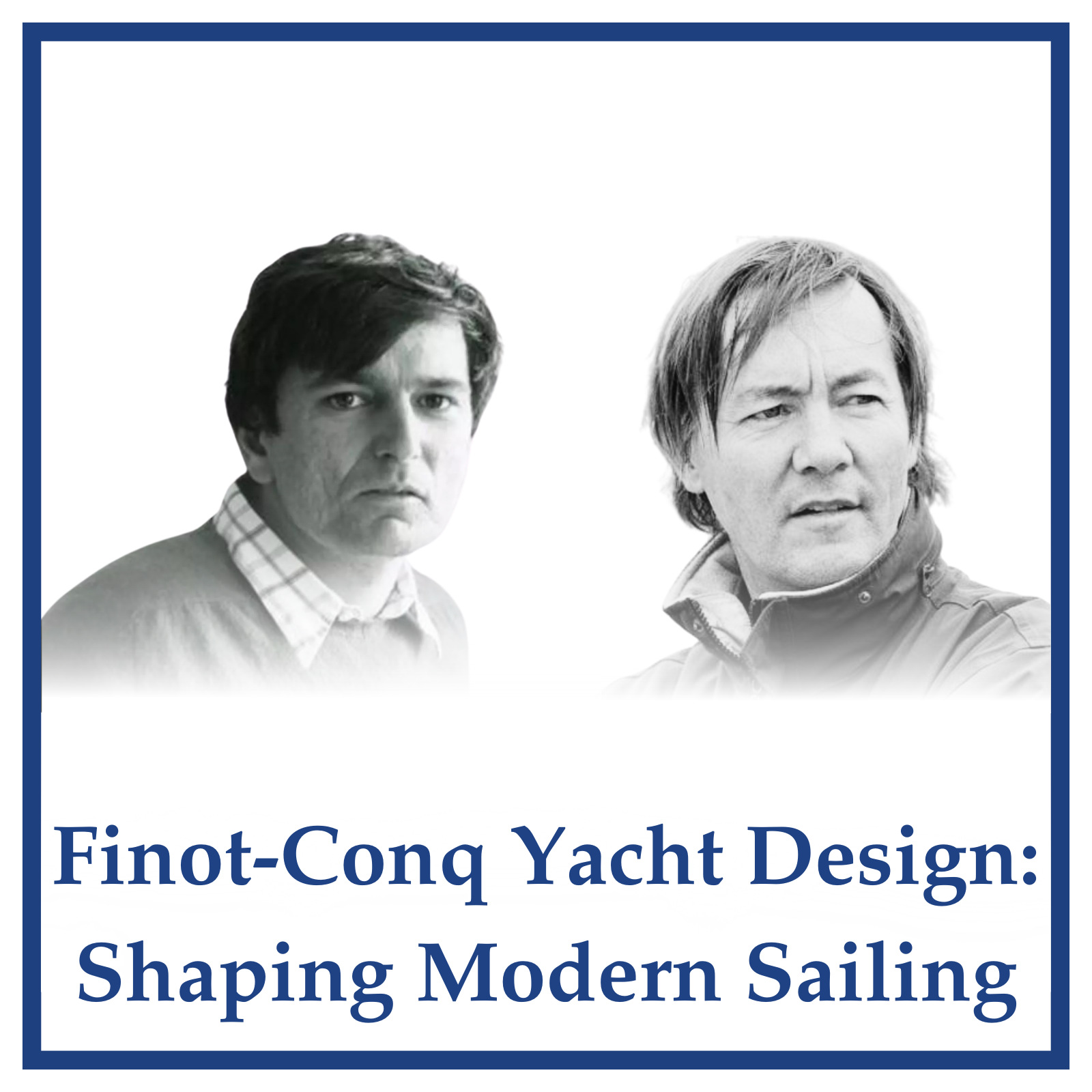
If you have ever stepped aboard a Beneteau Oceanis and thought it felt exactly right, there is a good chance Finot-Conq had something to do with it. The French design partnership of Jean-Marie Finot and Pascal Conq quietly became one of the most influential studios in the history of production sailing, shaping how millions of people experience the water. Their reach spans from small trailerable daysailers that sold in the thousands to sixty-foot IMOCA racers that circled the globe solo, and the same design intelligence connects all of it. Over four decades, they did not just design boats. They moved the entire cruising market forward.
Jean-Marie Finot, born in 1941 in the Vosges region of France, came to naval architecture by instinct. Raised in a region rebuilt after wartime destruction, he was first drawn to architecture of another kind: buildings. Sailing eventually pulled him in a different direction. After training in the studio of designer Philippe Harlé, he opened his own firm in 1969, and the company that became Groupe Finot was underway. The first major signal of what he could do came almost immediately.
The Boat That Started Everything
The Écume de Mer, designed in 1968 and developed with Philippe Harlé, was a quarter-ton IOR racer that immediately stood apart. It won the Quarter Ton Cup in 1970 and again in 1972, then was voted Boat of the Year in France in 1975. More than 5,000 were eventually built, a number that was extraordinary for a design of that era. For a young designer still finding his footing, it was an exceptionally loud opening statement.
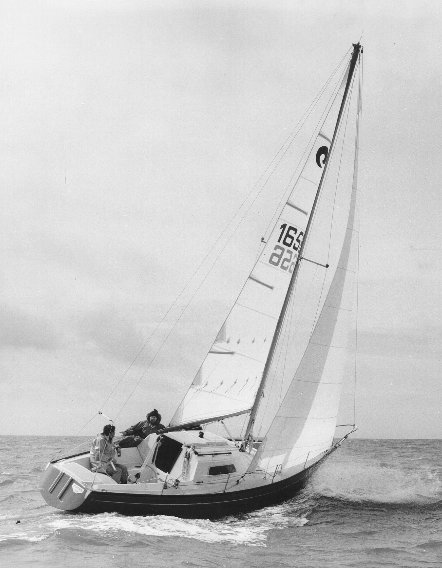
The Écume de Mer established two things that would define Finot’s career. First, he had an eye for hull forms that could be built affordably and perform well at the same time. Second, he understood that popularity and performance were not competing goals. A boat that sailed beautifully and attracted buyers by the thousands was not a compromise; it was the entire point.
Throughout the 1970s and early 1980s, Groupe Finot produced a steady stream of racing and cruising designs. The formula shifted as the market shifted. When IOR racing dominated, Finot designed IOR boats. When production cruisers became the commercial backbone of the French boatbuilding industry, he adapted without losing what made his designs recognizable: speed, balance, and a certain French visual clarity that aged well.
Enter Pascal Conq
Pascal Conq joined Groupe Finot in 1985, and the partnership changed the trajectory of both men’s careers. Where Finot was the firm’s founder and public face, Conq brought a deep technical engagement with offshore racing that pushed the studio’s ambitions further than production cruising alone. He was, by reputation, a quieter figure than Finot, regarded by colleagues as a methodical innovator who did some of his most important work out of the spotlight.
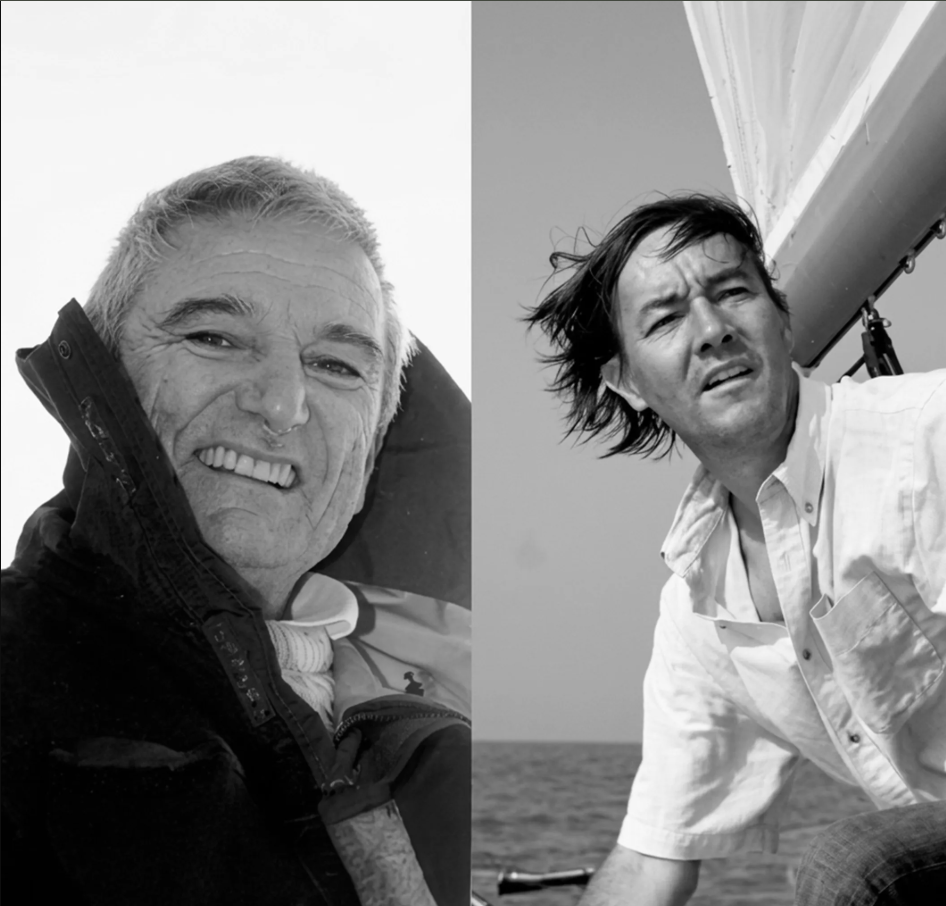
Conq had already been exploring canting keel dynamics in the early 1980s, a line of work that would eventually feed directly into the IMOCA 60 program. His arrival gave the studio a second serious technical voice at precisely the moment when offshore racing was becoming more scientifically demanding. The pair complemented each other in ways that are recognizable in the breadth of their output: one design office producing everything from one of France’s most popular trailerable daysailers to the most technically advanced solo ocean racers in the world.
In 2009, the design side of the operation was formalized as Finot-Conq SARL. The name change cemented what had been true for two decades: this was a genuine partnership, not a founder with a junior associate.
Hear It From Them:
In 1992, François Chalain, Pascal Conq and myself set ourselves the challenge of setting sail with a small yacht: a cockpit for four people, a simple set of sails, a simple space, an elegant boat inside and out that could be trailed and beached. Safety led us to a displacement of over 1,000 kg and retractable ballast, for greater stability. The boat was unsinkable. The search for simplicity guided us towards the integrated coachroof, bringing manoeuvres into the cockpit, and creating good vision to the bow. We searched for sturdiness, the simplicity of a flower at sea, the elegance of a bird.” The response was her success and the love of sailors for their boat.
Jean-Marie Finot
The Beneteau Relationship: Forty Years of Production Sailing
The relationship with Beneteau is the longest and most commercially consequential chapter of the studio’s story. Starting in the late 1970s and running through the present day, Finot and Conq designed 61 boats for Beneteau between 1978 and 2017 alone. The total number of boats built to Finot-Conq plans now exceeds 40,000, and the studio has had a direct hand in shaping multiple generations of both the First and Oceanis lines.
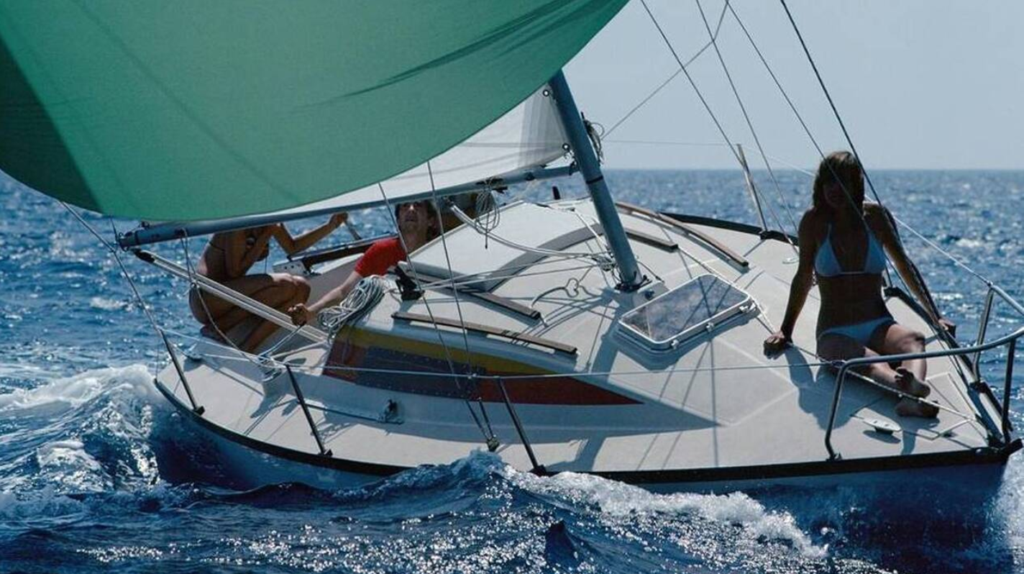
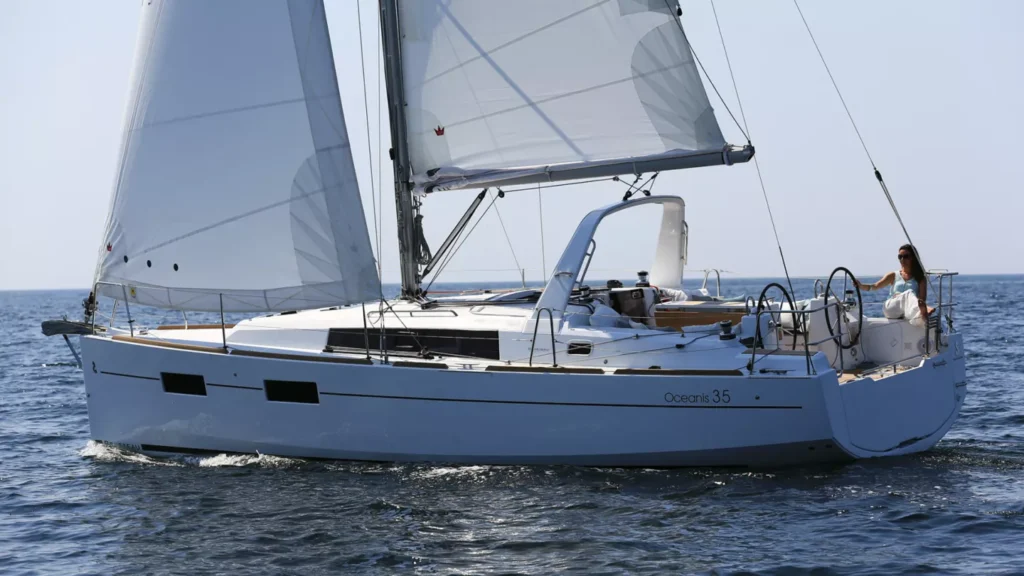
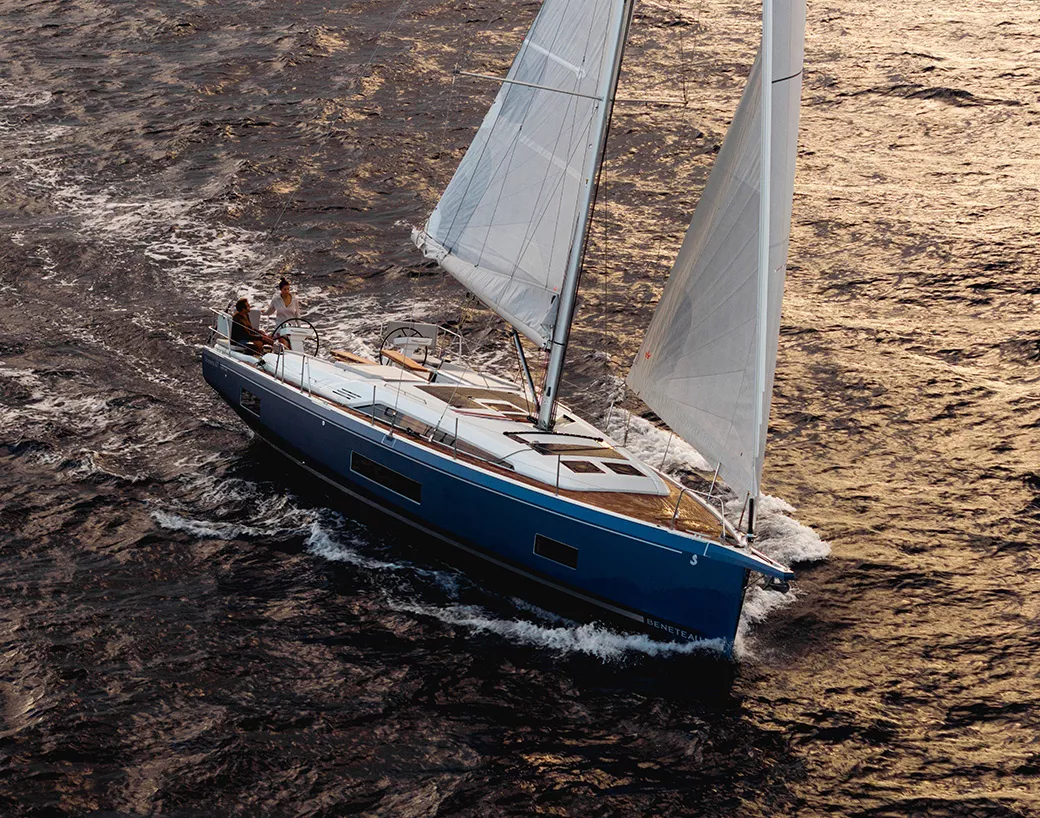
The Figaro Beneteau, the one-design singlehanded racer that became the proving ground for a generation of French offshore sailors, came from the studio. Its hull was so well-conceived that variations of it were used across more than 2,000 production hulls, including the First 310, First 31.7, and several Oceanis cruisers that buyers purchased without knowing they were getting something derived from a race boat. The First 31.7 alone produced around 1,200 hulls, making it one of the best-selling 30-foot performance cruisers ever built.
The First 210, a compact trailerable sloop with a swing keel, went on to sell for 28 years under various names and updates, eventually finding its way into the Guinness Book of Records for production numbers in its category. Nearly 5,000 were built.
In the cruising segment, the Oceanis 331 illustrates what the studio brought to Beneteau’s mainstream production. Built between 1999 and 2005, 822 hulls were completed. It offered two or three cabin configurations, a sensible deck layout, and a hull balance that made it genuinely pleasant to sail rather than merely adequate. It also came in a centerboard variant, giving it access to shoaler waters than a standard fin keel allowed. The 331 was everything a charter-ready, family-ready cruiser needed to be, designed without fuss and trusted enough to be built in Marion, South Carolina as well as in France.
IMOCA 60 and The Vendée Globe
We’ve spoken about the IMOCA 60 several times now, and it warrants explaining a little backstory before we discuss it in further detail. The IMOCA 60 is a class of 60-foot, ultra-fast ocean racing yachts. Governed by the International Monohull Open Class Association (IMOCA), these boats used in grueling solo and double-handed round-the-world races like the Vendée Globe.
Before the arrival of the legendary naval architecture firm Finot-Conq, 60-foot ocean racers were heavy, conservative, displacement-style boats. They had traditional narrow, rounded hulls with deep, heavy keels.
The IMOCA 60 class gave Finot-Conq a laboratory that no production program ever could. Beginning with the first Open 60 designed for Alain Gautier in 1989, the studio entered a period of offshore racing dominance that lasted nearly two decades. Out of eighteen 60-foot yachts designed and built for seven Vendée Globe races, Finot-Conq boats started 33 times and 24 of them finished. Four consecutive victories came between 1992 and 2005: Alain Gautier on Bagages Superior in 1992, Christophe Auguin on Geodis in 1996, Michel Desjoyeaux on PRB in 2000, and Vincent Riou on that same PRB hull in 2004, the only IMOCA to win the race twice.
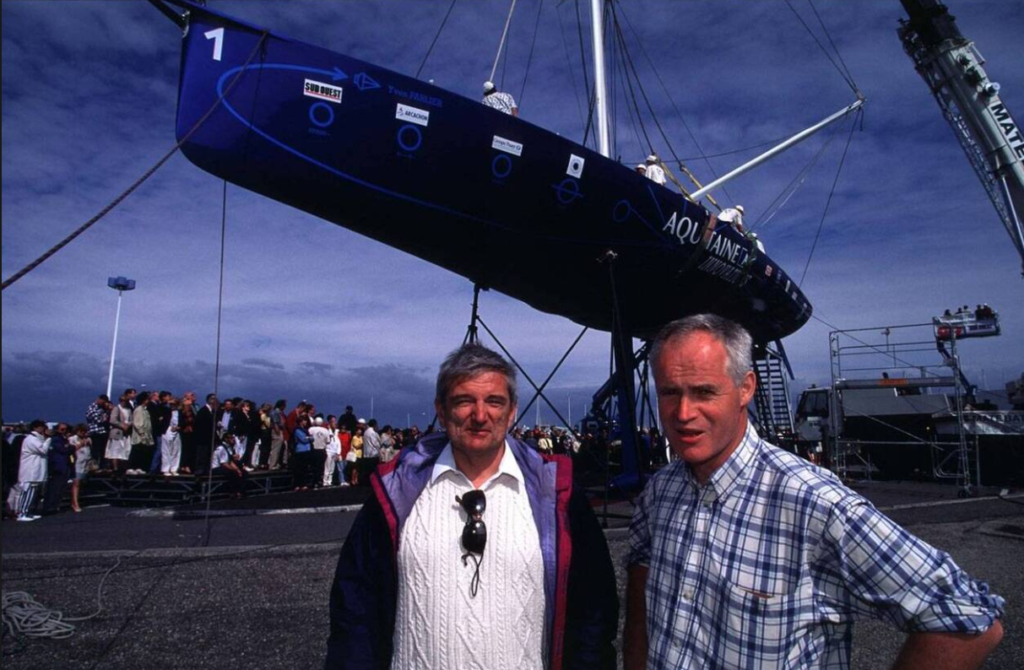
The technical work that came out of this program was not incremental. Finot-Conq developed or significantly advanced nearly every major structural and performance feature that defines the modern IMOCA class, including:
- Twin rudders
- Deck-mounted booms
- Sheer-mounted shrouds
- Vacuum-cured prepreg carbon
- Nomex honeycomb hull construction
- Composite keel fins
- 1st canting keel to survive solo circumnavigation
- Integral pivot composite canting keels
- Ballast systems adapted to canting keel dynamics
- Twin asymmetrical daggerboards
- Wing masts with deck spreaders
- Lifting rudders designed to survive collision
Taken together, this is a list that represents most of what makes a modern IMOCA 60 look and behave the way it does. The studio did not arrive at these innovations through theoretical exercises. They came out of real offshore races, where the penalty for getting it wrong was measured in rescues, retirements, and careers cut short.

| Boat / Program | Class / Type | Year | Result / Significance |
|---|---|---|---|
| Ecume de Mer | Quarter Ton IOR | 1968 | 1,385 built; Quarter Ton Cup 1970 and 1972; first ever French Boat of the Year 1975 |
| Revolution | IOR Offshore Racer | 1975 | Admiral’s Cup 1975; RORC Championship four consecutive years 1976–1979 |
| Urgent | Micro Class | 1982 | Pascal Conq’s first canting keel racing yacht; foundational development for all future canting keel work |
| Thom’pousse | Mini 6.50 | 1989 | First Finot-Conq victory in the Mini-Transat; launched wide open-type mini development |
| Figaro Beneteau I | One-Design Singlehander | 1990 | Designed for the Solitaire du Figaro; in use until 2002; hull used in 2,000+ production boats across First and Oceanis lines |
| Generali Concorde (IMOCA 60) | IMOCA 60 / Vendee Globe | 1989 | Alain Gautier; rig failure while leading 1989/90 Vendee Globe; finished 6th; studio’s first 60-ft offshore program |
| Bagages Superior (IMOCA 60) | IMOCA 60 / Vendee Globe | 1992 | Alain Gautier wins Vendee Globe 1992/93; first of four consecutive Finot-Conq victories |
| Geodis (IMOCA 60) | IMOCA 60 / Vendee Globe | 1996 | Christophe Auguin wins Vendee Globe 1996/97; twin rudders and canting keel innovations refined |
| PRB (IMOCA 60) | IMOCA 60 / Vendee Globe | 2000 | Michel Desjoyeaux wins Vendee Globe 2000/01; same hull won again 2004/05 with Vincent Riou — the only IMOCA to win the race twice |
| Hugo Boss (IMOCA 60) | IMOCA 60 / Speed Record | 2007 | Alex Thomson sets world 24-hour speed record for 60-ft monohull; broke the 500 nautical mile barrier |
| Pogo 2 | Mini 6.50 | 2002 | Built by Structures shipyard; won series category of the Mini-Transat five times |
| Mini #667 | Mini 6.50 | 2013 | Benoit Marie; sixth Mini-Transat victory for Finot-Conq designs |
| Nomad IV | 100-ft Superyacht | 2014 | Showboat International Design Award, Naval Architecture-Sailing Yacht category, Kitzbuhel |
The Innovations In Context: What Racing Gave to Cruising
The connection between the IMOCA program and the cruising boats that followed is not metaphorical. Finot-Conq’s approach to hull development was explicit: racing teaches you what cruising can become. Wider beams carried aft, more shape stability from pronounced chines, better-balanced underwater profiles, lighter construction strategies translated into production materials. All of it moved in one direction, from the race course toward the boats that families and retired couples and charter fleets actually sail.
The logic was stated simply by the studio itself: sailing fast leaves more time for the stopover. That is not a marketing phrase. It is the design philosophy that explains why a Finot-Conq cruiser at 45 feet tends to feel more alive under sail than its displacement and accommodation volume would suggest.
The First Evolution
| Model | Generation | Introduced | Notes |
|---|---|---|---|
| First 22 | 1st (1977–1983) | 1977 | First Finot-Beneteau collaboration; based on mini-tonner “Clementine” |
| First 24 | 1st (1977–1983) | 1978 | |
| First 25 | 1st (1977–1983) | 1979 | |
| First 26 | 1st (1977–1983) | 1979 | ~300 built; fin keel; built 1979–1991 |
| First 27 | 1st (1977–1983) | 1979 | |
| First 28 | 1st (1977–1983) | 1980 | |
| First Class 7 | One-Design | 1982 | One-design monotype; Finot |
| First Class 7.5 | One-Design | 1983 | |
| First Class 8 | One-Design | 1982 | Precursor to the Figaro program; one-design fleet racer |
| First Class 10 | One-Design | 1982 | 114 built; co-designed with Jacques Fauroux; 34 ft racer-cruiser |
| First Class 12 | One-Design | 1984 | |
| First Class Challenge | One-Design | 1986 | |
| First Class Europe | One-Design | 1987 | |
| First 235 | 2nd (1983–1988) | 1983 | |
| First 265 | 2nd (1983–1988) | 1984 | 520 built; developed into Oceanis 281 |
| First 285 | 2nd (1983–1988) | 1984 | |
| First 310 | 2nd (1983–1988) | 1985 | Collaboration with Philippe Starck |
| First 210 Spirit | 4th (1992–2004) | 1992 | ~5,000 built over 28-year production run; Guinness record in category; swing keel trailerable |
| First 211 | 4th (1992–2004) | 1993 | |
| First 260 Spirit | 4th (1992–2004) | 1994 | 500 built; centerboard; developed into First 25.7 |
| First 300 Spirit | 4th (1992–2004) | 1994 | |
| First 31.7 | 4th (1992–2004) | 1995 | ~1,200 built; shares Figaro Beneteau hull; best-selling 30-ft performance cruiser ever built |
| First 21.7 | 5th (2004–2016) | 2004 | |
| First 21.7 S | 5th (2004–2016) | 2005 | |
| First 25.7 | 5th (2004–2016) | 2004 | Development of First 260 Spirit; became First 25S in 2008 |
| First 27.7 S | 5th (2004–2016) | 2005 | |
| First 25 (First 25S) | 5th (2004–2016) | 2008 | Development of First 25.7; dual rudders; fin keel or centerboard |
| First 20 | Current / Active | 2015 | Successor to First 210 line, featured updated rigging for a modern sail plan |
The Modern Oceanis
The Oceanis 47, introduced at the Cannes Yachting Festival in September 2025 and making its North American debut at the Annapolis Boat Show in October 2025, represents the current endpoint of everything Finot-Conq and Beneteau have built together. Designed in collaboration with Nauta Yacht Design for the interior and deck, it opens the eighth generation of the Oceanis line.
The hull carries a pronounced chine and extended beam carried aft, both directly traceable to shape-stability lessons learned on racing hulls. The underwater profile favors stiffness under sail while remaining comfortable at anchor. Twin rudders come standard, another IMOCA-derived feature brought into the cruising mainstream. The cockpit, redesigned with two independent fold-down tables that can become sun loungers, seats up to ten people and centralizes all sail handling near the helm. A furling mast and self-tacking jib are standard, with a performance First Line Pack available for sailors who want a longer mast, a 109% genoa, and a code zero for light air.
What connects the Oceanis 47 to the Oceanis 331 built a quarter century earlier is not just the Beneteau badge or the studio name. It is a consistent belief about what a cruising boat should do: go where the owner wants to go, feel good doing it, and provide a home aboard that makes the voyage worth taking.
| Model | Generation | Introduced | Notes |
|---|---|---|---|
| Oceanis 300 | 2nd (1991–1994) | 1991 | BWS hull technology introduced this generation |
| Oceanis 321 | 2nd (1991–1994) | 1992 | |
| Oceanis 400 | 2nd (1991–1994) | 1992 | |
| Oceanis 510 | 2nd (1991–1994) | 1992 | Improvement from the 500 |
| Oceanis 281 | CC 3rd (1994–2003) | 1995 | Developed from First 265 hull |
| Oceanis 40 CC | CC 3rd (1994–2003) | 1995 | |
| Oceanis 42 CC | CC 3rd (1994–2003) | 1996 | |
| Oceanis Clipper 311 | 3rd (1995–2008) | 1995 | Result of Moorings charter collaboration |
| Oceanis 323 | 4th (1995–2008) | 1996 | |
| Oceanis 331 | 4th (1995–2008) | 1999 | 822 built; fin keel and centerboard versions; built in France and Marion, SC |
| Oceanis 411 | 4th (1995–2008) | 1997 | 1,044 built; Boat of the Year 1998 (France); 7-year production run |
| Oceanis 423 | 4th (1995–2008) | 2000 | |
| Oceanis 473 | 4th (1995–2008) | 2002 | |
| Oceanis 523 | 4th (1995–2008) | 2004 | |
| Oceanis 31 | 5th (2005–2014) | 2008 | Collaboration with Nauta Design |
| Oceanis 37 | 5th (2005–2014) | 2010 | |
| Oceanis 35 | 6th (2015–2022) | 2015 | |
| Oceanis 35.1 | 6th (2015–2022) | 2017 | Development of Oceanis 35; Nauta Design interior |
| Oceanis 38 | 6th (2015–2022) | 2014 | Large cockpit; successor to Oceanis 37 |
| Oceanis 38.1 | 6th (2015–2022) | 2017 | |
| Oceanis 41 | 6th (2015–2022) | 2015 | |
| Oceanis 41.1 | 6th (2015–2022) | 2017 | |
| Oceanis 45 | 6th (2015–2022) | 2015 | |
| Oceanis 46.1 | 6th (2015–2022) | 2019 | European Yacht of the Year 2019; 7th such award for Finot-Conq |
| Oceanis 30.1 | 7th / Current | 2019 | Successor to Oceanis 31, compact and robust “pocket yacht” |
| Oceanis 34.1 | 7th / Current | 2020 | |
| Oceanis 37.1 | 7th / Current | 2021 | |
| Oceanis 40.1 | 7th / Current | 2020 | |
| Oceanis 47 | 8th / Current | 2025 | Nauta Design interior; 8th generation Oceanis |
The Finot-Conq Legacy Today
Jean-Marie Finot passed away in April 2025 at the age of 83. Pascal Conq and the studio he helped build remain active, and the Oceanis 47 that debuted months after Finot’s death bears the full Finot-Conq name for good reason. The partnership outlasted the circumstances of any single project, and the body of work it produced has few equals in the modern era of yacht design.
For buyers exploring used Beneteau Oceanis models, understanding the Finot-Conq lineage helps explain why some of these ultra-comfortable cruisers sail surprisngly well. All of them reflect the same underlying philosophy: build a fast, stable, seaworthy hull, give it an interior people genuinely want to live in, and trust that sailors will recognize the quality when they step aboard.
At Murray Yacht Sales, we carry and broker Beneteau models across the Oceanis range, and we are glad to help you find the right fit. Whether you are researching a specific model or working out which generation of Oceanis lines up with your cruising plans, we know these boats well and enjoy talking through the differences.