

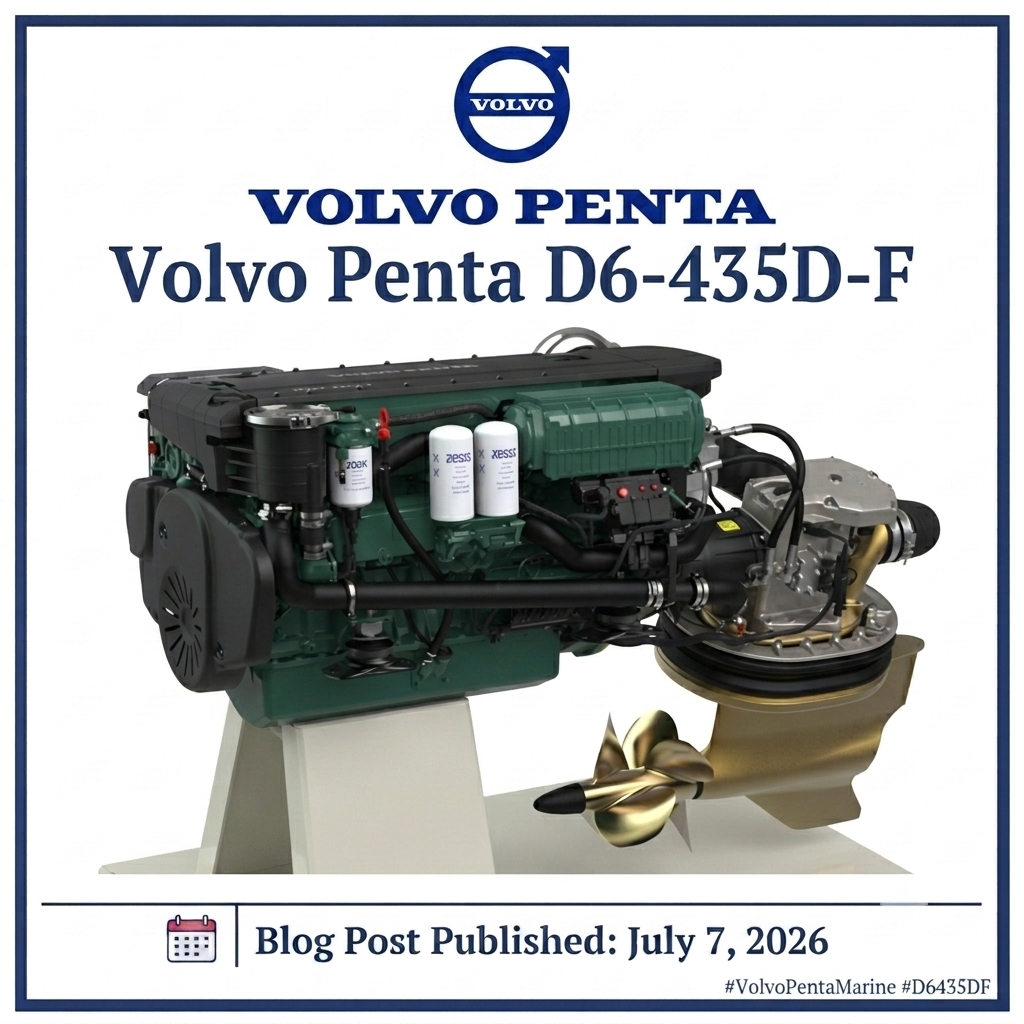
The Volvo Penta D6-435: Engine Guide for Owners and Buyers
July 7, 2026
Murray Yacht Sales
The Volvo Penta D6-435 occupies a pivotal position in modern marine diesel engineering, delivering a robust, high-performance propulsion solution that has become a benchmark for mid-sized express cruisers, flybridge yachts, and sport fishing vessels. First introduced in late 2006 to bridge the critical power gap between the mid-range D6-370 and the larger D9-500, the D6-435 represents the highest output variant of Volvo Penta’s highly successful 5.5-liter inline six-cylinder platform. For vessel owners navigating the secondary market or prospective buyers evaluating powerboats from the late 2000s through the mid-2010s, this comprehensive guide from Murray Yacht Sales provides an exhaustive technical analysis, practical service advice, and a breakdown of common field issues to monitor.
ENGINE BACKGROUND
Introduced in 2003, the D6 platform was engineered from its inception as a dedicated marine engine, distinct from industrial or automotive power plants adapted for wet operations. This clean-sheet design allowed Volvo Penta to optimize the structural block, cooling pathways, and electronic systems specifically for the harsh demands of the saltwater environment. The D6-435, launching in late 2006, was specifically positioned as the modern, lightweight successor to the widely utilized and virtually legendary TAMD74 series.
Comparative sea trials conducted on a 43-foot Storebro 420 Biscay demonstrated that the D6-435 delivered a 25-percent increase in acceleration up to 20 knots, achieved a higher top speed, and slashed exhaust emissions by half compared to the older TAMD74L. Most notably, the engine package reduced the physical footprint by 150 millimeters in length and saved 368 kilograms (811 pounds) of weight per engine, offering boat builders over 700 kilograms of weight savings in twin inboard configurations.
The mechanical core of the D6-435 is a cast-iron engine block and cylinder head reinforced with a structural “ladder frame” to mitigate vibration and lower onboard noise levels. It incorporates double overhead camshafts, four valves per cylinder with hydraulic lash adjusters, integrated cylinder liners, and a seven-bearing crankshaft designed to withstand extreme torque loads.
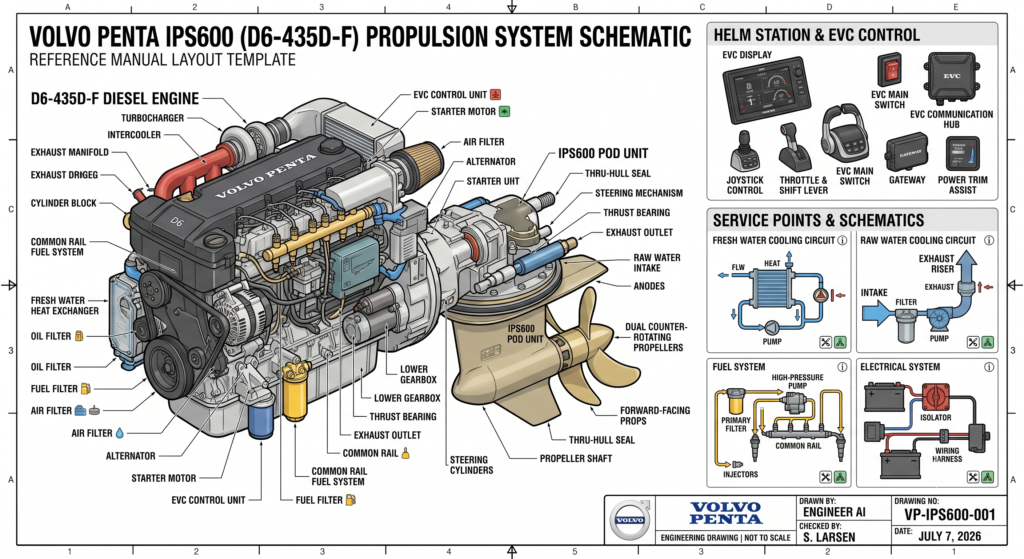
To deliver responsive acceleration across the full RPM range without the typical delay of single-turbo systems, the D6-435 employs a dual-stage aspiration system. At low engine speeds, a belt-driven mechanical supercharger (compressor) engages via an electromagnetic clutch to supply immediate low-end boost. As the engine speed increases and exhaust flow builds, a freshwater-cooled turbocharger takes over. Once the turbocharger reaches its optimal operating pressure, typically between 3,100 and 3,500 RPM, the Electronic Vessel Control (EVC) disengages the supercharger clutch, facilitating a seamless transition to pure turbocharger-derived boost.
In high-performance commercial and survival craft installations, certain versions of this platform adhere to the Safety of Life at Sea (SOLAS) requirements. These specialized versions incorporate advanced safety modifications, including an elevated alternator designed to function when water rises to the center of the crankshaft, sealed starter motor drainage, a capsizing relay that automatically cuts fuel supply to prevent catastrophic oil starvation if the vessel overturns, and a crankcase ventilation solenoid valve to prevent engine oil leaks during capsize events.
SPECS AT A GLANCE
The technical parameters of the D6-435 highlight its power density and high-torque characteristics under demanding marine operations.
| Technical Parameter | Specification / Data |
| Engine Configuration | Inline 6-cylinder, 4-stroke diesel |
| Crankshaft Power | 320 kW (435 HP) @ 3,500 RPM |
| Propeller Shaft Power | 310 kW (422 HP) @ 3,500 RPM (Shaft configuration) |
| Displacement | 5.5 Liters (336 cubic inches) |
| Bore x Stroke | 103 mm x 110 mm (4.06 in. x 4.33 in.) |
| Compression Ratio | 17.5:1 |
| Fuel System | High-pressure common-rail direct injection (CR) |
| Aspiration | Supercharged (compressor) and turbocharged with aftercooler |
| Alternator Charging | 14V / 115A or 28V / 80A |
| Emissions Compliance | IMO NOx Tier II, EU RCD Stage II, US EPA Tier 3 |
| Engine Weight (Dry, Bobtail) | 584 kg (1,287 lbs) |
| Engine Weight (with HS85AE) | 699 kg (1,541 lbs) |
| Maximum Torque Output | 993 Nm (732 lb-ft) @ 2,000 RPM |
| Fuel Consumption Rating | Approximately 220 g/kWh |
VARIANTS AND MODEL DESIGNATIONS
Understanding Volvo Penta’s alphanumeric naming convention is critical for identifying the exact drive pairings and engineering updates of a specific engine. The engine model designation is typically located on an identification tag on the engine block or the valve cover. Decoding the specific model designation D6-435D-F yields critical technical information regarding its configuration :
| Code Segment | Technical Representation | Engineering Application |
| D6 | Engine Family | Diesel, inline six-cylinder block configuration |
| 435 | Power Output | Peak rating of 435 horsepower at the crankshaft |
| D | Drive Type | Engineered for Inboard Performance System (IPS) pod drive |
| -F | Production Revision | Sixth generation build (manufactured 2013–2015) |
The drive type indicator dictates the layout of the vessel’s engine room and propulsion gear. The D6-435D-F is paired with the Volvo Penta IPS600 pod drive system, featuring forward-facing, steerable, counter-rotating propellers that pull the vessel through the water rather than pushing it. This contrasts with the D6-435I-F, which designates an inboard shaft-drive configuration mated to conventional hydraulic gearboxes such as the HS85AE down-angle or HS85IVE V-drive. Additionally, the D6-435 WJ is a specialized, lightweight bobtail variant designed specifically for water-jet propulsion installations.
The sequential generation letter at the end of the designation represents years of continuous engineering refinements. Earlier versions (A through E) utilized older iterations of EVC software and pre-updated exhaust components, whereas the F-generation incorporates factory-upgraded seal designs, improved electrical harnesses, and optimized cooling path layouts. In 2020, Volvo Penta introduced a heavily re-engineered family of D6 engines with redesigned cylinder heads, stouter internal components, and upgraded EVC systems (such as the D6-440 and D6-480) that succeeded the D6-435 in newer model builds.
WHAT BOATS USE THE VOLVO PENTA D6-435
The high power-to-weight ratio and compact physical envelope of the D6-435 make it a preferred choice for mid-sized luxury flybridge yachts, sport cruisers, and high-performance express cruisers ranging from 35 to 55 feet.
| Manufacturer & Model | Typical Production Years | Engine Installation & Drive Configuration |
| Bavaria Virtess 42 | 2016 | Twin Volvo Penta IPS600 (D6-435D-F) |
| Fairline Targa 45 Open | 2018 – 2021 | Twin Volvo Penta IPS600 (D6-435D-F) |
| Prestige 450S | 2013 – 2017 | Twin Volvo Penta IPS600 (D6-435D-F) |
| Fairline Targa 48 Open | 2014 – 2020 | Twin Volvo Penta IPS600 (D6-435D-F) |
| Carver 47 Motor Yacht | 2006 – 2012 | Twin Inboard Shaft (D6-435I) |
| Nimbus 365 Coupé | In Production | Single Inboard Shaft (D6-435I) |
| Wally 55 Wallypower | 2009 – 2015 | Triple Volvo Penta IPS600 (D6-435D) |
| Beneteau Monte Carlo 52 | 2019 – 2023 | Twin Volvo Penta IPS600 (D6-435D-F) |
| Princess 42 | 2008 – 2014 | Twin Inboard Shaft (D6-435I) |
| Beneteau Monte Carlo 47 | 2010 – 2015 | Twin Inboard Shaft (D6-435I) |
| Carver 43 Super Sport | 2006 – 2011 | Twin Inboard Shaft (D6-435I) |
| Galeon 420 Fly | 2012 – 2016 | Twin Inboard Shaft (D6-435I) or IPS600 |
COMMON PROBLEMS AND WHAT TO WATCH FOR
While the D6-435 platform delivers exceptional performance and throttle response, several well-documented mechanical and electrical issues require diligent monitoring by owners and technicians.
Supercharger Handoff Hesitation and Exhaust Housing Corrosion
A frequent and well-documented operational issue reported by vessel operators is a power hesitation or stalling at the supercharger-to-turbocharger handoff point. During normal acceleration, the engine climbs cleanly through the RPM range. However, if the turbocharger’s exhaust housing develops corrosion—a common issue in saltwater engines—the turbocharger will fail to generate adequate boost to match the engine control unit’s lookup tables.
When the EVC system disengages the supercharger’s electromagnetic clutch at around 3,100 RPM, insufficient turbocharger boost causes a sudden drop in manifold pressure. The engine will pause, hesitate for several minutes, or fail to achieve its wide-open throttle limit of 3,500 RPM. This hesitation is often accompanied by the activation of diagnostic fault codes on the EVC display. To resolve this failure, technicians must either descale the exhaust housing or replace the wastegate solenoid to restore proper boost response.
EVC Network Corrosion and System Grounding Faults
The Electronic Vessel Control system is the neural network of the propulsion package, integrating throttle, gear shift, and steering. Corrosion at multi-pin wiring harnesses or degraded battery voltage during engine startup often triggers false communication alarms. A common failure point is the Marine Diagnostic Interface (MDI) module or the helm control unit.
Small drops in system voltage can cause the engine throttle to freeze or prevent the transmission’s electromagnetic shift valves from engaging. Maintaining pristine, dry electrical connections coated with dielectric grease is essential to prevent unexpected emergency mode shutdowns.
Heat Exchanger Scaling and Tube Bundle Degradation
The multi-cooler cooling system of the D6-435 passes seawater through the fuel cooler, charge air cooler (aftercooler), engine oil cooler, and main heat exchanger. Saltwater scale and mineral deposits accumulate rapidly within the narrow internal tubes of the aftercooler core. If these heat exchangers are not physically disassembled, cleaned, and pressure-tested at least every four years or 1,000 service hours, the engine will experience elevated cylinder head temperatures under load.
This scaling directly leads to warped cylinder heads, blown gaskets, or cracked exhaust manifolds. Corrosion at the oil filter adapter, where it meets the oil cooler, is another critical area to monitor, as seal degradation can lead to rapid coolant or oil leaks.
Manual Belt Tensioner Slippage
Unlike modern engines utilizing spring-loaded self-adjusting tensioners, the serpentine belts on the D4 and D6 engines require manual adjustment. Volvo Penta specifies that the belt tension must be adjusted by applying exactly 70 Nm (52 lbf-ft) of torque to the tensioning roller’s square fitting before locking the mounting bolts.
Because the mechanical supercharger places an immense physical load on the belt system during engagement, a slightly loose belt will slip, generating substantial black belt dust across the front of the engine, producing a high-pitched squeal, and causing the raw-water pump impeller to slip. Technicians must check belt tension annually or every 200 service hours.
Fuel System Sensitivity and MPROP Valve Failure
Operating at pressures reaching up to 30,000 psi, the common-rail fuel injection system is highly sensitive to fuel quality. Water contamination or degraded diesel fuel quickly scores the precision tolerances of the high-pressure fuel injectors, leading to fuel pressure regulator (MPROP) malfunctions.
Symptoms include hard starting, fuel pressure oscillation (engine surging or hunting at idle), and raw unburnt diesel soot exiting the exhaust. Copper injector sleeves that pass through the cast-iron cylinder head are also known to degrade over time, allowing high-pressure fuel or combustion gases to bypass into the cooling system or oil passages, requiring specialized puller tools to repair.
PARTS, AVAILABILITY, AND SERVICEABILITY
For vessel owners, securing reliable parts support is critical to maintaining vessel uptime. Genuine Volvo Penta service parts, including service kits, oil filters, air filters, and fuel filters, are widely distributed across an established dealer network. Specialized components such as fuel injectors, replacement turbochargers, and replacement heat exchanger inserts remain highly accessible but represent a substantial capital investment on aging engines.
While routine tasks like changing engine oil, replacing anodes, and installing new raw-water impellers can be performed by experienced do-it-yourself owners, advanced diagnostics require specialized equipment. Pinpointing electrical faults, clearing soft EVC error codes, and checking fuel rail pressures can only be performed using Volvo Penta’s proprietary VODIA diagnostic tool. Consequently, having a qualified dealer or an independent technician equipped with VODIA diagnostics within the vessel’s home port is a vital factor in long-term serviceability.
THE BUYER’S PERSPECTIVE
When evaluating a boat powered by Volvo Penta D6-435 engines, prospective buyers must perform a structured mechanical inspection and sea trial. Priority questions to address include:
- What is the specific drive configuration of the vessel, and what is its specific service history? When evaluating an IPS-driven vessel, has the pod-drive oil been analyzed for water intrusion, and have the steering cylinder seals been inspected?
- Are complete service logs available, and has a VODIA diagnostic tool been connected to pull the full history of active and inactive fault codes?
- What is the age and history of the fuel injection system? Have the high-pressure fuel injectors or the fuel rail pressure sensors been replaced or serviced?
- When was the last time the heat exchanger, aftercooler core, and oil coolers were physically removed, descaled, and pressure-tested?
During the sea trial, it is vital to run the boat from a cold start to observe starting behaviors, such as engine hunting or smoke production. Once warmed up, the vessel must be accelerated through the 2,800-3,500 RPM range to verify a seamless handoff between the supercharger and the turbocharger. Any hesitation or sluggish acceleration during this transition warrants immediate inspection of the turbocharger’s exhaust housing and the supercharger’s electromagnetic clutch.
Finally, the engines must achieve their full-rated wide-open-throttle speed of 3,500 RPM under load. Failure to reach 3,500 RPM suggests hull fouling, incorrect propeller pitch, or engine performance degradation.
CLOSING AND CALL TO ACTION
The Volvo Penta D6-435 remains an exceptionally capable, power-dense propulsion system that rewards meticulous, preventative maintenance. For boat owners who adhere strictly to seasonal zinc anode replacements, annual belt tensioning, and regular cooling system flushing, these engines deliver decades of smooth, smoke-free cruising.
Interested buyers or current owners seeking advice on vessels powered by the Volvo Penta D6-435 platform are encouraged to contact the professional brokerage team at Murray Yacht Sales. With over five decades of experience on the Gulf Coast, Murray Yacht Sales provides expert vessel evaluations and market analyses. Questions regarding specific listings or engine maintenance can be submitted directly via the online contact form below. Alternatively, the regional offices can be reached directly via telephone or email :
Houston, Texas Regional Office Phone: (281) 673-6705 | Email: [email protected]
New Orleans, Louisiana Regional Office Phone: (504) 283-2507 | Email: [email protected]
St. Petersburg, Florida Regional Office Phone: (727) 214-1590 | Email: [email protected]