

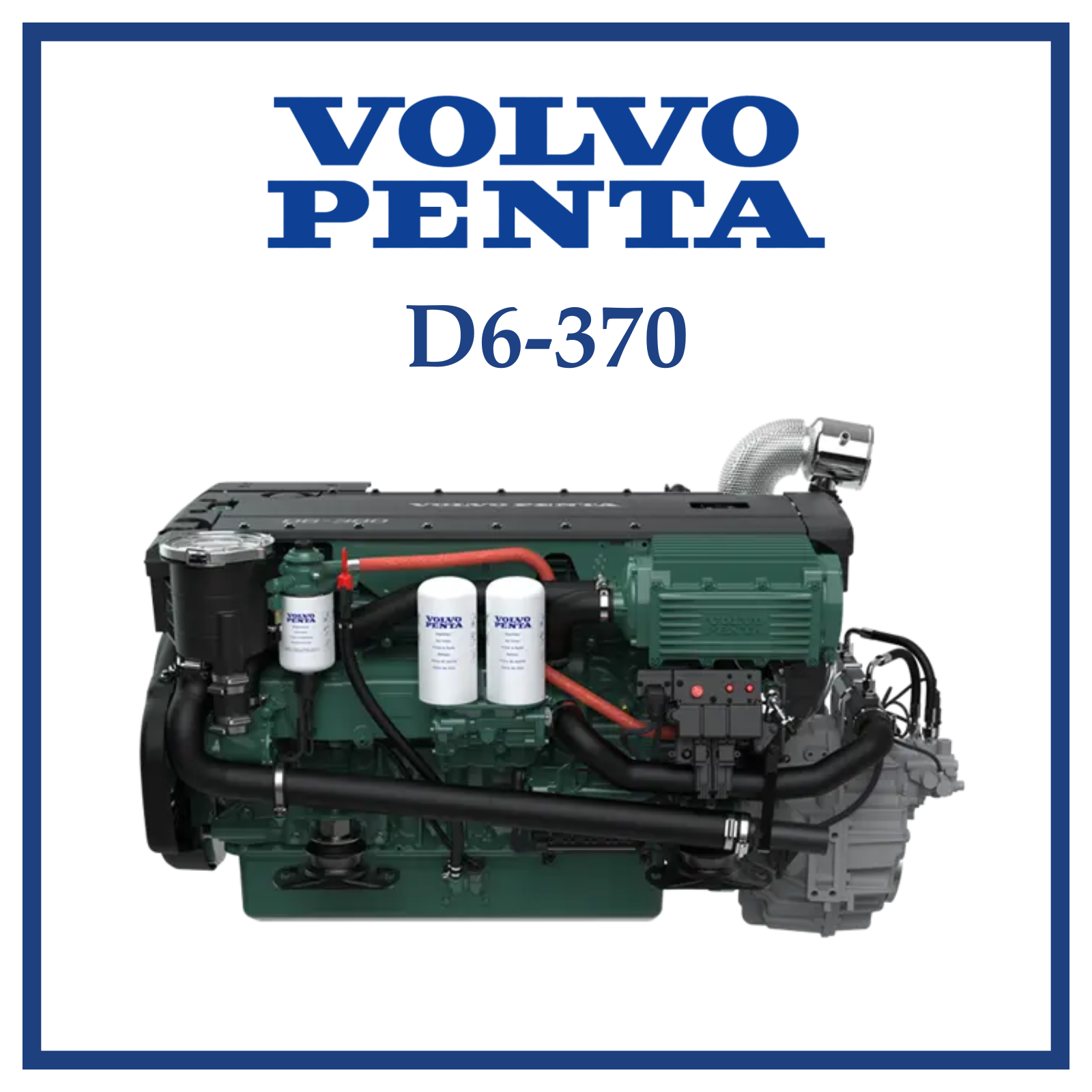
The Volvo Penta D6-370 shows up in a wide range of boats, from swift trawlers and flybridge yachts to express cruisers and high-performance day boats – and for good reason. At 370 horsepower from a 5.5-liter inline six, it delivers strong torque, clean throttle response, and the kind of integration with Volvo Penta’s electronic systems that boat builders and buyers have come to expect from the platform. This is a modern engine in every sense: common-rail injection, double overhead camshafts, electronic vessel control, and available in shaft, IPS pod, and sterndrive configurations.
This guide covers the specs, the variants, the boats it powers, what to watch for mechanically, and what ownership looks like in practice.
Engine Background
Volvo Penta introduced the D6 platform in 2003, purpose-built for marine duty rather than adapted from a truck or industrial application. The D6 is a 5.5-liter inline six-cylinder diesel with common-rail fuel injection, double overhead camshafts, four valves per cylinder, a turbocharger, and an aftercooler. The D6-370 is the 370 HP output rating within that family, produced across several generations as Volvo Penta refined the platform over the years.
The engine was designed from the outset to work as part of an integrated propulsion system. The Electronic Vessel Control (EVC) system ties the engine, throttle, shifting, trim, and optional joystick docking into a single coordinated package. That level of integration was a meaningful step forward when the D6 launched and remains one of its defining characteristics today.
The D6 family has been refreshed significantly over the years, most notably with a comprehensive update around 2020 that addressed reliability, service intervals, and power output across the range. The D6-370 specifically was produced through the mid-2010s before higher output variants became the standard offering. Boats from roughly 2005 through 2016 are most likely to carry the D6-370 designation.
Specs At A Glance
| Configuration | Inline 6-cylinder, 4-stroke diesel |
| Displacement | 5.5 liters (336 cu in) |
| Bore x Stroke | 103 mm x 110 mm |
| Rated Output | 370 HP (272 kW) @ 3,500 RPM |
| Propeller Shaft Power | 363 HP (267 kW) — inboard shaft configuration |
| Aspiration | Turbocharged and aftercooled (intercooled) |
| Fuel System | Common-rail direct injection |
| Valvetrain | Double overhead camshafts, 4 valves per cylinder |
| Compression Ratio | 17.5:1 |
| Cooling | Freshwater-cooled with heat exchanger |
| Emissions | IMO NOx, EU RCD, US EPA Tier 3 |
| Drive Options | Inboard shaft (HS80AE/HS80IVE), IPS pod, Duoprop sterndrive |
| Dry Weight (with HS80AE) | 677 kg / 1,493 lbs |
| Typical Production Years | Approx. 2004 to 2016 |
Variants and Model Designations
The D6 is an output family, not a single engine. The 370 sits in the middle of the D6 range, which has historically spanned from around 300 HP on the low end to 480 HP on the high end. Understanding where the D6-370 sits helps when comparing boats with different D6 designations:
The D6-300 and D6-310 are lower-output variants found in smaller hulls and single-engine applications. The D6-370 represents the mid-range output most commonly found in twin-engine express cruisers and flybridge boats in the 35 to 45 ft range, and as a single-engine fit in boats like the Beneteau Swift Trawler 30. The D6-400, D6-435, and D6-480 are higher-output variants that followed, now appearing in newer and larger builds.
Drive configuration matters as much as output rating when evaluating a D6-370 boat. The three configurations are meaningfully different:
The inboard shaft version pairs with a conventional reverse gear (typically HS80AE or HS80IVE) and drives a traditional shaft and propeller. This is the most mechanically straightforward configuration and the most serviceable by independent mechanics.
The IPS version uses Volvo Penta’s pod-drive system with forward-facing counter-rotating propellers. It offers better fuel efficiency, joystick docking capability, and impressive maneuverability, but it ties you more closely to the Volvo Penta dealer network for anything beyond routine maintenance.
The Duoprop sterndrive version uses an external drive unit with contra-rotating propellers and is common in express cruiser applications. It sits between the inboard shaft and IPS in terms of complexity and servicing.
WHAT BOATS USE THE VOLVO PENTA D6-370
The D6-370 powered a wide range of production boats from the mid-2000s through the mid-2010s. These are the models most commonly encountered in brokerage:
| Boat Make and Model | Years | Config |
|---|---|---|
| Beneteau Swift Trawler 30 | 2015 to 2019 | Single, inboard shaft |
| Carver 44 CMY | 2006 to 2012 | Twin, inboard shaft |
| Tiara Yachts 3600 Open | 2007 to 2013 | Twin, IPS or shaft |
| Galeon 390 Fly / 390 HT | 2010 to 2016 | Twin, IPS or shaft |
| Bavaria S36 Open / Coupe / HT | 2012 to 2016 | Twin, IPS or shaft |
| Jeanneau Velasco 37F | 2012 to 2016 | Twin, IPS |
| Chris-Craft Corsair 36 Hard Top | 2010 to 2015 | Twin, IPS |
| Beneteau Antares 30 / 30S / 32 | 2010 to 2016 | Single or twin, shaft |
The D6-370 also appeared in various Sabre and Sealine models during this period, and Volvo Penta engines power boats from over 140 manufacturers, so this list is not exhaustive. If your boat has a D6-370 and isn’t listed here, the engine guide still applies.
COMMON PROBLEMS AND WHAT TO WATCH FOR
The D6-370 is a capable engine with a solid track record when properly maintained, but the platform has a few well-documented issues every owner and buyer should know about.
EVC System Faults and Electrical Gremlins
The most commonly reported D6-370 issue is not the engine itself but the Electronic Vessel Control system around it. EVC fault codes, communication errors between the PCU (Power Control Unit) and HCU (Helm Control Unit), and sensor failures are regular topics in D6 owner forums. Symptoms range from nuisance warning lights to genuine no-start conditions where the system incorrectly registers the engine as being in gear.
The practical reality: many EVC faults trace to corroded connectors, faulty Datalink cables, or control unit communication failures rather than mechanical problems. The troubleshooting process is logical, but it often requires Volvo Penta’s VODIA diagnostic tool to read and clear codes properly. This is the primary reason D6-370 owners benefit from having a qualified Volvo dealer within a reasonable distance.
Common-Rail Injector Issues
The D6 platform uses a high-pressure common-rail injection system operating at around 30,000 psi. Injector problems — ranging from clogging at low hours to full injector failure — have been reported across the D6 and D4 families, particularly on earlier production engines. Hard starting that progressively worsens is a common symptom before full failure. Unlike mechanical injection systems, common-rail injectors cannot simply be cleaned and reinstalled — damaged injectors need replacement, and the fuel system requires careful bleeding afterward. Ask for injector service records on any D6-370 with significant hours or age.
Heat Exchanger Maintenance
Like the TAMD61A before it, the D6-370 depends on a properly functioning heat exchanger circuit for cooling. Scale buildup in the raw water passages and degraded exchanger cores are a recurring maintenance item, particularly on boats that have seen warm Gulf Coast or tropical water. Periodic flushing and inspection is part of responsible ownership. Neglected exchangers lead to chronic overheating that can cause head gasket failure.
IPS-Specific: Drive Oil and Seal Condition
For boats with the IPS pod configuration, drive oil condition is a critical maintenance indicator. The oil should be changed on schedule and tested for water contamination at every service. Early IPS drives (pre-2009 approximately) used a bronze steering seal that was prone to premature wear in salt water. Volvo later updated to a stainless steel seal, but replacement is labor-intensive and requires drive removal. Any pre-2009 IPS boat deserves a close look at seal condition on survey.
EVC-Tied Throttle and Gear Lock
A specific and frustrating failure mode involves the system preventing engine start because it incorrectly detects the transmission as being in gear. This can sometimes be resolved by power-cycling the system, but recurring instances typically point to a faulty sensor or control unit. Again, this falls squarely into Volvo dealer territory for proper diagnosis.
PARTS, AVAILABILITY, AND SERVICEABILITY
The D6-370 is an actively supported engine. Volvo Penta maintains a full parts catalog, and the D6 platform’s widespread adoption means parts are available through dealers and quality aftermarket suppliers. Consumables — filters, impellers, belts, zincs, and coolant — are straightforward to source.
The bigger serviceability question with the D6-370 is not parts but labor. The common-rail injection system and EVC electronics require dealer-level diagnostic tools for anything beyond routine maintenance. Independent marine mechanics can handle oil changes, impellers, and basic cooling system work, but fault code diagnosis and injector service are generally Volvo dealer jobs. This is not unique to the D6 — it reflects the broader reality of modern electronically managed marine engines — but it is a meaningful contrast to the mechanical simplicity of older engines like the Caterpillar 3208 or even Volvo’s own TAMD series.
For IPS configurations, budget for drive service every 300 to 400 hours (or annually, whichever comes first), and plan for a haul-out for most drive work. The newer generation IPS drives allow oil changes from inside the boat, but seal and transmission work still requires the boat out of the water.
BUYER’S PERSPECTIVE
The D6-370 is a modern, capable engine and a legitimate asset on a well-maintained boat. The EVC integration and joystick docking (on IPS-equipped boats) are genuinely appreciated by owners, and the engine’s fuel efficiency and torque characteristics are well suited to the boats it powers.
The questions worth prioritizing before purchase:
- What drive configuration is the boat? IPS, shaft, or sterndrive each has different service implications and costs.
- Is there a Volvo Penta dealer with D6 experience within reasonable reach of where you’ll base the boat?
- Are EVC service records on file, and have any fault codes been diagnosed and resolved?
- What is the injector service history?
- On IPS boats: when was drive oil last changed, and has it been tested for water contamination?
- On pre-2009 IPS boats: has the bronze steering seal been replaced with the updated stainless unit?
On value: the D6-370 is a positive story for resale on boats where the EVC system is functioning cleanly and the service history is documented. Boats with unresolved EVC fault histories or gap-filled service records should be discounted accordingly. A functioning, well-maintained D6-370 package — engine plus drive — is worth the price premium it commands over older mechanical alternatives.
Higher hours for this platform (above 2,000 on the engine, 1,000 on IPS drives) warrant a thorough survey including heat exchanger inspection, injector compression analysis, and drive oil sampling.
CLOSING
The Volvo Penta D6-370 is a strong modern diesel in a competitive class. It rewards attentive ownership and a relationship with a qualified Volvo dealer. For owners, the maintenance priorities are clear: EVC system health, injector condition, heat exchangers, and for IPS boats, drive oil and seal integrity. For buyers, the service history and drive configuration tell you most of what you need to know.
Questions about a boat powered by the D6-370? Our team at Murray Yacht Sales is happy to help you think through what you’re looking at. Reach out anytime.