

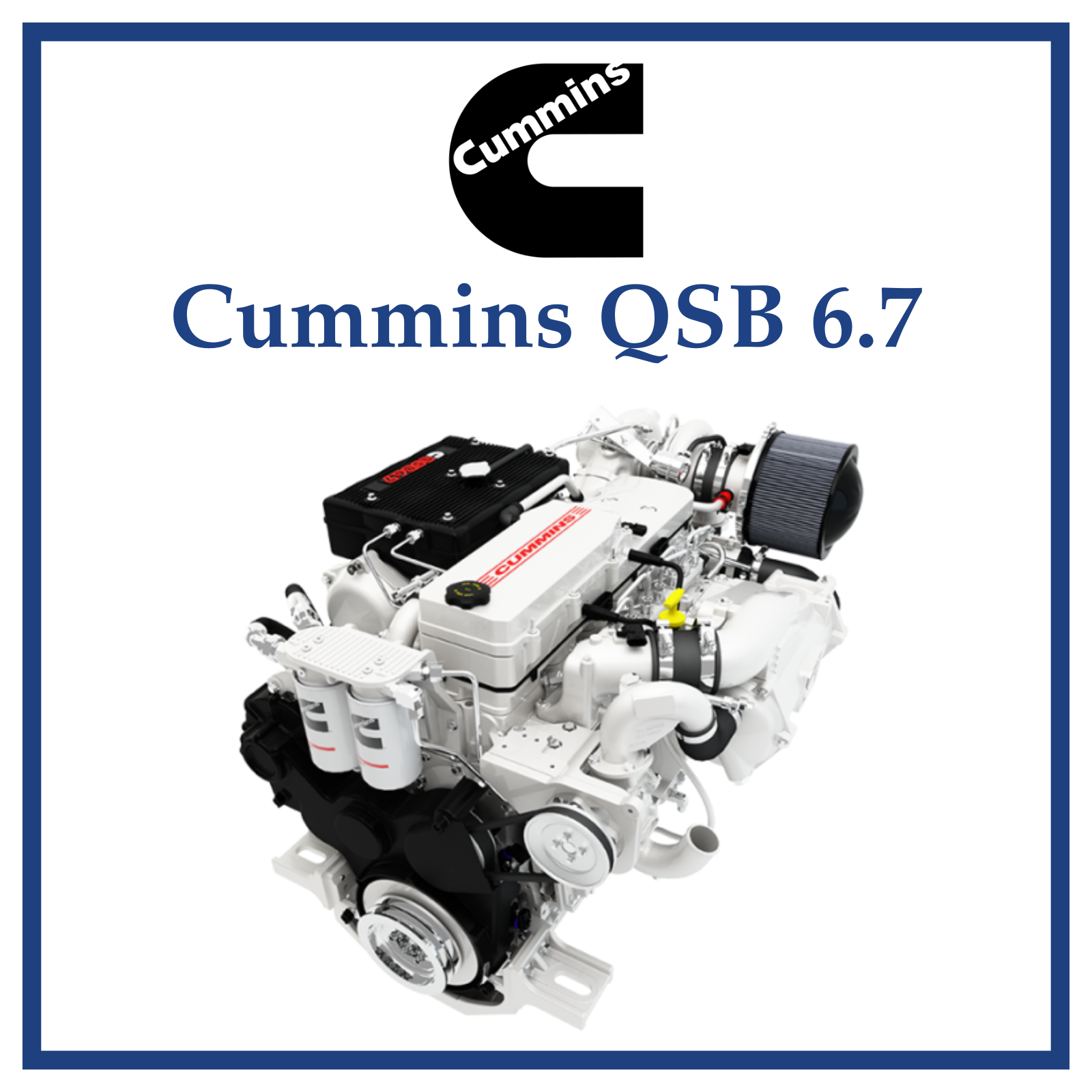
The Cummins QSB Series is one of the most widely installed marine diesel engines of the last 20+ years. It shows up in trawlers, express cruisers, sportfishers, and pilot house boats from dozens of builders — and for good reason. They are clean, quiet, powerful across a wide RPM range, and backed by one of the industry’s most capable service networks. If you spend time around boats in the 30 to 50 foot range, you have almost certainly spent time around this engine.
This guide focuses on the QSB 6.7 as installed in the Beneteau Swift Trawler 34 and similar single-engine semi-displacement applications, while also covering the broader platform for owners and buyers across the range of boats it powers.
The Code Architecture At a Glance
A standard, full-length Cummins QSB model code reads left-to-right following this structural sequence:
[ Engine Platform ][ Displacement ]-[ Application ][ Horsepower ][ Cooling Type ]
Example breakdown for a common configuration: QSB6.7-M380 SW
QSB: Quantum System B-Series platform6.7: 6.7 Liters DisplacementM: Marine Propulsion380: 380 HorsepowerSW: Seawater (Heat Exchanger) Cooled
Part 1: Engine Platform & Electronics (Prefix)
The first three letters define the engine’s technological generation and structural foundation.
| Code Segment | Meaning | Technical Context |
| Q | Quantum System | Denotes a full suite of electronic controls, a full-authority Electronic Control Module (ECM), and High-Pressure Common Rail (HPCR) fuel injection. (This differentiates it from legacy mechanical lines). |
| S | System | Part of the overarching electronic system identifier. |
| B | B-Series Block | Indicates it belongs to Cummins’ mid-range engine architecture family. |
Part 2: Engine Size (Displacement)
The numbers directly following the prefix state the total cylinder displacement in liters.
| Numerical Code | Number of Cylinders | Typical Configurations & Common Uses |
| 5.9 | 6-Cylinder | The legendary 24-valve blocks widely deployed in older mid-tier marine hulls and heavy off-highway equipment. |
| 6.7 | 6-Cylinder | The current industry standard for modern heavy industrial, commercial workboats, and pleasure crafts. |
| 7 (or 7.0) | 6-Cylinder | Typically designates specialized fixed-speed or marine auxiliary variants built out on the 6.7L platform architecture. |
Part 3: Application & Package Suffixes
Found right after the hyphen, these letters dictate the exact operational ecosystem the engine was customized to handle.
| Code Letter | Meaning | Application Details |
| M | Marine Propulsion | Built specifically for variable-speed, variable-load boat hulls (planing or displacement). |
| DM | Diesel Marine Auxiliary | Fixed-speed configurations optimized specifically for driving onboard ship generators or hydraulic power packs. |
| SL | Slim Line | A physically repackaged, low-profile variant designed to slide into space-constricted engine bays. |
Part 4: Output & Thermal Configurations
The final bits of the code reveal the maximum power ceiling and how the engine keeps its cool.
| Segment Type | Example | Meaning & Implementation |
| Numeric Value | 110, 260, 480 | Indicates the engine’s Advertised Horsepower (HP) rating at full throttle. |
| SW | SW | Seawater Cooled: Utilizes a jacketed heat exchanger meant to be fed by an external raw water pump. |
| KC | KC | Keel Cooled: Employs a closed-loop internal cooling layout designed to route through structural cooling channels in a vessel’s hull. |
Part 5: The Duty Cycle & Performance Ratings (The “HO” Slot)
These optional codes appear right after the horsepower rating. They indicate how hard and for how long the engine can legally be run at wide-open throttle (WOT).
| Code | Rating Type | Max WOT Allowance | Typical Applications & Constraints |
| HO | High Output | 1 hour out of every 8 hours of operation. | Strictly for recreational/pleasure crafts (sportfishers, yachts). |
| INT / ID | Intermittent Duty | 2 hours out of every 8 hours of operation. | Planing hulls used for intermittent commercial work: police boats, customs patrol, charter fishing, and emergency fire pumps. |
| MCD / MD | Medium Continuous | 6 hours out of every 12 hours of operation. | High-speed cyclical commercial vessels: planing ferries, coastal freighters, and high-speed displacement yachts. |
| HD | Heavy Duty | 10 hours out of every 12 hours of operation. | Low-speed displacement vessels under stable loads: mid-water trawlers, crew boats, and commercial towboats. |
| CON / CD | Continuous Duty | Unrestricted (24/7 continuous full throttle). | Deep-water ocean-going vessels, bottom-drag trawlers, pushboats, and heavy tugs. |
| GS | Generator Set | Fixed RPM operation (1500/1800 RPM). | Specifically governed to drive constant-speed prime or auxiliary power generation units. |
Engine Background
Cummins introduced the QSB 6.7 marine diesel in 2012 as a direct replacement for the QSB 5.9, a well-regarded engine in its own right that had been in production since 2004. The 6.7 brought a larger displacement, a redesigned 24-valve cylinder head, a new high-pressure common-rail fuel system, and meaningfully better emissions compliance — meeting US EPA Tier 3 standards without aftertreatment. At the same time, it got smaller in one dimension and actually shed a few pounds compared to its predecessor, keeping it viable for tight engine rooms.
The engine was purpose-built for marine duty at Cummins’ facilities in Darlington, UK, and Rocky Mount, North Carolina. It is not a marinized truck engine, a distinction that matters in terms of how cooling systems, mounting, and emissions management are engineered for the marine environment.
The QSB 6.7 carries over the SmartCraft electronics integration from the 5.9, giving owners and technicians real-time access to fuel consumption, duty cycle, engine load, fault codes, and diagnostics from the helm display. That level of transparency is one of the engine’s most appreciated practical features, and it shows up consistently in owner feedback.
Specs At A Glance
| Configuration | Inline 6-cylinder, 4-stroke diesel |
| Displacement | 6.7 liters (408 cu in) |
| Bore x Stroke | 107 mm x 124 mm |
| Available HP Range | 250 HP to 550 HP (output determined by ECM mapping) |
| Common Marine Ratings | 380, 425, 480, 550 HP |
| Aspiration | Turbocharged and aftercooled (intercooled) |
| Fuel System | Bosch High Pressure Common Rail (HPCR) |
| Valvetrain | 24-valve cylinder head |
| Cooling | Freshwater-cooled with heat exchanger (raw water circuit) |
| Emissions | US EPA Tier 3, IMO NOx compliant |
| Oil Service Interval | 500 hours using ULSD fuel |
| Weight | 658 kg / 1,450 lbs |
| Electronics | Cummins SmartCraft (VesselView compatible) |
| Introduced | 2012 |
VARIANTS AND MODEL DESIGNATIONS
The QSB 6.7 is a single-engine platform with output determined almost entirely by ECM mapping. The block, bore, stroke, and hardware are the same across ratings — what changes is how the fuel system is programmed. This has a practical upside: a well-maintained lower-HP unit shares the same parts and service procedures as its higher-output siblings.
Common recreational marine ratings are 380, 425, 480, and 550 HP. The 425 HP rating is the most prevalent in trawler and semi-displacement applications, including the Swift Trawler 34. The 480 and 550 HP variants appear more frequently in express cruisers and sportfishing boats where higher speeds are the priority.
A “Slimline” variant of the QSB 6.7 is also available, designed with a lower profile for tight engine rooms. It produces 355 to 425 HP and is a common repower choice for boats that previously carried the QSB 5.9 or older 6BTA — the dimensions are close enough that the swap is often straightforward.
One note for Swift Trawler 34 buyers specifically: earlier ST34 hulls (2009 to approximately 2012) left the factory with the QSB 5.9 at 425 HP. Later hulls received the QSB 6.7 at the same 425 HP rating. The two engines are close siblings, and the ownership experience is similar, but they are different engines. When evaluating a specific boat, confirm which engine is installed before applying the specifics in this guide.
WHAT BOATS USE THE CUMMINS QSB 6.7
The QSB 6.7 is one of the most widely installed marine diesels in its class. These are the production boats most commonly encountered in brokerage with this engine:
| Boat Make and Model | Years | Notes |
|---|---|---|
| Beneteau Swift Trawler 34 | 2012 to 2017 | Single 425 HP, inboard shaft; earlier QSB 5.9 |
| Sabre 38 / 42 Express | 2010 to present | Twin 380 or 425 HP; also, IPS and Zeus pod |
| Back Cove 37 | 2013 to present | Single 480 HP, inboard shaft; Downeast style |
| Prestige 420 | 2019 to 2025 | Twin 380 or 425 HP; also, IPS and Zeus pod |
| Mainship 34 Trawler | 2011 to 2013 | Single 425 HP, inboard shaft |
| American Tug 395 | 2015 to present | Single 425 HP; some hulls have QSB 5.9 |
| Ranger Tugs R-31 | 2014 to present | Single 370 HP, inboard shaft |
| Helmsman 38E Pilothouse | 2015 to present | Single 250 or 380 HP, inboard shaft |
| Pursuit OS 385 Offshore | 2014 to 2020 | Twin 480 HP; center console sportfisher |
COMMON CONCERNS AND WHAT TO WATCH FOR
The QSB 6.7 has an excellent overall reliability record. Owners with 1,000 hours or more commonly report few significant issues when the fuel system is kept clean, and service intervals are respected. That said, the platform has several documented patterns worth knowing before a survey or while troubleshooting.
On-Engine Fuel Filter Backing Out
Cummins issued Technical Service Bulletin TSB240112 to address a specific and well-documented issue: the on-engine fuel filter backing out of the filter head during operation. The root cause was a threaded insert with insufficient thread engagement to maintain proper torque under vibration. The result is fuel weeping at the filter head, which can lead to air intrusion in the fuel system and intermittent low fuel pressure alarms. The TSB details the updated insert and correct torque procedure. If you own a QSB 6.7 and have not confirmed whether this has been addressed, it is worth checking — this is a documented fix, not a mystery fault.
Fuel Rail Pressure and Common Rail Actuator Faults
The most frequently reported fault code on the QSB 6.7 is related to the fuel rail pressure actuator on the high-pressure common rail pump. Symptoms include intermittent black smoke at mid-RPM cruise, unstable RPMs, and fault codes indicating commanded pressure not matching actual delivery pressure. In many cases, replacing the fuel actuator resolves the issue — and it is a job an experienced owner can handle independently with parts from a Cummins dealer. Recurring issues after actuator replacement suggest further investigation of the injectors or the high-pressure pump itself.
Turbocharger Wear and Oil Ingestion
Locked or oil-fouled turbos have been reported on QSB 6.7 installations, typically traced to extended idle periods, infrequent operation, or oil carryover from the crankcase breather. The Walker AirSep oil separator is a factory-fitted or readily available add-on that captures oil mist before it reaches the turbo. On boats that see irregular use, regular short runs at operating temperature are important for turbo health.
PARTS AVAILABILITY AND SERVICEABILITY
This is one of the strongest arguments for the QSB 6.7. Cummins operates one of the largest marine dealer networks in the world, and the QSB platform is widely stocked. Filters, injectors, turbochargers, lift pumps, fuel actuators, belts, and cooling system components are all available from Cummins dealers, independent suppliers, and from Seaboard Marine, which has built an exceptional reputation as the specialist resource for QSB owners.
The 500-hour oil service interval (on ULSD fuel) is a genuine practical benefit compared to many competitors. Front-mounted filters make oil and fuel filter changes accessible without contorting around the engine. Service points are well-placed, and most experienced marine diesel mechanics are familiar with the platform.
For owners who want to handle their own maintenance, the QSB 6.7 is approachable. The SmartCraft system provides enough diagnostic transparency to understand what the engine is telling you, and the Seaboard Marine community forum is one helpful resource for troubleshooting. Fault code interpretation that might otherwise require a dealer visit can often be self-diagnosed with forum guidance.
BUYER’S PERSPECTIVE
A well-maintained QSB 6.7 is among the most desirable engines in its class on a used boat. The combination of parts availability, dealer network depth, diagnostic transparency, and long service intervals puts it at or near the top of what buyers want to find under the hatch. On the Swift Trawler 34 specifically, the single-engine configuration paired with bow and stern thrusters is a proven setup that experienced single-handed and short-handed crews appreciate for its simplicity and economy.
Questions worth prioritizing before purchase:
- Has TSB240112 (fuel filter backing out) been addressed? Ask specifically.
- Are complete service records on file, including filter changes and any fault code history?
- Has there been a history of low-fuel-pressure alarms or unplanned shutdowns under load?
- What pre-filtration setup is installed? A dual Racor system is preferable.
- What are the current hours, and when was the last 500-hour service completed?
On valuation: a QSB 6.7-equipped boat with clean records and low hours commands a real premium in the current brokerage market, and it earns it. Buyers should be more cautious about boats with thin service histories or gap-filled records than about the engine itself — the engine is good, and the question is always whether it has been treated accordingly.
CLOSING
The Cummins QSB 6.7 is a benchmark marine diesel — capable, clean, and well-supported. In the Swift Trawler 34 it is an excellent match for the hull and the cruising style the boat was designed for. In twin applications across express cruisers and sportfishers, it earns consistent praise for its torque delivery and low-end responsiveness. Keep the fuel system clean, respect the service intervals, and know your fault codes. The engine will take care of the rest.
Questions about a boat powered by the QSB 6.7? Our team at Murray Yacht Sales is happy to help. Reach out anytime.