

Some catamaran brands instantly reveal the era of multihull design you’re examining. Some boats symbolize charter efficiency. Others signify speed. Still, some represent apartment-like volume.
Privilège became known for something unique: serious offshore cruising comfort while still maintaining the feeling that a boat was designed by a sailor.
From a brokerage perspective, that distinction matters. When you step aboard older Privilège catamarans from the late 1980s and 1990s, you can immediately feel the priorities. Heavy doors, thick cabinetry, conservative structures, protected helms, and deep systems access. These boats were built during a time when catamarans were still proving themselves as true ocean-crossing cruising yachts rather than just spacious coastal vessels.
Over the years, the wider catamaran market has changed significantly. Buyers started to focus more on larger social areas, flybridges, lighter interiors, easier handling, and layouts suited for charter. Despite these shifts, Privilège largely maintained a philosophy centered on the owner, often favoring long-range private cruising over maximizing charter capacity.
This consistency is a key reason why the brand still holds value among experienced sailors today.
A Brand Born From Offshore Racing
The story begins with Philippe Jeantot, one of the most accomplished offshore sailors of his era. Jeantot was a two-time world champion in solo sailing and later founded the legendary Vendée Globe.
That background matters because Privilège was not created by a marketing department studying consumer trends. It grew from a sailor trying to solve a real-world problem.
According to company histories, Jeantot originally wanted a catamaran capable of safely and comfortably carrying his family during long-distance cruising. Comfort, strength, and safety became the foundational design criteria. In 1985, he founded Jeantot Marine in Les Sables-d’Olonne and presented the company’s first catamaran at the Paris Boat Show. Multiple accounts note that he reportedly displayed the boat more out of personal pride than a calculated business ambition — but strong demand quickly pushed the project into a real production company.
That origin story is still evident in older Privilège models today. These boats were not originally conceived as floating resorts. They were intended to survive offshore passages while remaining livable for extended periods aboard.
The Early Years – Building a Rugged Reputation
The first generation of Privilège catamarans arrived during a very different era for multihulls.
In the 1980s, cruising catamarans were still fighting skepticism from many traditional sailors. Builders had not yet fully optimized lightweight construction, interior volume, or bridge deck clearance the way modern designs do today. Many early cruising cats rode low, carried more weight, and emphasized structural durability over speed.
Models like the Privilège 39 helped establish the brand’s reputation for rugged offshore capability. Designed by naval architect Eric LeFevre, the 39 featured solid fiberglass construction below the waterline and a reputation for bluewater reliability.
From a brokerage perspective, many of these older Privilège boats still attract buyers specifically because of their “overbuilt” reputation. They are not the lightest catamarans on the market. They are not typically the fastest in light air. But owners frequently describe them as reassuring boats offshore.
That tradeoff became part of the brand identity.
The Rise of Luxury Offshore Catamarans
By the late 1980s and early 1990s, the catamaran market was expanding rapidly. Buyers increasingly wanted true liveaboard comfort alongside ocean-crossing capability.
Privilège was well positioned for that transition, and by 1989 Jeantot Marine had established a strong foothold in the global multihull market.
Around this time, Privilège also began a long collaboration with renowned naval architect Marc Lombard. His influence helped shape the brand over the next several decades. Lombard’s designs gradually modernized the boats without abandoning the core philosophy. You began seeing sleeker profiles, improved performance, elevated helm positions, and better integration of owner-focused layouts.
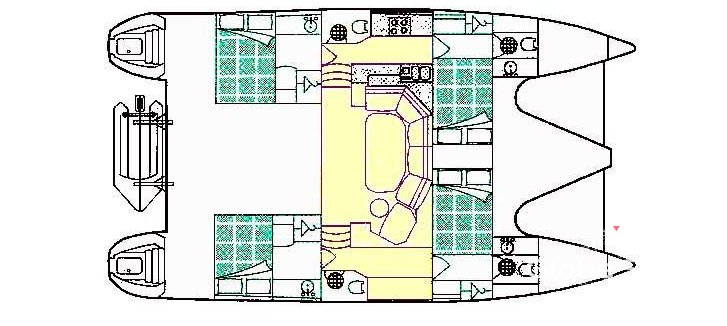
The brand gained additional recognition when the Privilège 45 and Privilège 42 won “Boat of the Year” honors in the United States during the mid-1990s. Still, Privilège never fully chased the ultra-light, charter-first direction some competitors later pursued.
Cementing A Legacy
In 1996, Jeantot Marine transitioned to Alliaura Marine following a change in ownership.
This period marked a major expansion phase for the brand.
Alliaura pushed Privilège further into the luxury offshore market, especially in larger catamarans exceeding 50 feet. During these years, the company produced several iconic models, including the:
- Privilège 435
- Privilège 465
- Privilège 585
- Privilège 615
- Privilège 745
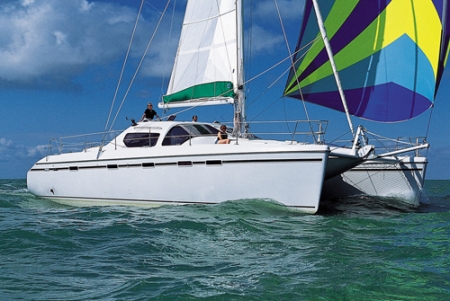
Each of these boats helped the brand cement its reputation as a premium bluewater catamaran brand. One consistent and very distinct feature that emerged in these years was the “central pod,” which integrated substantial living spaces into the bridge deck. This contrasted with what many builders were doing at the time, leaving the space between the hulls fully open forward.
From a design perspective, this approach also reflected the brand’s philosophy: prioritize offshore comfort and structural integrity rather than simply minimizing weight.
Resisting A Charter-Focused Market Shift
One of the most interesting aspects of Privilège’s history is how consistently the company targeted owners in a market increasingly focused on charter demand.
As the 2000s progressed, much of the catamaran market increasingly optimized around:
- maximum interior volume
- massive cockpit entertaining spaces
- simplified systems
- high production numbers
- lighter construction
- charter fleet economics
Brands like Lagoon and Fountaine Pajot expanded heavily into global production and charter demand during this period. Meanwhile, Privilège remained comparatively niche. The company continued focusing on semi-custom builds, owner layouts, upscale finishes, and long-distance cruising capability.
That decision reduced total production volume but also helped preserve the brand’s reputation among experienced offshore sailors.
Even today, many brokerage clients specifically searching for older Privilège models are not looking for the newest trend. They are often looking for a boat that feels substantial, proven, and capable of serious passagemaking.
Financial Challenges and Rebirth
Like many yacht builders, Privilège faced challenges following the 2008 global financial crisis.
Alliaura Marine eventually entered liquidation in 2012. But the story did not end there.
The Privilège brand and tooling were acquired, and production returned to Les Sables-d’Olonne under Privilège Marine. Many longtime employees reportedly returned as well, helping preserve institutional knowledge and construction expertise.
That continuity matters more than many buyers realize. In yacht building, especially in semi-custom yacht building, craftsmanship often lives within the workforce as much as in the molds or engineering drawings.
The HanseYachts Era and Modern Evolution
In 2017, HanseYachts AG became the majority shareholder of Privilège Marine.
This ushered in another modernization phase.
Newer models like the Privilège Signature 510, 580, and 650 continued evolving toward cleaner styling, larger social areas, and more contemporary interiors while still retaining many traditional Privilège characteristics.
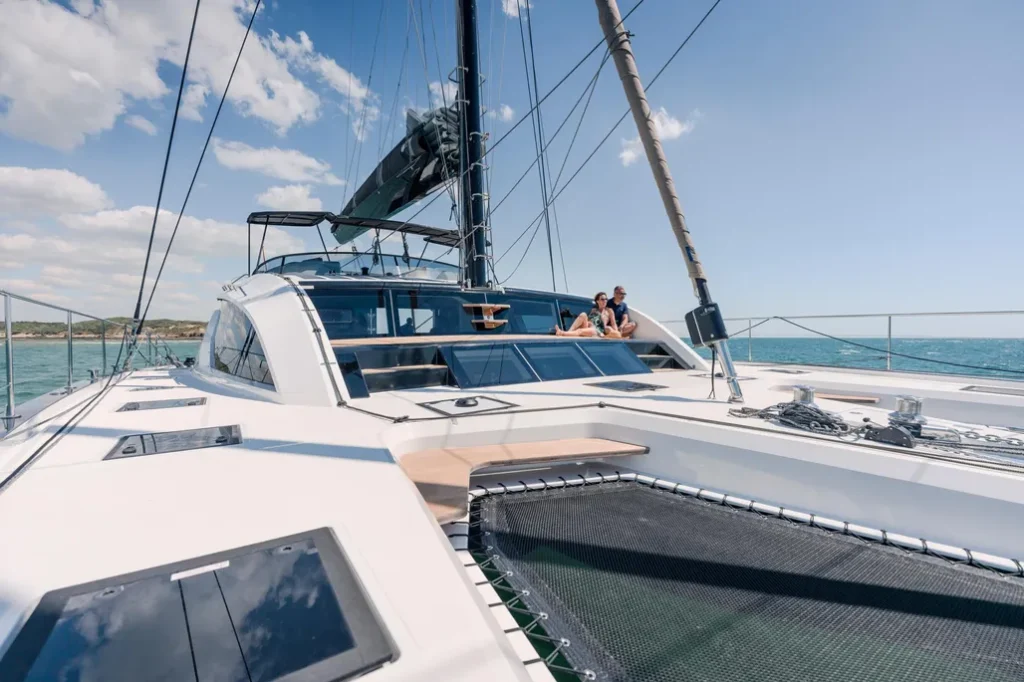
Modern buyers now expect vastly different things from catamarans than they did in 1985:
- expansive owner suites
- panoramic glazing
- integrated electronics
- hydraulic systems
- apartment-style living spaces
The challenge for legacy brands like Privilège has been adapting to those expectations without losing the offshore DNA that built their reputation in the first place.
Why Privilège Still Matters
From a brokerage perspective, Privilège occupies an interesting place in the catamaran market.
These boats are rarely the highest-volume production catamarans. They are not usually the least expensive option on the brokerage market. They are also not purely performance-oriented multihulls in the racing sense.
Instead, they developed a reputation for something more nuanced: a luxurious cruising catamaran built by people who genuinely understood offshore sailing.
That distinction still resonates today.
You can trace decades of catamaran evolution through the Privilège lineup itself:
- the heavier offshore-oriented designs of the 1980s
- the luxury expansion of the 1990s and 2000s
- the flybridge and lifestyle shifts of the modern era
- the ongoing balance between comfort, safety, and seaworthiness
And perhaps most importantly, the story never fully lost its human element.
A world champion solo sailor wanted a safer, more comfortable way to sail with his family. That idea evolved into one of the most respected names in bluewater cruising catamarans.