
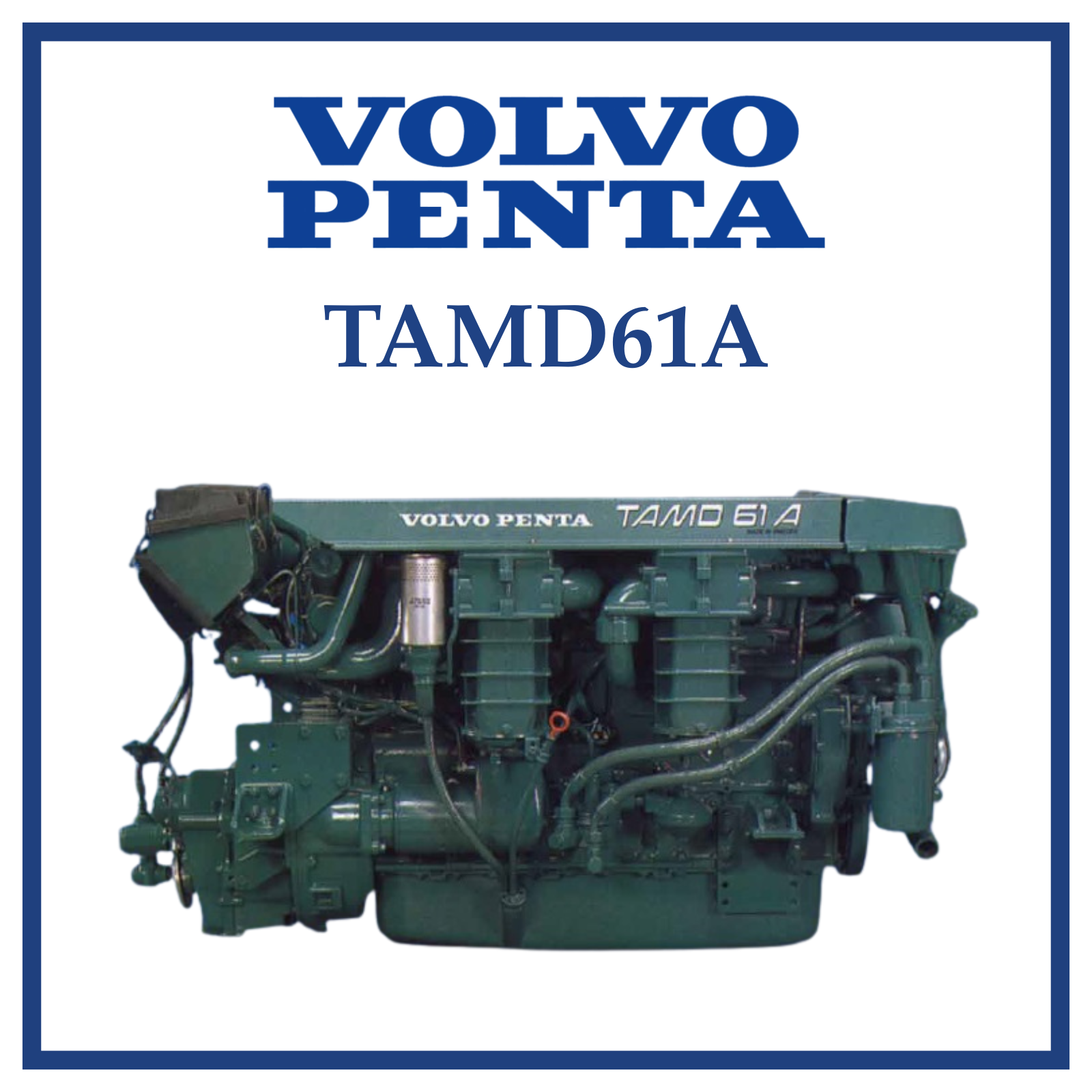
The Volvo Penta TAMD61A is one of those engines that earned its reputation quietly. No flashy marketing, no dramatic reinvention, just a well-engineered inline six that powered some of the finest European motor yachts of the late 1980s and early 1990s, and kept on running.
This guide covers everything worth knowing: the specs, the variants, the boats you’ll find them in, the problems to watch for, and what it means to own or buy one today.
Engine Background
Volvo Penta introduced the 61 Series in the mid 1980’s, engineered from the ground up for inboard marine propulsion. The TAMD61A is a 5.5-liter inline six-cylinder diesel, turbocharged and aftercooled, with mechanical direct injection. It was produced through 1995 and in that window became the go-to powerplant for a generation of express cruiser and flybridge builders.
The design reflected genuine engineering care for its era. Finite Element Analysis was used to maximize block rigidity without adding weight. Oil-cooled pistons reduced carbon buildup. A gear-driven freshwater pump and revised thermostat improved cooling reliability over earlier Volvo Penta diesel designs. An air pre-heating system made cold-weather starting predictable. These were all critical improvements that showed up in the engine’s long-term track record.
The TAMD61A replaced the earlier TAMD60 series and was itself succeeded by updated 61 and 71 series variants as emissions requirements tightened in the mid-1990s.
Specs At A Glance
| Specification | Detail |
| Configuration | Inline 6-cylinder, 4-stroke diesel |
| Displacement | 5.5 liters (336 cu in) |
| Bore × Stroke | 99 mm × 120 mm |
| Rated Output | 306 HP (225 kW) / 301 bhp @ 2,800 RPM |
| Aspiration | Turbocharged & Aftercooled (intercooled) |
| Fuel System | Mechanical direct injection |
| Cooling System | Freshwater-cooled with heat exchanger (raw water circuit) |
| Production Years | 1986 – 1995 |
| Typical Gearbox | ZF, MG506 – MG509 series (reduction ratios 1:1 to 4.95:1) |
| Typical Application | Twin-engine motor yachts, 35–50 ft European express cruisers |
Variants and Model Designations
The TAMD61A sits in the middle of Volvo Penta’s 61/71 Series family. The naming convention is worth understanding, because you’ll encounter close relatives in listings and it helps to know what you’re looking at.
The prefix breaks down as follows:
- T for turbocharged
- A for aftercooled
- M for marine
- D for diesel
- 61 for the engine series and displacement class
- A for the primary production variant.
The nearest siblings are the TAMD62A, a higher-output variant producing approximately 330 to 365 HP in some configurations, and the TAMD71A and TAMD72A, which share the naming logic but use a larger 7.0-liter displacement and typically produce 330 to 425 HP. Those powered larger vessels in the 45 to 60 ft range. If you’re comparing boats and one has a TAMD71 where another has a TAMD61A, that’s a meaningfully larger and more powerful engine, not simply a trim upgrade.
Boats built before 1986 may carry the older TAMD60 series, which the 61A effectively replaced. Worth noting for parts sourcing purposes if you come across one.
What Boats Use The Volvo Penta TAMD61A?
The TAMD61A was a preferred powerplant for many motor yacht builders throughout its production run. These are the models you’ll encounter most often in the brokerage market:
| Boat Make & Model | Year Range |
| Island Gypsy 40, 44, and 57 | 1982-1991 |
| Fairline Squadron 40–46 | 1988–1995 |
| Princess 415 / 420 | 1989–1995 |
| Sealine 410 / 420 Statesman | 1991–1997 |
| Azimut 37 / 40 Flybridge | 1989–1996 |
| Ocean Alexander 390 Sundeck | 1985-1994 |
The TAMD61A was predominantly deployed in twin-engine configurations on these boats. Single-engine applications were relatively uncommon in this class, though some European river cruisers and commercial workboats used single installations. If you know of additional models not listed here, we’d like to hear about it. This is a living resource, and we update it as we learn more
Common Problems And What To Watch For
The TAMD61A has a solid long-term reputation. Owners report few major issues on well-maintained engines. That said, there are specific failure patterns every owner and prospective buyer should know.
Early Exhaust Valve Failure (Pre-1988 Engines)
The most serious known issue with the TAMD61A involves exhaust valve and seat failure on early production units, specifically engines built before approximately 1988. The valve head could separate from the stem, travel back through the head, exit the manifold, and strike the turbocharger. The downstream damage to pistons, liners, valves, turbo, and potentially the head is severe and expensive.
Volvo Penta addressed this under warranty in some cases during the late 1980s without issuing a formal recall. If you’re looking at a pre-1988 boat with no documented head work or valve inspection on file, a compression test and valve inspection should be part of your due diligence. Experienced owners offer some reassurance here: the consensus is that if the engines ran through their early years without incident, the risk diminishes substantially with age and hours.
Blocked Exhaust Elbow Spray Fins
The water-cooled exhaust elbow contains internal spray fins that direct raw water cooling across the elbow body. These fins accumulate scale and carbon over time, restricting the raw water circuit and causing overheating. The fix is well-documented: remove the elbow, clean the fins, and bend every other tab outward approximately 4mm per the Volvo service modification. It’s a straightforward job, but it’s frequently overlooked on boats that haven’t had attentive maintenance. Ask when the exhaust elbows were last removed and inspected.
Heat Exchanger Degradation
The TAMD61A runs six heat exchangers. Blocked or corroded exchangers are the most common cause of overheating that doesn’t resolve with a new impeller or thermostat. The aluminum castings are also susceptible to galvanic corrosion at the junction with the exhaust elbow. Confirm that pencil anodes have been replaced on schedule and ask whether the exchanger bodies have been inspected or replaced. Aftermarket stainless steel replacements are available from UK and European suppliers and are generally considered an upgrade over the original aluminum castings.
Maintenance And Support
The TAMD61A left production in 1995, which puts it in legacy territory, but it is far from unsupported. Volvo Penta still lists genuine parts through their official catalog and dealer network. Consumables including oil filters, fuel filters, impellers, belts, exhaust elbows, thermostats, and heat exchanger components are all available through third-party suppliers at reasonable prices.
The mechanical direct injection system is a real asset here. There is no proprietary engine management software to deal with and no electronic fuel system that requires dealer-level diagnostics. A competent marine diesel mechanic can service and rebuild these engines. Cylinder liners are replaceable, and head work is a well-understood job for any shop with experience in European marine diesels.
The heat exchanger aluminum castings are the most expensive wear item and the hardest to source as original Volvo parts. The aftermarket stainless replacements mentioned above are worth knowing about if exchanger replacement comes up during ownership or negotiation.
Buyer’s Perspective
A well-maintained pair of TAMD61As with reasonable hours represents a known quantity: predictable reliability, manageable running costs, and a platform with enough of a community around it that problems are well-documented and solutions are findable.
Engines above 3,000 hours warrant a full mechanical survey with compression testing. These engines are rebuildable and long-lived, but buyers should realistically price in exchanger work and potential injector or head service at that mileage.
Final Thoughts
The Volvo Penta TAMD61A powered some of the best trawlers and motor yachts of its generation and continues to do so in boats that have been looked after. The platform rewards attentive maintenance and is well understood by experienced marine diesel mechanics. For owners, the priorities are clear: elbows, exchangers, coolant, and records. For buyers, the same list applies, plus a close look at engine hours and a compression test if the history is thin.
Questions about a specific boat or engine? Reach out to our team at Murray Yacht Sales. We’re happy to help you think through what you’re looking at before you commit.