
By Murray Yacht Sales
The Yanmar Saildrive series has powered more production sailboats and catamarans than almost any other propulsion system in its class. Showing up under the companionway steps of Beneteau Oceanis cruisers, Jeanneau Sun Odysseys, and beneath the floorboards of Lagoon and Excess catamarans, Yanmar saildrives are ubiquitous. This guide covers the drive history, model decoding, common upgrades, and what ownership and surveying look like in practice.
Saildrive Background & Historical Dates
The Yanmar saildrive family evolved alongside their marine diesel engines. Moving from standard shaft drives to saildrives (sail drives) revolutionized production boatbuilding, enabling modular installations, reduced vibration, and simplified alignment. Over the decades, Yanmar released several generations, each refining the power delivery and clutching mechanisms.
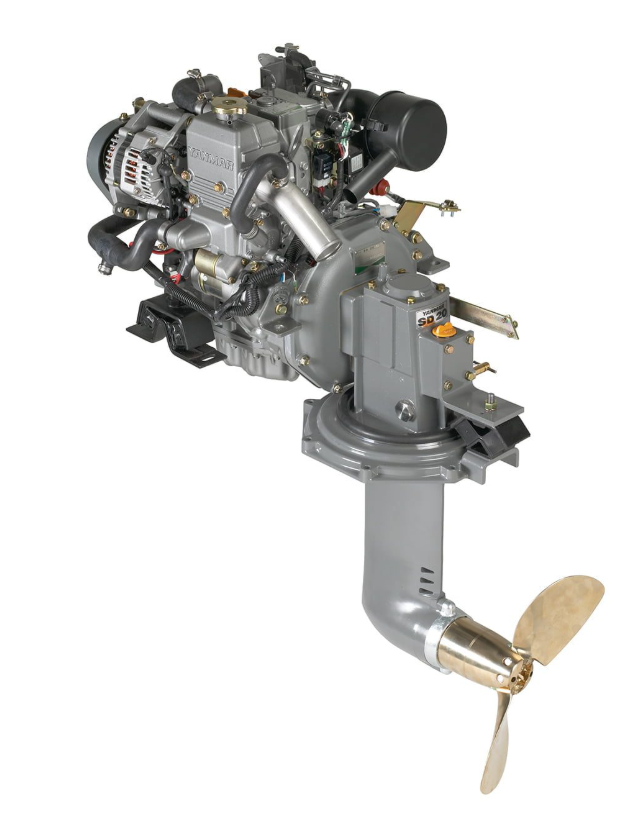
● SD20 (Late 1990s – 2010s): The standard pairing for smaller engines like the 1GM10, 2YM15, 3YM20, and 3YM30. It uses a simple dog clutch and is known for its durability in lower-horsepower applications.
● SD31 / SD40 / SD50 (Early 2000s – 2014): Designed for higher-torque engines (3JH and 4JH series up to 75 HP). The SD50 used a cone clutch for smoother shifting than a dog clutch. However, this generation became famous for clutch slipping after several hundred hours, requiring periodic lapping or replacement.
● SD25 (2014 – Present): The modernized update to the SD20, engineered to pair with the updated 3YM30AE and other YM-series engines. It features improved sealing and lower maintenance needs.
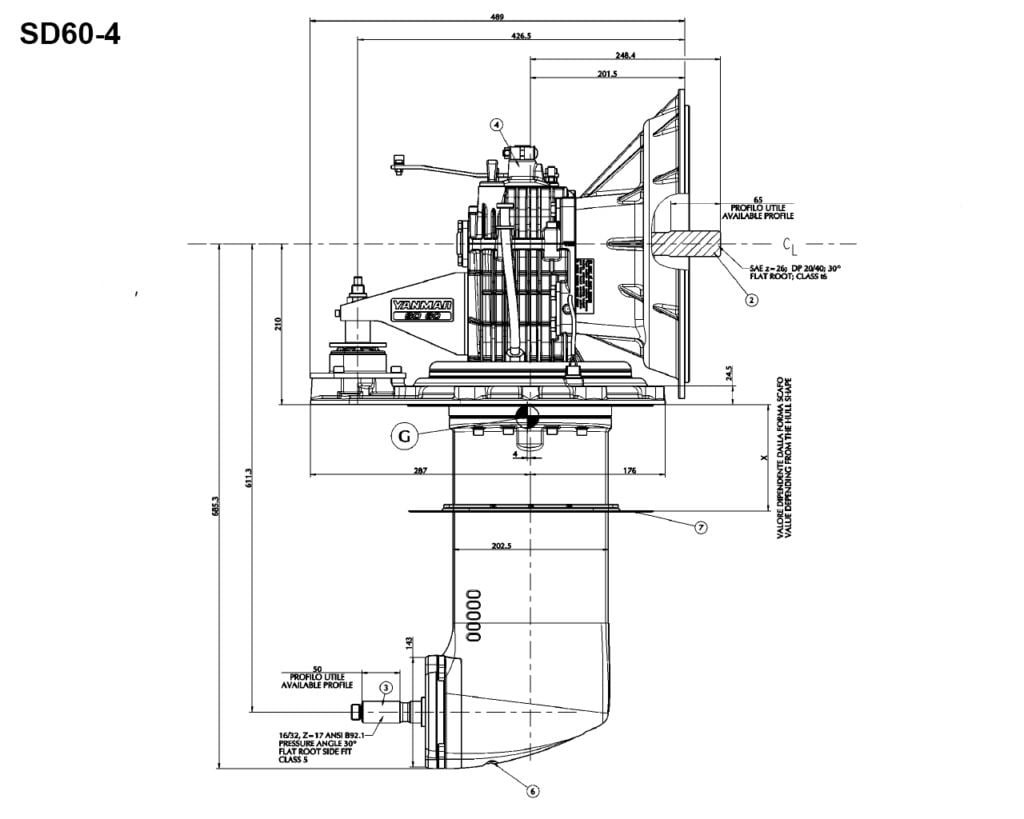
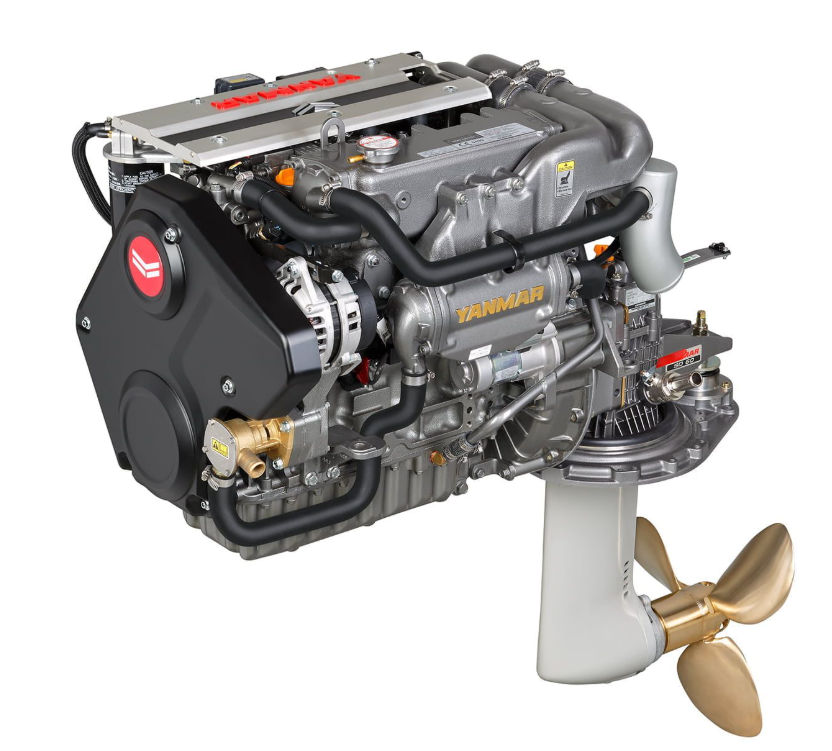
● SD60 (2014 – Present): Built by ZF, this unit replaced the SD50. It abandoned the problematic cone clutch in favor of a multi-disc clutch pack. Notably, the SD60 allows the gear oil to be changed from inside the vessel without hauling out.
● SDe Series (New): Yanmar’s entry into electric propulsion, featuring the SDe7 (7kW), SDe10 (10kW), and SDe15 (15kW) 48V plug-and-play electric saildrives.
Decoding the Model Numbers
Yanmar saildrive designations are straightforward once you know the pattern:
●SD – Saildrive
● Number (20, 50, 60): Indicates the torque rating and frame size. Smaller numbers (20, 25) are for smaller-displacement engines (YM series), while larger numbers (50, 60, 110, 150) handle higher-output engines (JH and 4LV series).
● Suffix “T” or “4T”: Indicates internal gear ratios optimized for specific RPM bands, typically matching 4-stroke diesel characteristics.
● Suffix “e” (SDe): The newest designation for 100% Electric drives.
SD 20 Saildrive
Common Issues: SD50 Slipping & The SD60 Upgrade
A specific and well-documented failure point on the SD40 and SD50 is the cone clutch mechanism. Over time, the cone glazing causes the drive to slip under load, often resulting in an inability to engage forward gear or a loss of propulsion when throttling up. The standard repair is to remove the gear assembly and “lap” (re-grind) the cone clutch with abrasive paste. Yanmar eventually superseded the SD50 with the SD60 to permanently solve this.
Upgrading to the SD60: Many owners choose to replace a failing SD50 with an SD60. However, the SD60 is approximately 42mm longer at the rear mount. Yanmar provides an official conversion adapter plate (raising the engine height by 12mm). It also requires a different damper coupling (spline type) and a reversal of the shift cable direction.
Compatible Systems and Vessels Chart
| Saildrive Model | Compatible Engines | Common Vessel Examples |
| SD20 / SD25 | 1GM10, 2YM15, 3YM20, 3YM30, 3YM30C, 3YM30AE | Beneteau Oceanis 31/34, Jeanneau Sun Odyssey 349, Hanse 315 |
| SD31 / SD40 | 3JH3, 3JH4, 4JH3 | Lagoon 380, Lagoon 400, older Beneteau Oceanis 40 |
| SD50 | 3JH4E, 3JH5E, 4JH4E, 4JH5E, 4JH4-TE | Lagoon 42 (Early), Hanse 400/430, Fountaine Pajot Helia 44 |
| SD60 | 3JH5E, 3JH40, 4JH5E, 4JH45, 4JH57, 4JH80 | Lagoon 42 (Late), Lagoon 46, Excess 11/14, Oceanis 37.1, Oceanis 46.1 |
| SDe Series (Electric) | 7kW, 10kW, 15kW 48V Systems | Modern retrofits, green-initiative tenders, day-sailers |
Maintenance Parts & Cross-Reference Guide
Servicing your Yanmar saildrive is a critical part of annual haul-outs. Zincs, seals, and oil require strict adherence to the maintenance schedule. Below is a cross-reference guide for the most common wearable parts on Yanmar saildrives
| Component | Applicable Drives | Yanmar Original Part # | Aftermarket / Tecnoseal # |
| Prop Anode (Split Ring x 2) | SD20, SD30, SD40, SD50, SD60 | 196450-02500 / 02501 | TEN01305/1 |
| Prop Anode (Full Ring) | SD20, SD30, SD40, SD50, SD60 | 196420-02652 | AN 5339 |
| Anode Adaptor Kit (Split) | SD20, SD30, SD40, SD50, SD60 | 196440-02690 | TEC 196440-02690 |
| Pencil Anode (Upper Gear) | SD30, SD31 | 27210-200550 | TEN01306 / AN 3448 |
| O-Ring for Pencil Anode | SD30, SD31 | 24321-000250 | LP 24321-000250 |
| Hull/Mounting Diaphragm Seal | SD20, SD30, SD40, SD50 | 196420-02551 | CEF 501001 / Volvo 22303438 |
| Oil Seal – Prop Shaft (Requires 2) | SD20, SD30 | 196313-02591 | LP SC355508 |
| Oil Seal – Prop Shaft (Requires 2) | SD40, SD50 | 196440-02870 | – |
| Oil Drain Plug Seal / Gasket | SD20, SD25, SD30, SD31 | 24341-000125 | – |
| Oil Drain Plug Seal / Gasket | SD40, SD50 | 189010-01130 | – |
SD 60 Saildrive
The Buyer’s Perspective
If you are surveying a vessel with a Yanmar saildrive, keep the following in mind:
● Diaphragm Seal Age: Yanmar officially recommends replacing the main hull diaphragm seal every 7 years, though many surveyors note they often look pristine well past a decade. Ask for the maintenance records.
● Oil Condition: The gear oil should be clear. Milky or opaque gear oil indicates water intrusion, typically past the propeller shaft seals (often caused by fishing line caught behind the prop).
● Clutch Engagement: If the boat has an SD40 or SD50, ensure the sea trial includes forward and reverse engagement tests under load.
● Corrosion: Yanmar Saildrives are constructed from aluminum, not bronze. Ensure the correct aluminum-safe bottom paint (like Trilux 33) is used and that there is at least an inch gap between copper-based bottom paint and the drive leg to prevent galvanic corrosion.
For parts, service, or to schedule a sea trial on vessels featuring these systems, contact our team.
2010 Yanmar Service Advisory:
DATE: April 29, 2010
TO: All Marine Distributors, Dealers, OEM Boat Builders and End Users
SUBJECT: Saildrive Corrosion
MODEL: All Saildrive Models
Yanmar America has received some reports from customers of unusual saildrive corrosion in the field. Upon investigating these reports, we have identified some installation and maintenance factors that can influence corrosion and, in some cases, failure of the drive leg.
To maximize assistance and knowledge in the field, Yanmar is outlining the following steps that must be taken by installers of saildrives (OEM Boat Builders and Distributors/Dealers performing repowers) and items of owner maintenance to mitigate corrosion issues with the drives, along with information to assist. Yanmar America is an advocate of the American Boat and Yacht Council (ABYC) and strongly recommends that its standards and guidelines be followed closely when installing a saildrive in a new boat or repowering a boat with a new saildrive. Refer to ABYC Standards A-28 Galvanic Isolators, E-2 Cathodic Protection and E-11 AC & DC Electrical Systems on Boats for the information that is required to install shore power systems, proper bonding and cathodic protection.